What does 'new creation' mean for my history?
6 min read
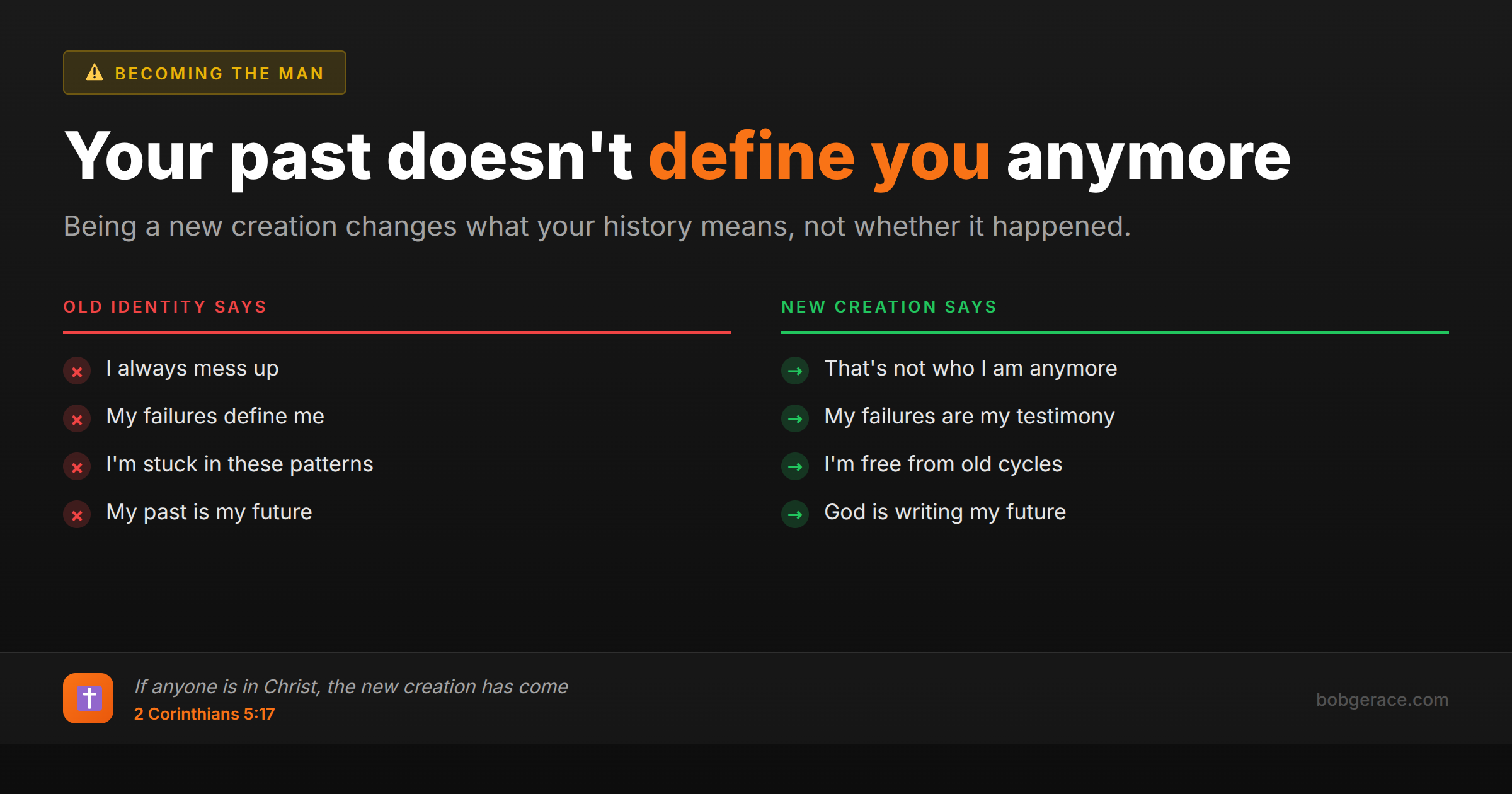
Being a 'new creation' means your past doesn't define your future. When Scripture says 'the old has gone, the new is here' (2 Corinthians 5:17), it's not erasing your history—it's changing what that history means. Your failures, mistakes, and broken patterns are no longer your identity. They become part of your testimony, not your trajectory. This doesn't mean consequences disappear or that trust rebuilds overnight. It means you're no longer enslaved to repeat the same destructive cycles. Your spouse may still be processing hurt from your past actions, and that's valid. But you can approach rebuilding from a position of genuine transformation, not just behavior modification. The new creation isn't about pretending the past didn't happen—it's about writing a completely different future.
The Full Picture
Here's what most people get wrong about being a new creation: they think it's either a magic eraser that makes everything okay instantly, or they think it's just religious talk that doesn't change anything practical. Both views miss the profound reality of what God actually does.
Your history gets reframed, not erased. Every mistake, every failure, every moment you 'blew it' becomes raw material for something greater. Think about it—would you trust someone who'd never struggled with anything? Or would you rather learn from someone who's been through hell and found a way out?
The patterns can actually break. This isn't positive thinking or willpower. When God makes you a new creation, He gives you access to His power to change. That explosive anger that's been your go-to for years? The defensiveness that shuts down every conversation? The habits that keep sabotaging your marriage? They don't have to define you anymore.
Your spouse needs to see the new creation, not just hear about it. This is where rubber meets road. Being a new creation isn't something you announce—it's something you demonstrate. Your wife doesn't need your theology lecture; she needs to experience a husband who actually responds differently when things get tense.
The beauty of new creation isn't that your past disappears. It's that your past gets hijacked for good. Every scar becomes a place where light gets in. Every failure becomes a foundation for humility. Every broken place becomes a spot where grace flows more freely.
This is why marriages can actually come back stronger after devastating seasons. Not because the pain wasn't real, but because new creation is more real.
What's Really Happening
From a therapeutic perspective, the concept of 'new creation' aligns powerfully with what we know about neuroplasticity and lasting behavioral change. The brain's ability to form new neural pathways means that even deeply ingrained patterns can be rewired—but it requires more than just deciding to change.
What's clinically fascinating about the new creation identity is how it addresses the shame cycle that keeps people stuck. Most individuals who repeatedly 'blow it' in their marriages are operating from a core belief that they're fundamentally flawed. This shame-based identity becomes a self-fulfilling prophecy: 'I'm the kind of person who always messes up, so of course I messed up again.'
The new creation identity interrupts this cycle at the deepest level. Instead of trying to modify behavior from a foundation of 'I'm broken and trying to do better,' you're operating from 'I'm already made new, and I'm learning to live from that reality.' This isn't denial—it's identity reformation.
Neurologically, this shift from shame-based identity to grace-based identity actually changes how the brain processes stress and triggers. When someone believes they're fundamentally new, they're more likely to interpret setbacks as temporary lapses rather than proof of their inherent brokenness. This interpretation difference dramatically affects recovery time and the likelihood of sustainable change.
The key therapeutic principle here is that lasting change happens when internal identity aligns with external behavior, not the other way around. The new creation concept provides the internal foundation that makes external transformation not just possible, but probable.
What Scripture Says
Scripture doesn't just hint at transformation—it declares it as reality for every believer. 2 Corinthians 5:17 makes it clear: 'Therefore, if anyone is in Christ, the new creation has come: The old has gone, the new is here!' Notice it doesn't say 'becoming new' or 'trying to be new.' You are new.
Ezekiel 36:26 shows God's method: 'I will give you a new heart and put a new spirit in you; I will remove from you your heart of stone and give you a heart of flesh.' God doesn't just tell you to try harder with the same broken heart. He gives you a completely different heart—one that's capable of responding differently.
Romans 6:6 addresses the power of past patterns: 'For we know that our old self was crucified with him so that the body ruled by sin might be done away with, that we should no longer be slaves to sin.' Your old reactive, defensive, explosive self isn't just wounded—it's dead. You don't have to obey its demands anymore.
Ephesians 4:22-24 gives the practical framework: 'You were taught, with regard to your former way of life, to put off your old self, which is being corrupted by its deceitful desires; to be made new in the attitude of your minds; and to put on the new self, created to be like God in true righteousness and holiness.'
1 Peter 2:9 reframes your entire identity: 'But you are a chosen people, a royal priesthood, a holy nation, God's special possession, that you may declare the praises of him who called you out of darkness into his wonderful light.' This isn't who you're trying to become—this is who you already are.
The Bible's message is consistent: your history doesn't determine your destiny. Your new identity does.
What To Do Right Now
-
1
Stop introducing yourself by your failures - when you mess up, respond with 'That's not who I am anymore' instead of 'I always do this'
-
2
Write down 3 specific patterns from your past that you're declaring dead - then pray over that list and ask God to show you who He's made you to be instead
-
3
Have an honest conversation with your spouse about what new creation means to you - but focus on what you're going to do differently, not just what you believe
-
4
Identify your biggest trigger and create a new response plan based on your new identity - practice it before you need it
-
5
Find someone further along who can speak into your new identity when you forget who you are - we all need people who see our new creation when we can only see our old patterns
-
6
Start each day by declaring your new creation identity out loud before you engage with your spouse - your brain needs to hear who you really are
Related Questions
- What does 'sins of the fathers' mean?
- Can God heal what happened to me?
- What is redemption of my story?
- How do I honor my parents while breaking from their patterns?
- What is sanctification?
- How does the Spirit actually change a person?
- What does 'godly sorrow' look like in practice?
- What does restoration look like in Scripture?
- Is my suffering redemptive?
- What can I learn from this crisis?
Also find Bob on
Subscribe for weekly videos on Christian marriage.
Your History Isn't Your Future
You know the theology. Now you need someone who knows your marriage—the specific patterns you're breaking, the trust you're rebuilding, the spouse who's still processing. That's what coaching does.
Talk to Bob →