Why can't I just change?
6 min read
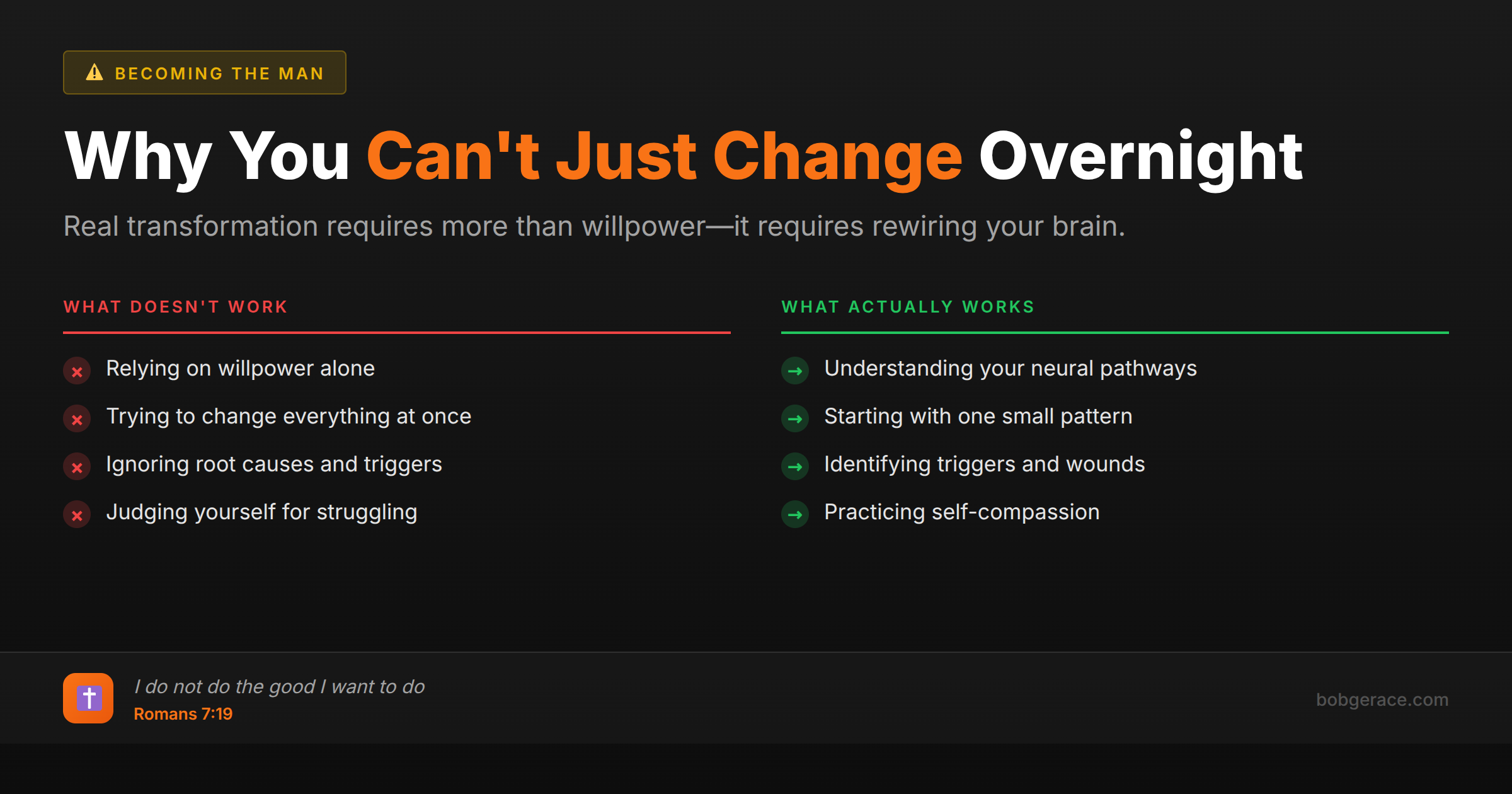
You can't 'just change' because lasting transformation involves more than willpower—it requires rewiring deeply embedded neural pathways, addressing root causes, and often healing past wounds. Most people try to change behaviors without understanding the underlying emotions, beliefs, and triggers that drive them. Real change happens when you identify your patterns, understand why they exist, and systematically replace them with new responses. It's not a character flaw that you can't instantly transform; it's simply how human psychology works. Change requires patience, strategy, and often support from others who can see your blind spots.
The Full Picture
Here's what most people don't understand about change: your brain is literally wired to resist it. Every pattern you've developed—whether it's defensiveness, withdrawal, anger outbursts, or people-pleasing—exists because at some point, it served a purpose. Maybe defensiveness protected you from criticism as a child. Perhaps withdrawal kept you safe from conflict. Your brain remembers these strategies and automatically defaults to them under stress.
The Change Paradox: The harder you try to force immediate change, the more your brain pushes back. This is why New Year's resolutions fail 92% of the time. Your subconscious mind interprets sudden behavioral shifts as threats to your survival system.
Why Willpower Fails: Willpower is like a muscle that gets exhausted. When you're stressed, tired, or triggered, your prefrontal cortex (the rational part of your brain) goes offline, and your limbic system (emotional brain) takes over. This is when you revert to old patterns despite your best intentions.
The Real Process: Genuine change happens in layers. First, you need awareness—recognizing your patterns without judgment. Then comes understanding—why these patterns exist. Next is interruption—catching yourself in the moment. Finally, replacement—consistently choosing new responses until they become automatic.
This process takes time because you're literally rewiring your brain. Neuroscientists call this neuroplasticity, and it typically requires 66-254 days to form new habits, depending on complexity. In marriage, you're not just changing yourself—you're also navigating your spouse's reactions to your changes, which can create additional resistance.
What's Really Happening
From a clinical perspective, the inability to 'just change' reflects normal brain function, not personal failure. Trauma responses often masquerade as character flaws. That explosive anger might be a hypervigilance response. The chronic people-pleasing could be a fawn response to perceived threats. Until these underlying trauma patterns are addressed, surface-level behavioral changes rarely stick.
Attachment styles also play a crucial role. If you have an anxious attachment style, your brain interprets relationship conflicts as existential threats, triggering intense emotional responses that override rational thinking. Securely attached individuals change more easily because their nervous systems aren't constantly in survival mode.
The shame cycle further complicates change. When you fail to maintain new behaviors, shame tells you it's because you're fundamentally flawed. This shame triggers the very behaviors you're trying to change, creating a vicious cycle. Breaking this requires self-compassion and understanding that setbacks are part of the process.
Couples' systems theory shows us that marriages develop homeostasis—a balance that resists change. Even positive changes can threaten this balance, causing your spouse to unconsciously sabotage your efforts. This isn't malicious; it's their nervous system trying to maintain predictability. Successful change in marriage often requires both partners to understand and support the transformation process.
The most effective therapeutic approaches—like EMDR, EFT, and somatic therapies—work with the nervous system, not just thoughts and behaviors.
What Scripture Says
Scripture acknowledges the struggle of change while offering hope for transformation. Romans 7:19 captures this perfectly: *'For I do not do the good I want to do, but the evil I do not want to do—this I keep on doing.'* Even the apostle Paul struggled with unwanted patterns.
Yet God promises transformation is possible. 2 Corinthians 5:17 declares: *'Therefore, if anyone is in Christ, the new creation has come: The old has gone, the new is here!'* This doesn't mean instant perfection, but a new identity and capacity for change.
Philippians 2:13 reveals the secret: *'For it is God who works in you to will and to act in order to fulfill his good purpose.'* Change isn't accomplished through willpower alone—God empowers both the desire and ability to transform. This takes pressure off you while inviting divine partnership.
Romans 12:2 outlines the process: *'Do not conform to the pattern of this world, but be transformed by the renewing of your mind.'* The Greek word 'transformed' (metamorphoo) means gradual change, like a caterpillar becoming a butterfly. Renewal happens progressively.
Galatians 6:9 provides encouragement for the journey: *'Let us not become weary in doing good, for at the proper time we will reap a harvest if we do not give up.'* Change takes time, but persistence yields results.
James 1:4 reminds us that *'perseverance must finish its work so that you may be mature and complete, not lacking anything.'* God uses the struggle of change to develop character and dependence on Him.
What To Do Right Now
-
1
Stop judging yourself - Accept that struggling to change is normal, not a character flaw
-
2
Identify your triggers - Notice what situations, emotions, or thoughts precede unwanted behaviors
-
3
Start with one small pattern - Choose the smallest, most manageable behavior to change first
-
4
Create environmental changes - Remove triggers and add supports that make good choices easier
-
5
Practice self-compassion - When you slip up, treat yourself with the same kindness you'd show a good friend
-
6
Get support - Change is easier with accountability, professional help, or a trusted community
Related Questions
- I know what to do but can't do it
- Why do I repeat patterns I hate?
- I keep making the same mistakes
- How do I break destructive patterns?
- Why does willpower fail under stress?
- What does it take to build new neural pathways?
- How long does recovery take?
- What is the typical betrayal trauma recovery timeline?
- Can I actually become a different man?
- What if I change and she still leaves?
Also find Bob on
Subscribe for weekly videos on Christian marriage.
You Don't Have to Figure This Out Alone
A coach who knows your marriage can see the patterns you can't—and help you rewire them where it actually matters.
Talk to Bob →