How do I change when motivation fades?
6 min read
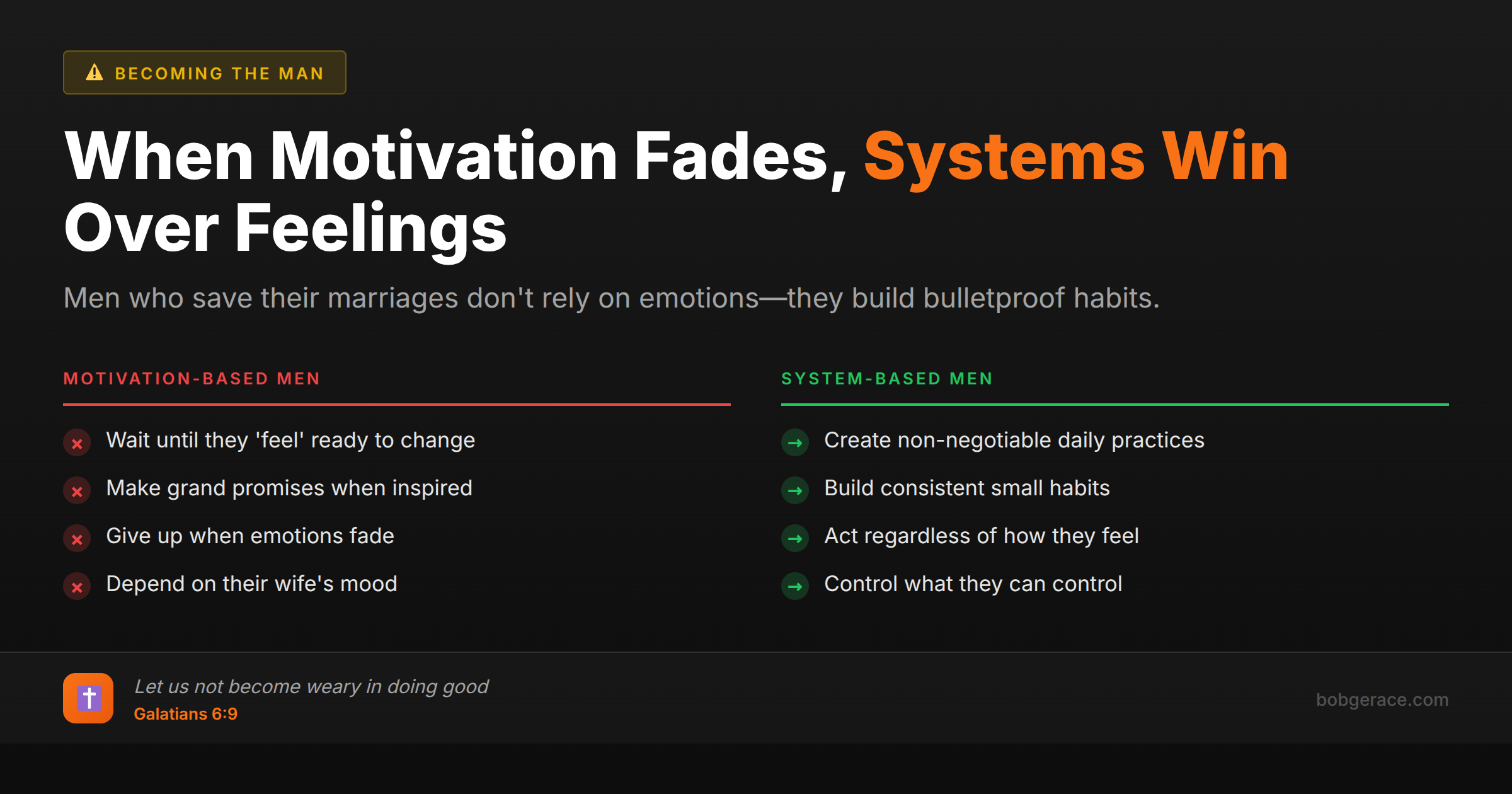
When motivation fades—and it will—you need systems, not feelings. The men who actually transform their marriages don't rely on motivation; they build habits and routines that work regardless of how they feel. This means creating non-negotiable daily practices, accountability structures, and environmental changes that make the right choices automatic. The truth is, motivation is unreliable by design. It's an emotion, and emotions fluctuate. Sustainable change happens through consistent action, even when—especially when—you don't feel like it. This is where character is built and marriages are saved.
The Full Picture
Here's what nobody tells you about change: motivation is the worst foundation for transformation. It's like building your house on sand—looks good when the weather's nice, but the first storm washes it away.
I've worked with hundreds of men who started strong. They read the books, attended the seminars, made grand declarations to their wives. Then life hit. Work got stressful. Kids got sick. The old patterns crept back in. And they concluded they were failures.
They weren't failures—they just built on the wrong foundation.
Real transformation happens through systems, not motivation. It's the difference between a sprint and a marathon. Sprinters rely on adrenaline and intensity. Marathon runners rely on training, pacing, and proven strategies that work mile after mile, regardless of how they feel.
Your marriage needs marathon-level change, not sprint-level excitement.
The science backs this up. Research shows that willpower is a finite resource. You wake up with a certain amount, and every decision depletes it. By evening, you're running on fumes. This is why most guys fail at change—they're trying to willpower their way through transformation.
Instead, you need what I call "decision architecture." This means structuring your environment, routines, and relationships so that the right choices become automatic. You remove the need to decide in the moment when your willpower is low.
Think about it this way: You don't rely on motivation to brush your teeth. You don't wake up and think, "Gee, I hope I feel motivated to practice good dental hygiene today." You just do it because it's a system, a habit, a non-negotiable part of your routine.
Your marriage transformation needs the same approach. The question isn't "How do I stay motivated?" The question is "What systems do I need to build so that I become the husband my wife needs, regardless of how I feel?"
What's Really Happening
From a psychological perspective, what we call "motivation" is actually a complex interplay of dopamine, anticipation, and reward prediction. When motivation fades, it's often because the brain's reward system has recalibrated—what initially felt exciting and new has become routine.
This is completely normal and predictable. The men who succeed in transformation understand what we call "implementation intentions"—specific if-then plans that bypass the need for in-the-moment decision-making. Instead of "I'll be more patient with my wife," it becomes "When I feel my anger rising, I will take three deep breaths and ask myself what she really needs right now."
The key is moving from goal intentions to implementation intentions. Goal intentions rely on motivation and willpower. Implementation intentions rely on predetermined responses to specific situations.
Neuroplasticity research shows us that lasting change occurs through consistent repetition, not intensity. Small, consistent actions literally rewire the brain over time. This is why the "motivation model" fails—it prioritizes intensity over consistency.
Environmental psychology also plays a crucial role. Your physical and social environment can either support or sabotage your transformation efforts. Men who successfully change often modify their environment first—changing their morning routine, their social circle, even their physical space to support their new identity.
The withdrawal from high-motivation states can feel discouraging, but it's actually a sign that you're ready to move from amateur to professional in your approach to change.
What Scripture Says
Scripture never promises that following God will always *feel* good or *feel* motivating. In fact, it assumes the opposite. The Bible's approach to transformation is built on discipline, faithfulness, and obedience—regardless of feelings.
Galatians 6:9 tells us, *"Let us not become weary in doing good, for at the proper time we will reap a harvest if we do not give up."* Notice it acknowledges we *will* become weary. It doesn't say "if you get tired"—it says "when you get tired, don't quit."
1 Corinthians 9:27 shows Paul's approach: *"I discipline my body and keep it under control, lest after preaching to others I myself should be disqualified."* Paul didn't rely on feeling spiritual—he disciplined himself.
Jesus himself modeled this in Gethsemane. Luke 22:42 records him saying, *"Father, if you are willing, remove this cup from me. Nevertheless, not my will, but yours, be done."* Even Jesus didn't always *feel* motivated to do what was right. He chose obedience over feelings.
Proverbs 21:5 provides the practical framework: *"The plans of the diligent lead surely to abundance, but everyone who is hasty comes only to poverty."* Diligence is steady, consistent action. Hastiness is motivation-driven spurts.
As a husband, you're called to love your wife as Christ loved the church (Ephesians 5:25). Christ's love wasn't based on feelings or motivation—it was based on covenant commitment and sacrificial action.
The biblical model is clear: faithfulness in small things leads to transformation in big things. Build your change on the rock of obedience, not the sand of emotion.
What To Do Right Now
-
1
Identify your keystone habit - Choose one daily practice that supports your transformation (morning prayer, daily check-in with wife, evening gratitude). Start with 5 minutes.
-
2
Create implementation intentions - Write specific if-then statements: "When my wife brings up a problem, I will listen completely before offering solutions."
-
3
Modify your environment - Remove temptations, add reminders. Put your phone in another room during family time. Leave encouraging notes where you'll see them.
-
4
Build accountability systems - Tell someone your commitment. Schedule weekly check-ins. Join a men's group or find an accountability partner.
-
5
Track behavior, not feelings - Keep a simple log of actions taken, not how you felt about them. Did you do the thing? Yes or no. That's it.
-
6
Prepare for motivation dips - Write yourself a letter to read when motivation fades. Remind yourself why you started and what's at stake. Keep it simple and direct.
Related Questions
- What does sustainable change require?
- How do I change from the inside out?
- Why do behavior changes alone not work?
- What makes change sustainable vs. temporary?
- How long does it take to rewire the brain?
- What is 'white-knuckling' vs. internalized change?
- I keep making the same mistakes
- Every time I make progress, I blow it
- How long does real change actually take?
- What if I change and she still leaves?
Also find Bob on
Subscribe for weekly videos on Christian marriage.
You Don't Have to Build This Alone
A coach who knows your marriage can help you design the systems that fit your actual life—and catch you when you're about to quit.
Talk to Bob →