What structures support sustainable change?
6 min read
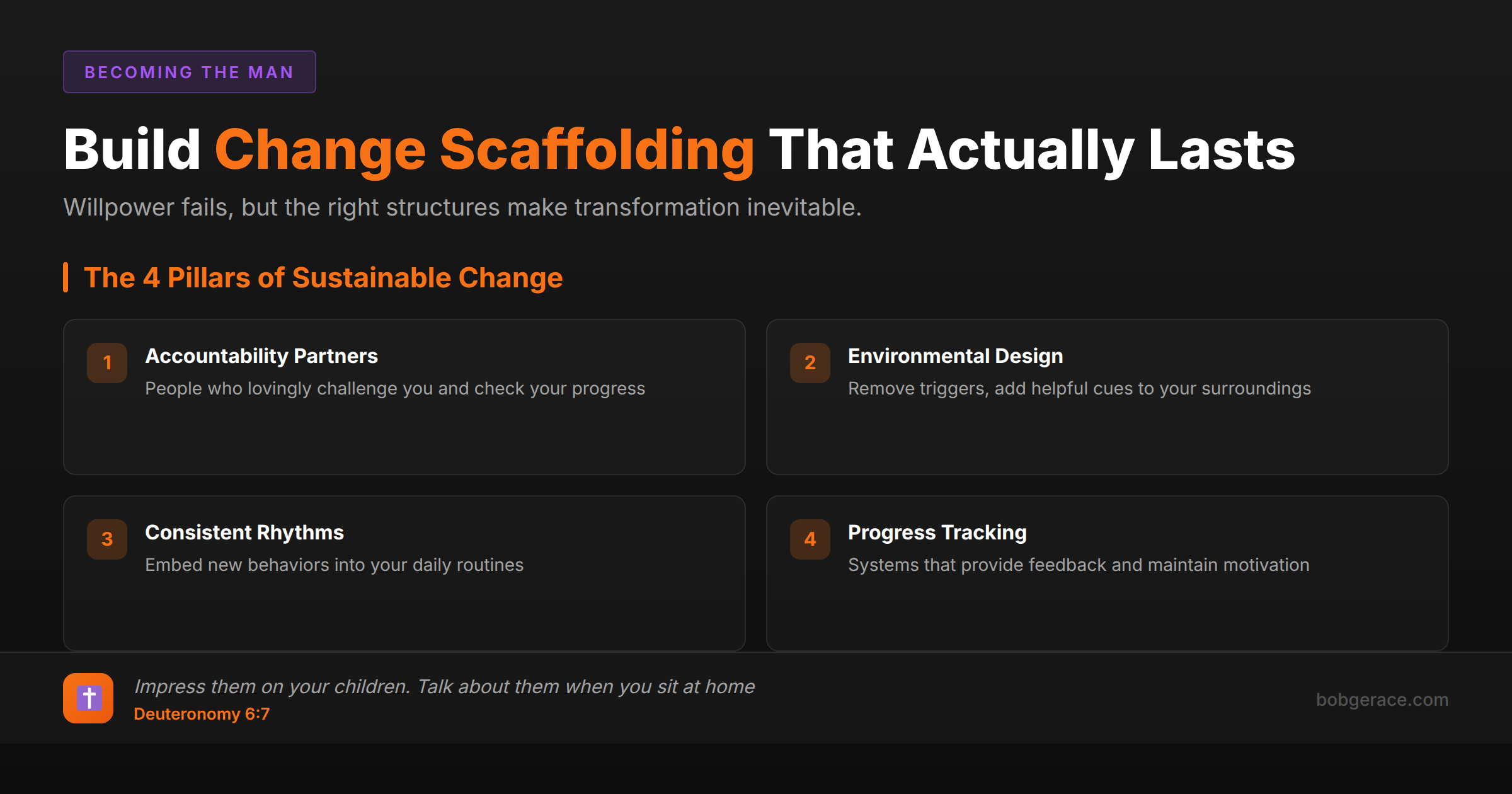
Sustainable change requires intentional structures that support new patterns long-term. The most effective structures include: accountability partnerships with people who will lovingly challenge you, environmental design that removes triggers and adds helpful cues, consistent rhythms that embed new behaviors into daily life, and progress tracking systems that provide feedback and motivation. Without these structures, change relies solely on willpower, which inevitably fails. Think of structures as scaffolding—they hold you up while new habits become second nature. The key is starting small, building one structure at a time, and gradually creating an ecosystem that makes your desired changes the easier choice.
The Full Picture
Here's the hard truth: motivation fades, but structures endure. You've probably experienced this cycle—you're fired up to change, you go hard for a few days or weeks, then life happens and you're back to square one. This isn't a character flaw; it's what happens when we rely on internal drive alone without external support systems.
Effective change structures work at multiple levels:
Environmental structures shape your physical space. If you're trying to stop checking your phone obsessively, leaving it in another room creates a barrier. If you want to pray together as a couple, having a designated space with Bibles ready removes friction.
Social structures involve other people in your change process. This might be a weekly check-in with a mentor, joining a couples' group, or simply telling your spouse your specific goals so they can encourage you.
Temporal structures embed new behaviors into existing routines. Rather than hoping you'll "find time" to implement changes, you attach them to established patterns—praying together right after morning coffee, or having difficult conversations during your weekly walk.
Measurement structures provide feedback loops. You can't manage what you don't measure. This might be tracking how often you choose curiosity over defensiveness, or noting patterns in a journal.
The compound effect is real—small, consistent actions supported by good structures create dramatic transformation over time. But you need systems that outlast your emotions and circumstances.
What's Really Happening
From a therapeutic standpoint, sustainable change occurs when we shift from conscious effort to unconscious competence. This transition requires what we call "environmental scaffolding"—external supports that reduce the cognitive load of change.
Neuroplasticity research shows that new neural pathways strengthen through repetition, but they need protection from old patterns. Structures provide this protection by creating what I call "choice architecture." Instead of relying on decision-making in high-stress moments, you've pre-decided through your structures.
I often see couples fail at change because they focus on the behavior while ignoring the system. For example, a husband wants to stop being defensive, but he hasn't created structures for self-awareness or alternative responses. When triggered, his brain defaults to familiar patterns.
Effective structures address three critical elements: triggers (what sets off old patterns), alternatives (new responses you want to build), and reinforcement (what rewards the new behavior). Without all three, change efforts typically fail within 30-60 days.
The most successful couples I work with understand that change is primarily a design problem, not a willpower problem. They architect their environment, relationships, and routines to make desired behaviors more likely and undesired behaviors more difficult.
What Scripture Says
Scripture consistently emphasizes the importance of structures for spiritual and relational growth. God knows we need external supports to sustain internal transformation.
Deuteronomy 6:6-9 gives us the template: "These commandments that I give you today are to be on your hearts. Impress them on your children. Talk about them when you sit at home and when you walk along the road, when you lie down and when you get up. Tie them as symbols on your hands and bind them on your foreheads. Write them on the doorframes of your houses and on your gates."
Notice the comprehensive structure—visual reminders, regular conversations, physical symbols, and environmental cues. God doesn't just say "remember my commands." He prescribes specific systems to embed truth into daily life.
Ecclesiastes 4:12 reminds us that "a cord of three strands is not quickly broken." Isolated change efforts are fragile, but change supported by multiple structures—community, accountability, and God's Word—creates strength.
Proverbs 27:17 teaches that "iron sharpens iron, so one person sharpens another." This isn't just about encouragement; it's about the structural necessity of relationships that challenge and refine us.
1 Corinthians 9:24-27 uses athletic metaphors—runners train with discipline and structure. Paul says he "beats his body and makes it his slave." This isn't self-abuse; it's creating systems of discipline that serve his larger purpose.
God designed us to need structures because lasting change requires more than good intentions—it requires wisdom in how we organize our lives.
What To Do Right Now
-
1
Identify your change target - Pick ONE specific behavior you want to change and write down exactly what success looks like
-
2
Map your current triggers - Notice what situations, emotions, or times of day make your old pattern most likely
-
3
Design environmental cues - Create physical reminders and remove obstacles that make your desired behavior easier
-
4
Establish accountability - Tell someone specific what you're changing and ask them to check in with you weekly
-
5
Attach to existing habits - Link your new behavior to something you already do consistently every day
-
6
Track your progress - Choose a simple method to record when you succeed or struggle with your new pattern
Related Questions
- What makes change sustainable vs. temporary?
- How do I change when motivation fades?
- What does sustainable change require?
- How long until new behaviors become automatic?
- What is 'implementation intention' and why does it help?
- What role does environment play in triggering patterns?
- What does quality coaching/therapy include?
- What daily practices indicate commitment?
- How long does recovery take?
- What are the stages of betrayal trauma recovery?
Also find Bob on
Subscribe for weekly videos on Christian marriage.
Build the structures for your marriage
You know what needs to change. A coach helps you design the specific accountability, rhythms, and systems that work for your actual life—not theory.
Talk to Bob →