Why do people cycle through stages multiple times?
6 min read
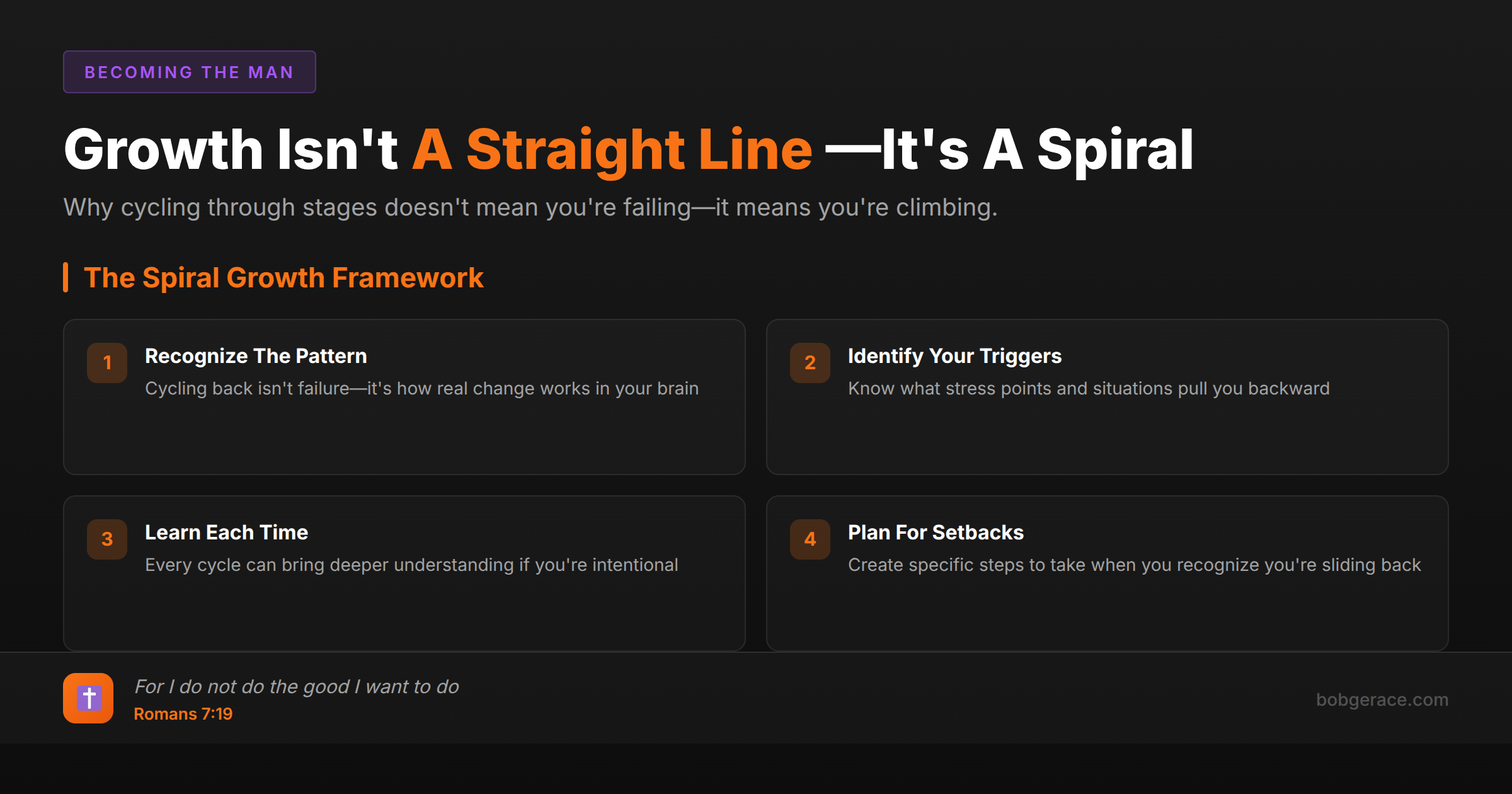
People cycle through stages multiple times because real change isn't a straight line—it's a spiral. Think of it like climbing a mountain on a winding path. You might pass the same landmarks several times, but each time you're at a higher elevation. This cycling happens because our brains are wired for familiar patterns, even destructive ones. When stress hits or old triggers surface, we naturally fall back to what we know. The good news? Each cycle through can bring deeper understanding and stronger skills if you're intentional about learning from it. The key is recognizing that cycling doesn't mean failure—it means you're human and you're still climbing.
The Full Picture
Here's what most people don't understand about change: it's supposed to cycle. We've been sold this lie that real transformation happens in a straight line—that once you "get it," you're done. That's complete nonsense.
The reality is that change happens in spirals, not straight lines. Every time you cycle back through familiar territory, you're doing so with more experience, better tools, and deeper wisdom. The problem comes when you interpret cycling as failure instead of progress.
Let me give you a real example. Say you're working on controlling your anger in arguments with your spouse. You might go through awareness ("I have a problem"), contemplation ("I need to change this"), preparation ("I'm going to try these techniques"), action ("I'm using my new skills"), and then BAM—you blow up again. You're back to square one, right? Wrong.
You're back to square one with new information. You now know what your specific triggers are. You've experienced what it feels like to succeed, even briefly. You've seen your spouse's response when you handle things better. This isn't failure—this is data collection.
The cycling happens for three main reasons: First, our brains are literally wired for the familiar. Neural pathways for old behaviors are like superhighways, while new behaviors are like dirt roads. Under stress, your brain defaults to the superhighway. Second, real change requires rewiring at multiple levels—emotional, mental, spiritual, and behavioral. That takes time and repetition. Third, life keeps throwing new challenges at you that test your growth in ways you haven't experienced yet.
Here's the game-changer: when you expect cycling and plan for it, you stop wasting energy on shame and start investing it in learning. Each cycle becomes an opportunity to go deeper, not evidence that you're hopeless.
What's Really Happening
From a clinical perspective, cycling through change stages is not only normal—it's neurologically predictable. Our brains operate on what we call "neural efficiency," meaning they default to established pathways because it requires less energy. When someone has been responding to conflict with anger for twenty years, that response is literally carved into their brain structure.
The Transtheoretical Model shows us that people typically cycle through precontemplation, contemplation, preparation, action, and maintenance multiple times before achieving lasting change. Research indicates that successful changers go through these stages an average of three to four times before maintaining new behaviors long-term.
What happens neurologically is fascinating. During periods of low stress, the prefrontal cortex—our rational, decision-making brain—can successfully override limbic system responses. But when stress increases, cortisol floods the system and the limbic system takes control. This is why people often say, "I knew what to do, but I couldn't access it in the moment."
The cycling also serves a psychological function called "integration." Each time someone revisits a stage, they're processing the change at a deeper level. The first time through contemplation, they might focus on external consequences. The second time, they're grappling with identity issues. The third time, they're dealing with underlying fears or beliefs.
This is why shame about cycling is so counterproductive. Shame activates the same stress response that triggers old patterns in the first place. When clients understand that cycling is part of the process, they can approach setbacks with curiosity instead of condemnation, which actually accelerates their progress.
What Scripture Says
Scripture is remarkably honest about the cyclical nature of growth and the reality of human struggle. God doesn't present change as a linear process—He shows us people who wrestled, fell back, got up, and kept moving forward.
Romans 7:19 captures this perfectly: "For I do not do the good I want to do, but the evil I do not want to do—this I keep on doing." Even Paul, the great apostle, acknowledged the cyclical struggle between what we know is right and what we actually do. This isn't a sign of spiritual failure—it's the human condition.
Proverbs 24:16 gives us hope: "For though the righteous fall seven times, they rise again, but the wicked stumble when calamity strikes." Notice it doesn't say the righteous never fall. It says they fall seven times—meaning multiple cycles—but they keep getting up. The difference isn't in the falling; it's in the rising.
James 1:2-4 reframes our perspective on cycling: "Consider it pure joy, my brothers and sisters, whenever you face trials of many kinds, because you know that the testing of your faith produces perseverance. Let perseverance finish its work so that you may be mature and complete, not lacking anything." Each cycle through difficulty is producing something valuable—perseverance and maturity.
2 Corinthians 12:9 reminds us that our weakness isn't disqualifying: "But he said to me, 'My grace is sufficient for you, for my power is made perfect in weakness.'" God's power shows up most clearly in our cycling, struggling, imperfect attempts at change.
Philippians 1:6 provides the ultimate assurance: "Being confident of this, that he who began a good work in you will carry it on to completion until the day of Christ Jesus." God isn't surprised by your cycling. He's committed to the process, not just the outcome.
1 John 1:9 offers grace for each cycle: "If we confess our sins, he is faithful and just and will forgive us our sins and purify us from all unrighteousness." Every time you cycle back through failure, confession, and recommitment, you're participating in God's design for growth.
What To Do Right Now
-
1
Reframe cycling as normal, not failure—write down three things you learned from your last 'setback'
-
2
Identify your specific triggers and stress points that cause you to cycle backward
-
3
Create a 'cycling plan'—specific steps to take when you recognize you're sliding back
-
4
Build accountability with someone who understands that cycling is part of the process
-
5
Track your cycles to see patterns and measure actual progress over time
-
6
Practice self-compassion techniques when cycling happens—treat yourself like you would a good friend
Related Questions
- What are the 'stages of change'?
- What predicts successful change vs. relapse?
- Why does 'trying harder' often backfire?
- I start strong then fall back
- Every time I make progress, I blow it
- How long until new patterns become default?
- How long does recovery take?
- What are the stages of betrayal trauma recovery?
- What does relapse tell us about change?
- How long does real change actually take?
Also find Bob on
Subscribe for weekly videos on Christian marriage.
You Don't Have to Figure This Out Alone
A coach who knows your marriage can see the patterns you're stuck in and help you break them—not with theory, but with what actually works for your situation.
Talk to Bob →