What's the difference between motivation and ability?
6 min read
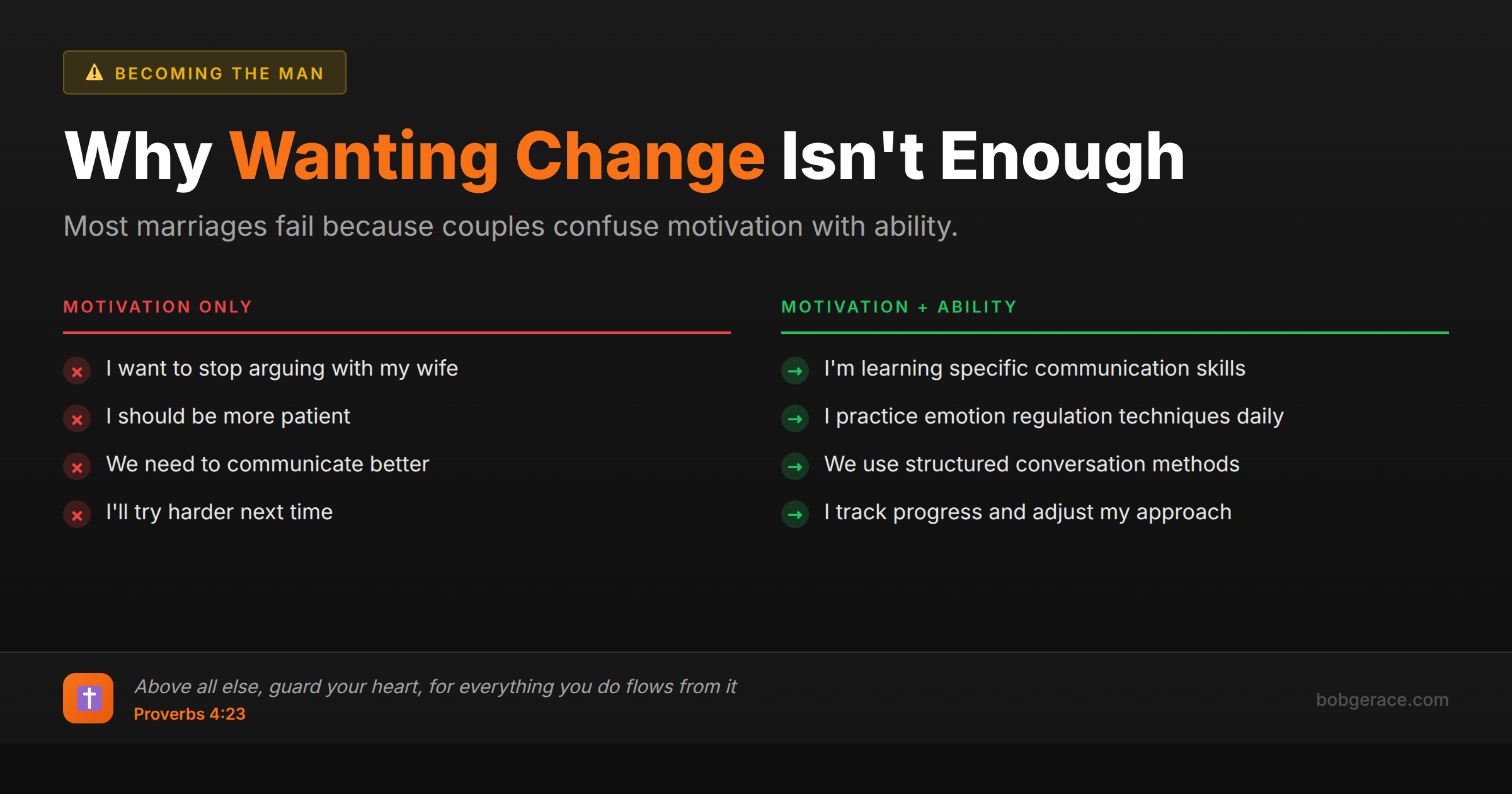
Motivation is your desire and willingness to change - the 'want to' behind your actions. Ability is having the actual skills, knowledge, and capacity to make that change happen - the 'how to' that turns intention into reality. In marriage, this distinction is crucial because many couples get stuck thinking that wanting to improve their relationship is enough. You might be highly motivated to stop arguing with your spouse, but if you lack the ability to communicate effectively, manage your emotions, or recognize triggers, you'll keep falling into the same patterns. Real change happens when both motivation and ability work together - when your desire to grow is matched by developing the actual skills needed to create lasting transformation in your marriage.
The Full Picture
Here's what I see all the time: spouses who are desperate to change their marriage, reading every book, attending every workshop, promising their partner they'll do better - but nothing sticks. They have motivation in spades, but they're missing the ability component.
Motivation is your internal drive. It's the pain of seeing your spouse's disappointment, the fear of losing your marriage, the hope for something better. It's what gets you searching for answers at 2 AM and making promises after another fight. Motivation answers the question: *Do you want to change?*
Ability is entirely different. It's having the actual tools, skills, and knowledge to execute change. It's knowing how to pause before reacting, how to express needs without attacking, how to repair after conflict. Ability answers: *Can you actually do what needs to be done?*
The problem is most people focus only on motivation. They think if they want it badly enough, change will happen. But wanting to be a better husband doesn't teach you how to listen without defending. Wanting to stop the cycle of conflict doesn't give you the skills to de-escalate tension.
The breakthrough comes when you address both. High motivation with low ability leads to repeated failure and frustration. High ability with low motivation leads to knowing what to do but not doing it. You need both working together - the drive to change and the skills to make it happen.
This is why some couples make dramatic improvements while others stay stuck despite trying just as hard. The ones who succeed understand that good intentions must be paired with practical skills.
What's Really Happening
From a clinical perspective, the motivation-ability distinction is foundational to successful therapeutic outcomes. What we see in couples therapy is that motivation often fluctuates - it's high after a major conflict but diminishes when things feel stable. Ability, however, builds over time and becomes internalized.
Motivation is largely emotional and circumstantial. It spikes during crisis moments and can drop when the immediate pressure is off. This is why couples often start strong in therapy but struggle with consistency. They're riding the wave of motivation without building the underlying abilities.
Ability involves neuroplasticity - literally rewiring your brain's response patterns. When someone learns to pause before reacting, they're creating new neural pathways. This requires repetition, practice, and often working against deeply ingrained patterns established over years or decades.
The most successful couples I work with learn to leverage motivation strategically while systematically building ability. They use high-motivation moments to commit to skill-building practices, knowing that motivation alone won't sustain them through the difficult work of change.
We also see that ability-building increases intrinsic motivation over time. As people experience success with new skills, their confidence grows, creating a positive feedback loop. They begin to believe change is possible because they have evidence - not just hope - that they can do things differently.
What Scripture Says
Scripture beautifully illustrates both the importance of right desires (motivation) and developing godly character (ability). The Bible doesn't present wanting good things as enough - it calls us to grow in wisdom and skill.
On Motivation - The Heart's Desire: *"Take delight in the Lord, and he will give you the desires of your heart"* (Psalm 37:4). God cares about our motivations and desires, especially when they align with His will for our marriages.
*"Above all else, guard your heart, for everything you do flows from it"* (Proverbs 4:23). Our motivation - what we truly want - shapes everything else.
On Ability - Growing in Wisdom and Skill: *"If any of you lacks wisdom, you should ask God, who gives generously to all without finding fault, and it will be given to you"* (James 1:5). Wisdom is about ability - knowing how to navigate relationships skillfully.
*"The simple believe anything, but the prudent give thought to their steps"* (Proverbs 14:15). This speaks to developing the ability to think before acting, a crucial marriage skill.
The Integration of Both: *"It is God who works in you to will and to act in order to fulfill his good purpose"* (Philippians 2:13). Notice both elements - God works in us to *will* (motivation) and to *act* (ability).
*"Therefore, my dear friends, as you have always obeyed—not only in my presence, but now much more in my absence—continue to work out your salvation with fear and trembling"* (Philippians 2:12). The "working out" requires both the desire to obey and the skills to live faithfully.
God doesn't just change our hearts; He develops our character through practice, wisdom, and skill-building.
What To Do Right Now
-
1
Assess Your Motivation: Write down specifically why you want to change your marriage patterns. What's driving you? Keep this visible for when motivation dips.
-
2
Identify Your Ability Gaps: List 3 specific skills you lack. Maybe it's listening without interrupting, managing anger, or expressing appreciation regularly.
-
3
Start Skill-Building: Choose one ability gap and commit to practicing it daily for two weeks. Focus on technique, not just trying harder.
-
4
Use Motivation Strategically: When you feel highly motivated, use that energy to set up systems and commit to practices that will carry you when motivation is low.
-
5
Practice in Low-Stakes Moments: Don't wait for big conflicts to try new skills. Practice better communication during casual conversations first.
-
6
Track Both Elements: Keep a simple log of your motivation level (1-10) and your skill practice. Notice how they influence each other over time.
Related Questions
Ready to Build Real Ability?
Stop relying on motivation alone. Let me show you the specific skills that create lasting change in marriage.
Learn the Skills →