What does moving from unconscious incompetence to unconscious competence look like?
6 min read
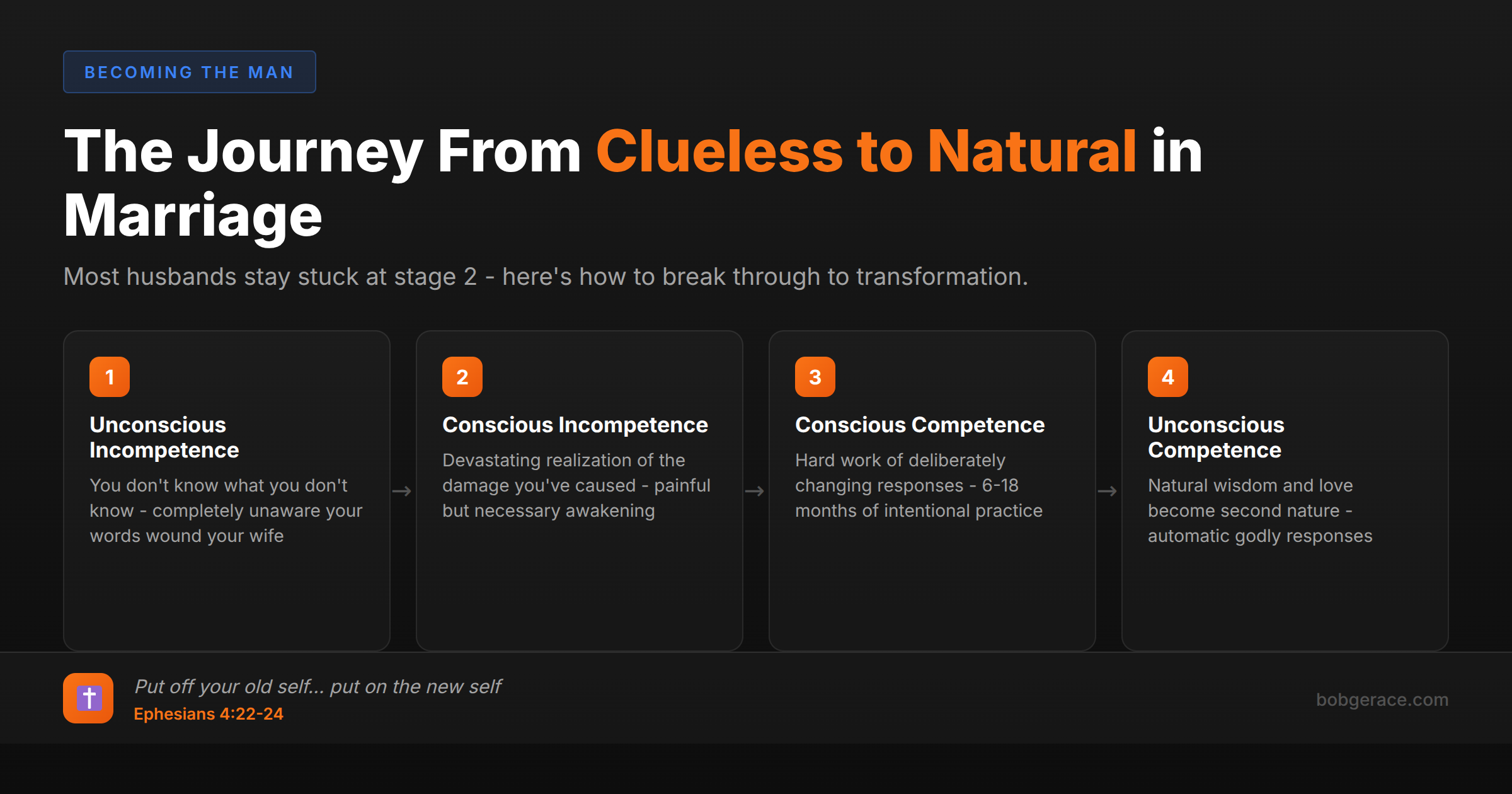
Moving from unconscious incompetence to unconscious competence in marriage is like learning to drive - you go from not knowing what you don't know, to painful awareness of your failures, to deliberate practice, and finally to natural, automatic skill. In marriage, this means starting completely unaware of how your words wound your wife, then having the devastating realization of the damage you've caused, followed by the hard work of consciously changing your responses, and ultimately developing new patterns that become second nature. This journey typically takes 6-18 months of consistent, intentional work, but the transformation is profound - you become the husband who naturally responds with wisdom and love instead of defensiveness and criticism.
The Full Picture
The four stages of competence reveal exactly how transformation happens in marriage. Stage 1: Unconscious Incompetence - You're destroying your marriage without realizing it. You think you're a good husband while your wife feels unheard, unloved, and unsafe. You dismiss her concerns as 'nagging' and wonder why she's always upset. This is the most dangerous stage because you're causing damage while remaining completely blind to it.
Stage 2: Conscious Incompetence - This is where most men want to quit. You suddenly see how your defensiveness, criticism, and emotional withdrawal have wounded your wife. The awareness is crushing. You realize you've been the problem, but you don't know how to change. Every conversation feels like a minefield. You're hyper-aware of your failures but lack the skills to respond differently.
Stage 3: Conscious Competence - The hard work begins. You're actively learning new ways to respond. When your wife shares a concern, you consciously choose to listen instead of defend. You deliberately ask questions instead of giving solutions. It feels awkward and requires intense focus. You'll slip back into old patterns regularly, but you catch yourself faster and course-correct.
Stage 4: Unconscious Competence - The breakthrough. Your new responses become automatic. When your wife shares her heart, you naturally lean in with curiosity instead of defensiveness. You instinctively create safety in conversations. Your marriage transforms because you've transformed. What once required painful conscious effort now flows naturally from who you've become.
What's Really Happening
Neurologically, this progression represents fundamental rewiring of the brain. In unconscious incompetence, men operate from deeply ingrained neural pathways formed in childhood - often defensive responses learned to survive criticism or conflict. The transition to conscious incompetence activates the anterior cingulate cortex, creating painful awareness of the gap between intention and impact.
The conscious competence stage is where neuroplasticity becomes crucial. Each time a man chooses a new response over an automatic reaction, he's literally building new neural pathways while weakening old ones. This requires significant prefrontal cortex activation - the brain's executive function center - which is why this stage feels so mentally exhausting.
Unconscious competence emerges when these new pathways become myelinated and dominant. The brain has essentially rewired itself. What's particularly powerful in marriage is that this creates positive feedback loops - as the husband responds differently, the wife feels safer and responds more positively, reinforcing his new behaviors.
Critically, most men get stuck in stage two because the emotional pain of awareness, combined with the wife's understandable continued hurt from past wounds, creates a perfect storm for giving up. Understanding this process helps couples navigate the inevitable turbulence of genuine transformation.
What Scripture Says
Scripture perfectly describes this transformation journey. Ephesians 4:22-24 captures the entire process: 'Put off your old self, which belongs to your former manner of life and is corrupt through deceitful desires, and be renewed in the spirit of your minds, and put on the new self, created after the likeness of God in true righteousness and holiness.' This is the movement from unconscious incompetence (corrupt old self) through conscious awareness (renewed mind) to unconscious competence (new self).
Proverbs 27:6 reveals why stage two feels so painful: 'Faithful are the wounds of a friend.' Your wife's confrontation of your unconscious incompetence is actually God's mercy - painful but necessary for growth. Hebrews 12:11 promises, 'For the moment all discipline seems painful rather than pleasant, but later it yields the peaceful fruit of righteousness to those who have been trained by it.'
Romans 12:2 describes the conscious competence stage: 'Do not be conformed to this world, but be transformed by the renewal of your mind, that by testing you may discern what is the will of God.' The 'testing' is the deliberate practice phase where you consciously choose new responses.
2 Corinthians 5:17 describes unconscious competence: 'Therefore, if anyone is in Christ, he is a new creation. The old has passed away; behold, the new has come.' This isn't just positional truth - it's the practical reality of neural transformation through God's grace.
What To Do Right Now
-
1
Identify your unconscious incompetence: Ask your wife, 'What do I do that hurts you that I might not even realize?' Listen without defending.
-
2
Embrace conscious incompetence: When you catch yourself in old patterns, pause and say, 'I'm doing it again. Help me understand what just happened.'
-
3
Practice conscious competence: Choose one specific behavior to change (like listening without interrupting) and focus intensely on it for 30 days.
-
4
Create accountability systems: Set phone reminders, work with a coach, or join a men's group to support your conscious practice.
-
5
Celebrate small wins: Acknowledge every successful new response, no matter how small - you're literally rewiring your brain.
-
6
Stay patient through the process: Remember that unconscious competence takes time - focus on consistency, not perfection, knowing transformation is happening even when you can't see it.
Related Questions
- What is 'transformational learning'?
- What makes change sustainable vs. temporary?
- What does neuroplasticity mean for adult change?
- How long does it take to rewire the brain?
- What is 'white-knuckling' vs. internalized change?
- What are the 'stages of change'?
- How long does recovery take?
- What does full recovery actually look like?
- What timeframe indicates real change?
- What should I expect to see at 30/90/180 days?
Also find Bob on
Subscribe for weekly videos on Christian marriage.
Your Marriage Isn't a Textbook Case
The stages are universal. How you move through them—given your specific history, her specific wounds, your actual patterns—isn't. A coach who knows your story can cut months off this process.
Talk to Bob →