What is 'identity-based change'?
6 min read
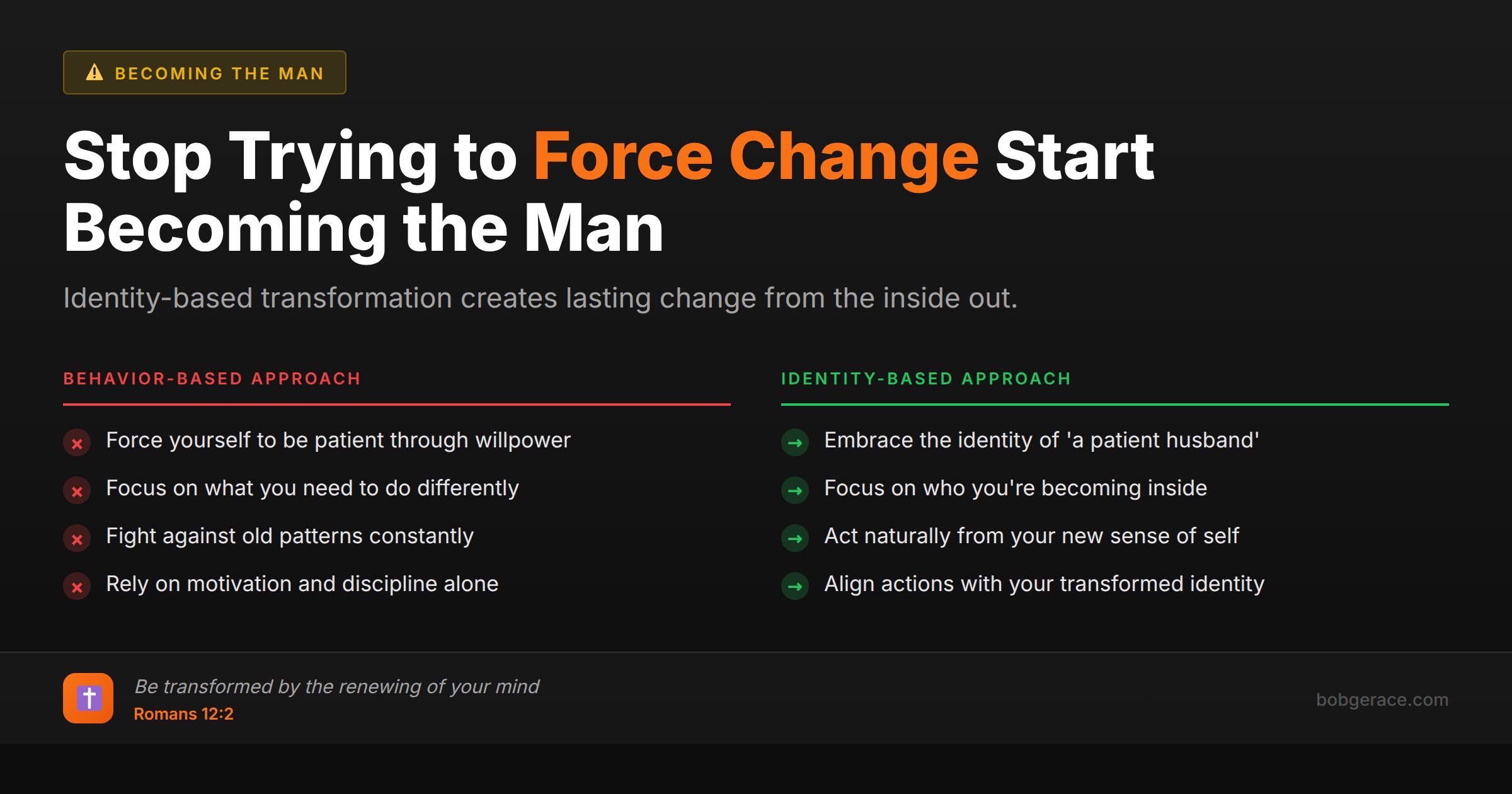
Identity-based change is a transformation approach that focuses on who you become rather than what you do. Instead of trying to force new behaviors through willpower, you shift your self-perception and naturally begin acting from that new identity. For example, rather than forcing yourself to be more patient, you embrace the identity of 'a patient husband' and then act accordingly. This approach is powerful in marriage because it creates lasting change from the inside out. When you see yourself as a loving, faithful, intentional husband, your actions naturally align with that identity. You stop fighting against your old patterns and start living from your new sense of self. It's not about perfection—it's about consistent identity alignment that transforms both you and your relationship.
The Full Picture
Most men approach change backwards. They focus on behaviors first—trying to be more romantic, communicate better, or show more affection—without addressing the deeper identity issues underneath. This creates an exhausting cycle of temporary improvements followed by inevitable regression back to old patterns.
Identity-based change flips this approach. It recognizes that sustainable transformation happens when you change who you believe you are, not just what you do. Your actions flow naturally from your identity. If you see yourself as selfish, you'll act selfishly even when trying to be generous. But when you genuinely embrace the identity of a generous man, generous actions become natural expressions of who you are.
This framework is especially crucial in marriage because your wife doesn't just need you to do loving things—she needs you to become a loving man. She can sense the difference between forced behavioral changes and authentic transformation. When you're operating from a changed identity, your efforts feel genuine rather than performative.
The process involves three key shifts: awareness (recognizing your current identity), intention (choosing who you want to become), and evidence (taking small actions that reinforce your new identity). Each time you act from your desired identity, you strengthen that neural pathway and weaken the old one. Over time, what felt forced becomes natural, and what seemed impossible becomes inevitable.
This isn't positive thinking or fake-it-till-you-make-it. It's a fundamental restructuring of how you see yourself, supported by consistent actions that prove your new identity is real.
What's Really Happening
From a therapeutic perspective, identity-based change aligns with what we know about neuroplasticity and behavioral psychology. Our brains are constantly forming neural pathways based on repeated thoughts and actions. When men try to change behaviors without addressing underlying identity beliefs, they're fighting against established neural networks that have been reinforced for years.
Identity-based change works because it leverages the brain's natural tendency toward consistency. Once you genuinely adopt a new identity, cognitive dissonance creates internal pressure to align your actions with that self-concept. This is why it feels uncomfortable to act against our identity—our brains are wired to maintain consistency between who we think we are and how we behave.
In marriage therapy, I often see men who are exhausted from trying to maintain behavioral changes that don't align with their core identity. They'll be affectionate for a few weeks, then revert to emotional distance because they still see themselves as 'not naturally affectionate.' The behavior change was superficial rather than systemic.
True transformation requires what psychologists call 'identity updating'—consciously revising your self-concept based on new evidence and experiences. This process is supported by self-affirmation theory, which shows that people are more open to change when it's framed as becoming who they really are rather than fixing what's wrong with them. The goal isn't to become someone else—it's to become the fullest, most mature version of yourself.
What Scripture Says
Scripture consistently teaches that transformation happens from the inside out, beginning with identity change. Romans 12:2 instructs us to 'be transformed by the renewing of your mind'—this is identity-based change at its core. The Greek word 'metamorphoo' suggests a complete transformation of nature, like a caterpillar becoming a butterfly.
2 Corinthians 5:17 declares that 'if anyone is in Christ, the new creation has come: The old has gone, the new is here!' This isn't just positional truth—it's identity truth. You're not just forgiven; you're fundamentally new. Your marriage transformation flows from embracing this new identity rather than trying to improve your old one.
Ephesians 4:22-24 provides the framework: 'Put off your old self... and put on the new self, created to be like God in true righteousness and holiness.' Notice the language—you're putting on a new self, not just new behaviors. The behaviors flow from the identity, not the other way around.
Galatians 2:20 captures the essence: 'I have been crucified with Christ and I no longer live, but Christ lives in me.' Paul's identity was so transformed that his old self was considered dead. This enabled him to live from a completely new foundation, which naturally produced new actions.
The biblical pattern is clear: God changes who you are, then teaches you to live from that new identity. Your role as a husband isn't to try harder at being loving—it's to embrace your identity as a man created in God's image and let that truth transform how you love your wife.
What To Do Right Now
-
1
Write down how you currently see yourself as a husband—be brutally honest about your self-perception
-
2
Define the identity of the husband you want to become using specific character traits, not just behaviors
-
3
Choose one small daily action that a man with your desired identity would naturally do
-
4
Create an identity statement: 'I am the kind of man who...' and repeat it daily while taking your chosen action
-
5
Track evidence of your new identity by writing down moments when you acted from your desired character
-
6
Share your identity transformation journey with a trusted friend or mentor for accountability and encouragement
Related Questions
- What's the difference between first-order and second-order change?
- Why does behavior change without belief change fail?
- What is 'transformational learning'?
- What makes change sustainable vs. temporary?
- How do I change from the inside out?
- What does real transformation look like?
- What is 'white-knuckling' vs. real transformation?
- How long does real change actually take?
- What are the 'stages of change'?
Also find Bob on
Subscribe for weekly videos on Christian marriage.
You Don't Have to Figure This Out Alone
Becoming that husband in your actual marriage—with your wife, your history, your triggers—takes more than a concept. A coach who knows your story can help you close the gap between who you want to be and who you're being today.
Talk to Bob →