What role does identity play in behavior change?
6 min read
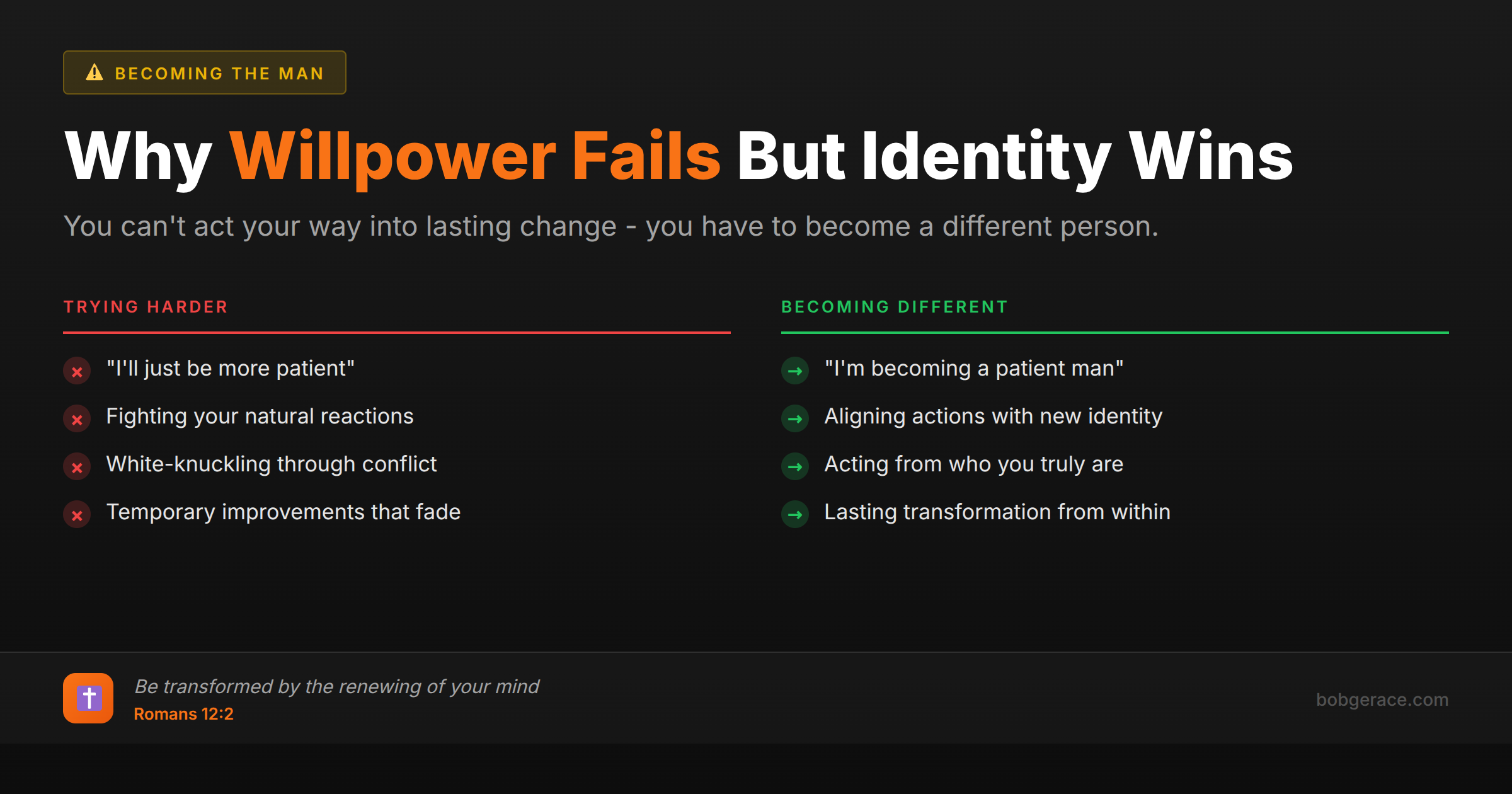
Identity is the engine that drives all lasting behavior change. When you try to change what you do without changing who you are, you're fighting an uphill battle that you'll eventually lose. Your identity acts like an internal thermostat - when your behavior gets too far from who you believe yourself to be, you unconsciously pull it back. In marriage, this means that trying to be more patient, kind, or forgiving through willpower alone rarely works long-term. You might manage it for a few weeks or months, but unless you see yourself as fundamentally a patient, kind, forgiving person, you'll snap back to your old patterns. The couples who experience lasting transformation understand this: they don't just try to act differently, they become different people.
The Full Picture
Most marriage advice focuses on behavior modification - do this, don't do that, try harder, be better. But here's what that approach misses: behavior flows from identity, not the other way around.
Your brain is constantly asking, "What would someone like me do in this situation?" If you see yourself as someone who gets easily frustrated, you'll find reasons to be frustrated. If you identify as someone who's not good at communication, you'll unconsciously sabotage conversations. If you believe you're just not a romantic person, you'll resist romantic gestures even when you try to make them.
This is why New Year's resolutions fail 80% of the time. People try to change their actions while keeping their old story about themselves intact. "I'm going to exercise every day" rarely works for someone who sees themselves as lazy. "I'm going to be more patient with my spouse" struggles against an identity that says "I'm just a hot-headed person."
The couples who break through to lasting change understand this principle: you don't rise to the level of your goals, you fall to the level of your identity. They stop trying to act like different people and start actually becoming different people.
Every action you take is a vote for the type of person you want to become. Choose poorly, and you reinforce an identity that works against your marriage. Choose well, and you literally rewire your brain to see yourself differently. When your identity shifts, behavior change becomes natural, even inevitable.
This is why the work we do goes so much deeper than communication techniques or conflict resolution strategies. We're in the business of identity transformation - helping you become the person your marriage needs you to be.
What's Really Happening
From a neuroscience perspective, identity change literally rewires your brain through neuroplasticity. When you repeatedly act in alignment with a new identity, you strengthen neural pathways that support those behaviors while weakening the old ones.
What's fascinating is how quickly this can happen. Research shows that identity shifts can begin in as little as 18-66 days of consistent action, though the average is around 66 days. Your brain doesn't distinguish between 'real' and 'practiced' identity - it simply reinforces whatever pattern you repeat most consistently.
I see this play out in couples therapy constantly. The partners who succeed aren't necessarily the ones who want change the most - they're the ones who commit to a new story about themselves. Instead of saying "I'm trying to be less critical," they say "I'm someone who builds my spouse up." Instead of "I need to work on my anger," it's "I'm becoming a person of peace."
This identity-first approach works because it addresses the root cause rather than just the symptoms. When clients operate from their old identity while trying to change behavior, they experience what psychologists call 'cognitive dissonance' - internal tension between who they are and what they're doing. This tension is exhausting and unsustainable.
But when behavior aligns with identity, everything flows naturally. There's no internal resistance because you're not fighting against yourself - you're simply being who you are. This is why identity work isn't just more effective than behavior modification, it's actually easier in the long run.
What Scripture Says
Scripture is crystal clear that transformation happens from the inside out. Romans 12:2 tells us, "Do not conform to the pattern of this world, but be transformed by the renewing of your mind." Notice it's not about trying harder - it's about renewing your mind, changing how you think about yourself.
2 Corinthians 5:17 declares, "Therefore, if anyone is in Christ, the new creation has come: The old has gone, the new is here!" This isn't just theological language - it's describing literal identity change. You're not just a sinner trying to do better; you're a new creation learning to live from that reality.
Jesus understood this principle perfectly. When He called His disciples, He didn't just give them tasks - He gave them new identities. Simon became Peter (the rock). James and John became 'Sons of Thunder.' He was calling out who they were becoming, not just what they were doing.
Ephesians 4:22-24 lays out the process: "Put off your old self, which is being corrupted by its deceitful desires; be made new in the attitude of your minds; and put on the new self, created to be like God in true righteousness and holiness." There's the old identity, the mind renewal process, and the new identity.
In marriage, this means you're not just a difficult person trying to be easier to live with. You're not just someone with anger issues working on self-control. Galatians 2:20 gives us the ultimate identity shift: "I have been crucified with Christ and I no longer live, but Christ lives in me." When you truly grasp this, behavior change becomes an expression of who you already are in Christ, not a desperate attempt to become someone you're not.
What To Do Right Now
-
1
Write down three ways you currently describe yourself that hurt your marriage ("I'm just not good at..." "I've always been..." "I'm the type of person who...")
-
2
Rewrite each limiting identity statement as a growth-focused truth ("I'm learning to..." "I'm becoming someone who..." "God is making me into...")
-
3
Choose one small daily action that aligns with your new identity - something so simple you can't fail
-
4
Start using identity-based language when you talk about yourself ("I'm someone who builds up my spouse" instead of "I'm trying to be more encouraging")
-
5
Find one Bible verse that describes who you are in Christ and read it daily for the next two weeks
-
6
Ask your spouse to point out when they see evidence of your new identity emerging - celebrate these moments together
Related Questions
- What is 'identity-based change'?
- Why does behavior change without belief change fail?
- What is 'transformational learning'?
- What's the difference between first-order and second-order change?
- How do I change from the inside out?
- What does real transformation look like?
- What does 'new creation' mean for my history?
- How do I recover my identity?
- What is the relationship between grace and effort?
Also find Bob on
Subscribe for weekly videos on Christian marriage.
Your Marriage Needs Your Specific Story
Identity work isn't generic. A coach who knows your marriage can see what you can't see about yourself and help you become who you need to be.
Talk to Bob →