Why does behavior change without belief change fail?
5 min read
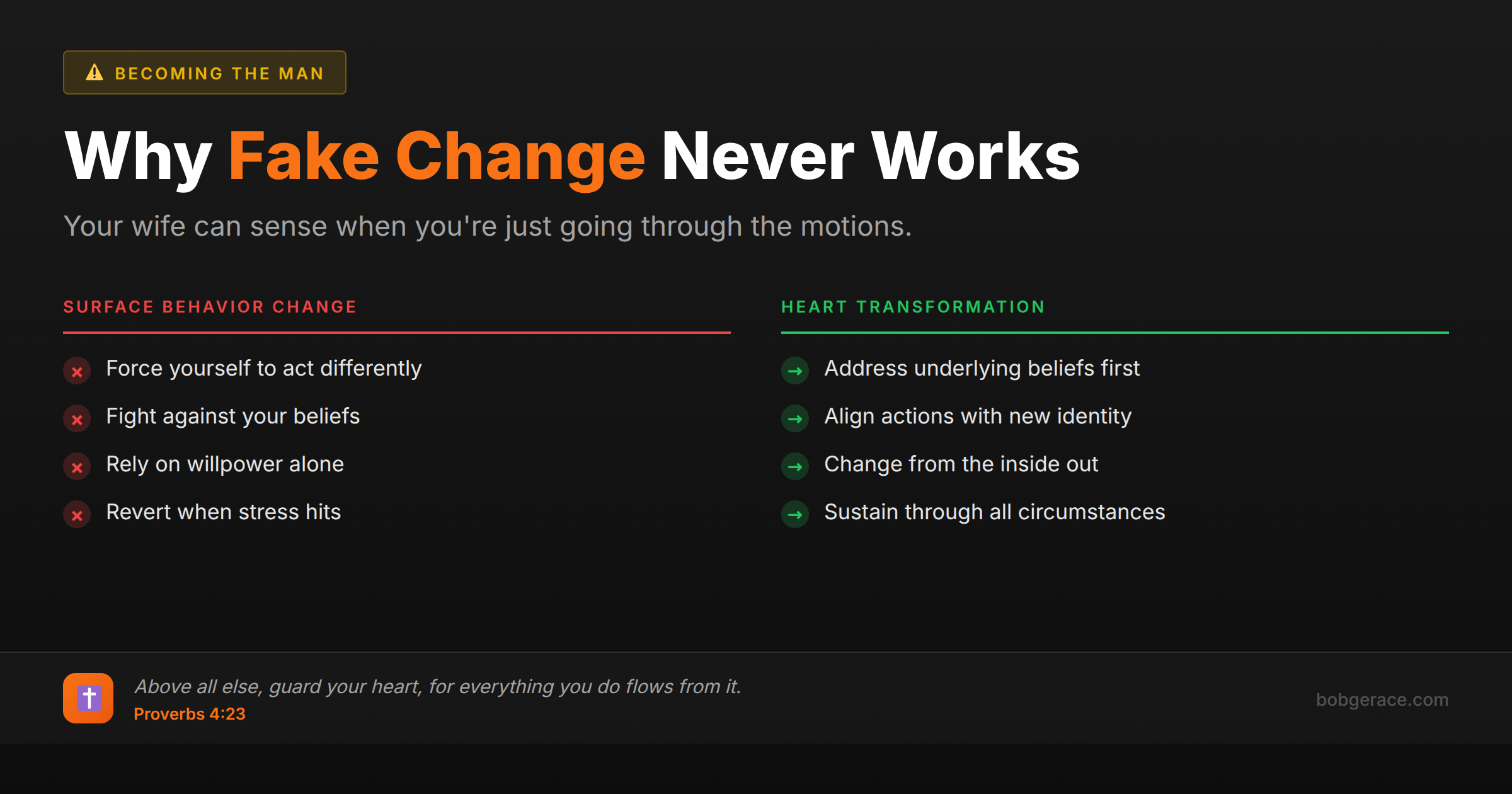
Behavior change without belief change fails because it's unsustainable and inauthentic. When you force yourself to act differently without addressing the underlying beliefs that drive your actions, you're essentially fighting against your own internal operating system. Your wife can sense the disconnect between what you're doing and who you're being. True transformation happens from the inside out. Your beliefs shape your thoughts, your thoughts drive your emotions, and your emotions fuel your actions. If you only change the surface behavior while keeping the same limiting beliefs about yourself, your marriage, or your worth, those old beliefs will eventually reassert themselves. You'll revert to old patterns when stress hits or when willpower runs low. Lasting change requires aligning your beliefs with the man you want to become.
The Full Picture
Here's what most men don't understand: your marriage problems aren't behavior problems—they're belief problems.
When I work with husbands who are struggling, they almost always start by asking me what they should *do* differently. "Should I buy more flowers? Should I help more with dishes? Should I initiate more conversations?" They're looking for a behavior checklist, thinking that if they just perform the right actions, their marriage will improve.
But here's the problem with that approach: forced behavior changes are exhausting and obvious. Your wife isn't stupid. She can tell when you're going through the motions versus when you're genuinely transformed. She can sense the difference between a man who's checking boxes and a man who's actually become someone different.
Let me paint you a picture. Imagine a husband who decides he needs to be more affectionate. So he forces himself to hug his wife every morning, even though deep down he believes she's never satisfied, that nothing he does will ever be enough. His hugs feel obligatory because they are. His wife receives these hugs but senses the underlying resentment and resignation. The behavior is there, but it's hollow.
Now imagine a different scenario: a husband who does the hard work of examining and changing his core belief about his wife's heart. He moves from "she's never satisfied" to "she deeply desires connection with me." From this new belief, affection flows naturally. His hugs are genuine expressions of love, not performance pieces. His wife feels the authentic warmth behind them.
This is why behavior change without belief change creates what I call "performance husbands"—men who are exhausted from constantly acting like someone they're not, married to wives who feel increasingly disconnected from who their husbands really are.
The truth is, your beliefs are your internal operating system. They're running in the background of every interaction, every decision, every response. If your operating system says "I'm not enough," "marriage is hard," or "my wife is the problem," then no amount of behavior modification will create the marriage you want. Those limiting beliefs will sabotage your efforts every time.
What's Really Happening
From a psychological standpoint, what we're dealing with here is the fundamental disconnect between conscious intention and unconscious programming. The behaviors we exhibit are largely driven by our core belief systems, which operate primarily at an unconscious level.
When a man attempts to change only his behaviors without addressing the underlying belief structures, he's essentially trying to override his psychological operating system through sheer willpower. This creates what we call "cognitive dissonance"—the mental discomfort that occurs when your actions don't align with your internal beliefs.
Research in neuroplasticity shows us that our brains are constantly reinforcing neural pathways based on our dominant thought patterns, which stem from our core beliefs. When you force behavioral changes without shifting these underlying neural networks, your brain actually fights against the new behaviors because they don't match your internal identity.
Moreover, this approach often leads to what I call "behavioral extinction." Just like in behavioral psychology, when behaviors aren't naturally reinforced by internal alignment, they tend to fade over time. The husband exhausts his mental resources trying to maintain behaviors that feel foreign to his core identity.
Wives are particularly attuned to authenticity versus performance because women are generally more skilled at reading nonverbal cues and emotional incongruence. When a husband is performing behaviors that don't match his internal state, it creates an uncanny valley effect—something feels "off" even if they can't pinpoint exactly what.
The sustainable approach involves what we call "identity-based change." Instead of asking "What should I do?" the question becomes "Who do I need to become?" This shifts the focus from external performance to internal transformation, creating behaviors that flow naturally from a renewed sense of self and purpose.
What Scripture Says
Scripture is crystal clear about the importance of heart transformation over external behavior. God has always been more concerned with who we are than what we do, because He knows that authentic behavior flows from a transformed heart.
Proverbs 4:23 tells us, "Above all else, guard your heart, for everything you do flows from it." Notice that everything you DO flows from your heart—your beliefs, your identity, your core convictions. God isn't telling us to guard our behaviors; He's telling us to guard the source from which all behavior springs.
Matthew 23:25-26 records Jesus confronting the Pharisees: "Woe to you, teachers of the law and Pharisees, you hypocrites! You clean the outside of the cup and dish, but inside they are full of greed and self-indulgence. Blind Pharisee! First clean the inside of the cup and dish, and then the outside also will be clean." This is exactly what happens when we focus only on behavior change—we become like the Pharisees, cleaning the outside while leaving the inside unchanged.
Ezekiel 36:26 reveals God's method for real transformation: "I will give you a new heart and put a new spirit in you; I will remove from you your heart of stone and give you a heart of flesh." God doesn't just modify our behavior—He transforms our hearts, our core beliefs, our very identity.
2 Corinthians 5:17 declares, "Therefore, if anyone is in Christ, the new creation has come: The old has gone, the new is here!" This isn't about behavior modification; this is about becoming a fundamentally different person. When your identity changes, your behaviors naturally align with who you've become.
Romans 12:2 gives us the process: "Do not conform to the pattern of this world, but be transformed by the renewing of your mind." Transformation happens through mind renewal—changing what you believe about yourself, your wife, your marriage, and your purpose. When your mind is renewed, transformation is inevitable.
God's way has always been inside-out transformation, not outside-in performance.
What To Do Right Now
-
1
Identify one recurring behavior pattern in your marriage that you've been trying to change through willpower alone
-
2
Ask yourself: 'What belief about myself, my wife, or marriage is driving this pattern?' Write down your honest answer
-
3
Challenge that limiting belief by asking: 'Is this belief absolutely true? What evidence contradicts it?'
-
4
Replace the limiting belief with a truth-based belief that aligns with who God says you are and calls you to be
-
5
Spend 10 minutes daily meditating on this new belief, allowing it to reshape your internal identity
-
6
Take one small action today that flows naturally from your new belief, not as performance but as authentic expression
Related Questions
- What is 'identity-based change'?
- What's the difference between first-order and second-order change?
- What is 'transformational learning'?
- How do I change from the inside out?
- What is 'white-knuckling' vs. internalized change?
- What makes change sustainable vs. temporary?
- What is 'white-knuckling' vs. real transformation?
- Why do old patterns come back when I'm triggered?
- What does real transformation look like?
- What's the relationship between human effort and divine transformation?
Also find Bob on
Subscribe for weekly videos on Christian marriage.
You Can't Fake This Work Alone
Changing what you believe about yourself and your marriage takes a human who sees your specific blind spots. I work with you on the beliefs driving your patterns—not just the surface moves.
Talk to Bob →