What role does crisis play in transformation?
6 min read
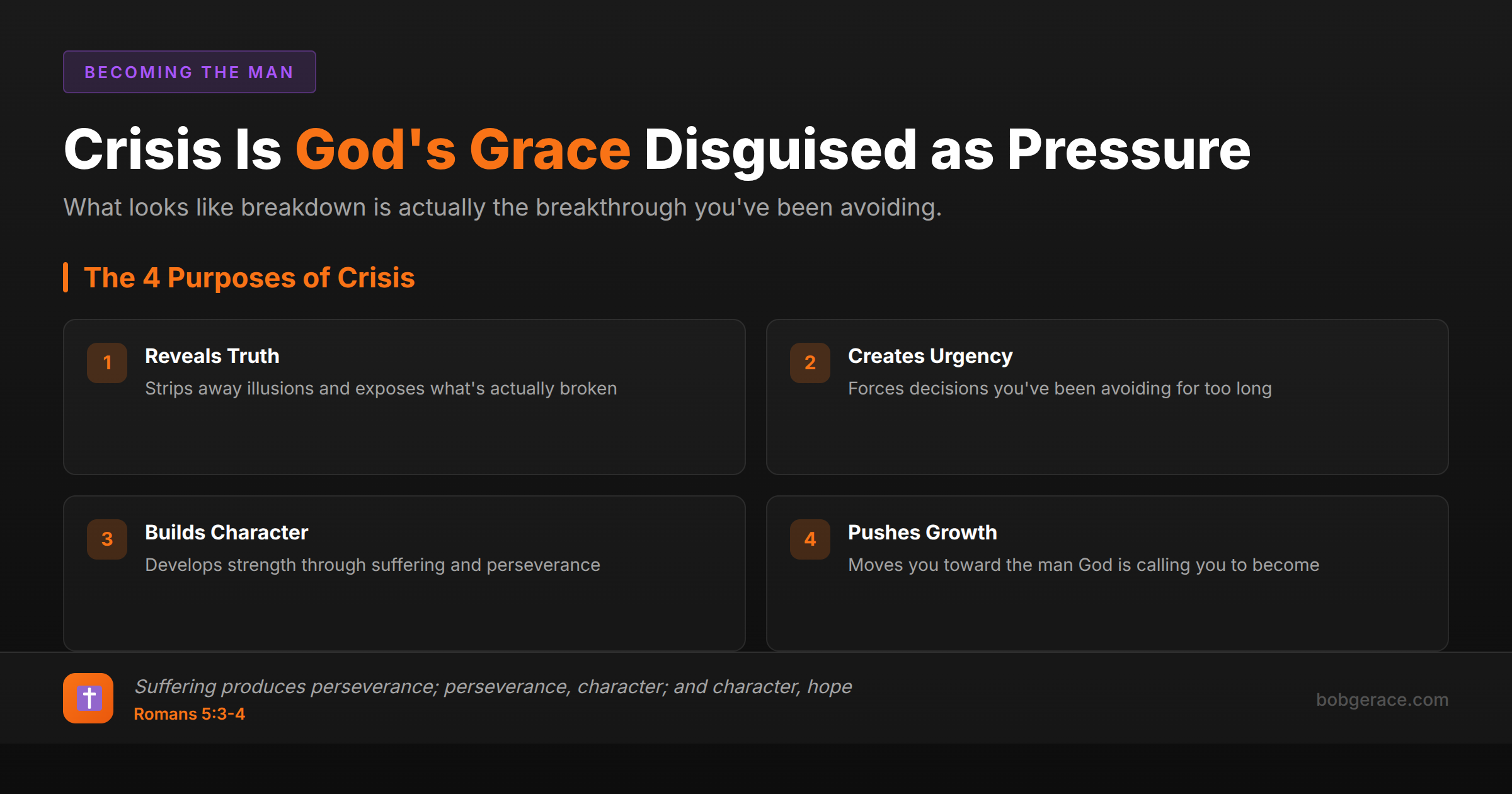
Crisis doesn't create transformation—it reveals what's already broken and forces us to make choices we've been avoiding. Most men change only when the pain of staying the same becomes greater than the pain of changing. Crisis strips away our illusions, exposes our weaknesses, and creates the urgency needed for real transformation. Without crisis, we tend to manage problems rather than solve them, medicate pain rather than heal it. Crisis is God's grace disguised as pressure, pushing us toward the men He's calling us to become when comfort and complacency have failed to motivate us.
The Full Picture
Crisis is transformation's uncomfortable catalyst. While we naturally resist and fear crisis, it serves a crucial role in male development and spiritual growth. Think of crisis as the chisel in God's hands—it's not pleasant, but it's necessary for sculpting the man you're meant to become.
Most transformation happens in three phases: First, the buildup—where problems accumulate but we maintain control through management, avoidance, or denial. Second, the breaking point—where our coping mechanisms fail and we face the reality of our situation. Third, the breakthrough—where we finally make the changes we should have made years ago.
Crisis accelerates decision-making. When your wife threatens divorce, when your kids won't talk to you, when your behavior finally catches up with you—suddenly you're willing to do things you previously dismissed as "unnecessary" or "extreme." Crisis removes the luxury of gradual change and demands immediate action.
Without crisis, most men remain stuck in comfortable dysfunction. We'll endure mediocre marriages, unfulfilling careers, and shallow relationships indefinitely if they're "manageable." Crisis forces us to confront the gap between who we are and who we need to be. It strips away our excuses and reveals our true priorities.
The men who thrive understand this principle: They don't waste their crisis. They recognize it as an opportunity for breakthrough rather than just something to survive. They lean into the discomfort, embrace the necessary changes, and emerge transformed rather than just recovered.
What's Really Happening
From a therapeutic perspective, crisis serves as what we call a "discontinuous change event"—a moment when gradual, incremental change becomes impossible and systemic transformation becomes necessary. The human brain is wired for homeostasis, meaning we naturally resist change even when our current patterns are destructive.
Crisis disrupts this homeostatic balance by creating cognitive dissonance—the psychological discomfort that occurs when our beliefs, behaviors, and reality no longer align. This dissonance becomes so uncomfortable that change becomes the path of least resistance, even though change itself is inherently difficult.
Neurologically, crisis activates our threat-detection systems, heightening focus and attention while simultaneously breaking down rigid thought patterns. This creates what researchers call "optimal anxiety"—enough stress to motivate change without becoming paralyzing. Men in crisis often report sudden clarity about issues they'd been avoiding for years.
The therapeutic concept of "post-traumatic growth" demonstrates that individuals who navigate crisis effectively often emerge stronger, wiser, and more resilient than before. However, this requires intentional engagement with the crisis rather than simply enduring it. Men who view crisis as information rather than punishment, as opportunity rather than just obstacle, consistently demonstrate better outcomes in therapy and life transformation.
What Scripture Says
Scripture consistently presents crisis as God's tool for transformation and growth. Romans 5:3-4 teaches us, "Not only so, but we also glory in our sufferings, because we know that suffering produces perseverance; perseverance, character; and character, hope." Crisis isn't punishment—it's God's process for developing the character we need.
James 1:2-4 instructs, "Consider it pure joy, my brothers and sisters, whenever you face trials of many kinds, because you know that the testing of your faith produces perseverance. Let perseverance finish its work so that you may be mature and complete, not lacking anything." Crisis tests and strengthens our faith, revealing areas where we need to grow.
Psalm 119:71 declares, "It was good for me to be afflicted so that I might learn your decrees." Sometimes we only learn what we need to learn through difficulty. Crisis strips away our self-reliance and drives us to dependence on God.
2 Corinthians 12:9 reminds us, "But he said to me, 'My grace is sufficient for you, for my power is made perfect in weakness.'" Crisis exposes our weakness, but that weakness becomes the very place where God's power is most evident.
Jeremiah 18:1-6 uses the potter's wheel metaphor—sometimes the clay must be broken down and reformed to become what the potter intended. Crisis is often God breaking down what isn't working to rebuild something better. Hebrews 12:11 concludes, "No discipline seems pleasant at the time, but painful. Later on, however, it produces a harvest of righteousness and peace for those who have been trained by it."
What To Do Right Now
-
1
Acknowledge the crisis as information—what is it telling you about what needs to change?
-
2
List the changes you've been avoiding that this crisis is now making unavoidable
-
3
Identify your current coping mechanisms and honestly assess which ones are helping versus hindering
-
4
Seek wise counsel from mentors, coaches, or counselors who can help you navigate transformation
-
5
Create accountability systems to ensure you don't revert to old patterns when the crisis pressure decreases
-
6
Document what you're learning so you can apply these lessons to prevent future crises
Related Questions
- What does real transformation look like?
- How do I change from the inside out?
- Can I actually become a different man?
- What is 'transformational learning'?
- What makes change sustainable vs. temporary?
- Is this suffering formative or just painful?
- What can I learn from this crisis?
- How do I grow regardless of outcome?
- What is 'post-traumatic growth'?
- What is the purpose of pain in God's economy?
Also find Bob on
Subscribe for weekly videos on Christian marriage.
You Don't Have to Figure This Out Alone
A coach who knows your specific marriage can see what you can't see and calibrate the work to where you actually are. Not generic advice—someone in your corner.
Talk to Bob →