What's the difference between first-order and second-order change?
6 min read
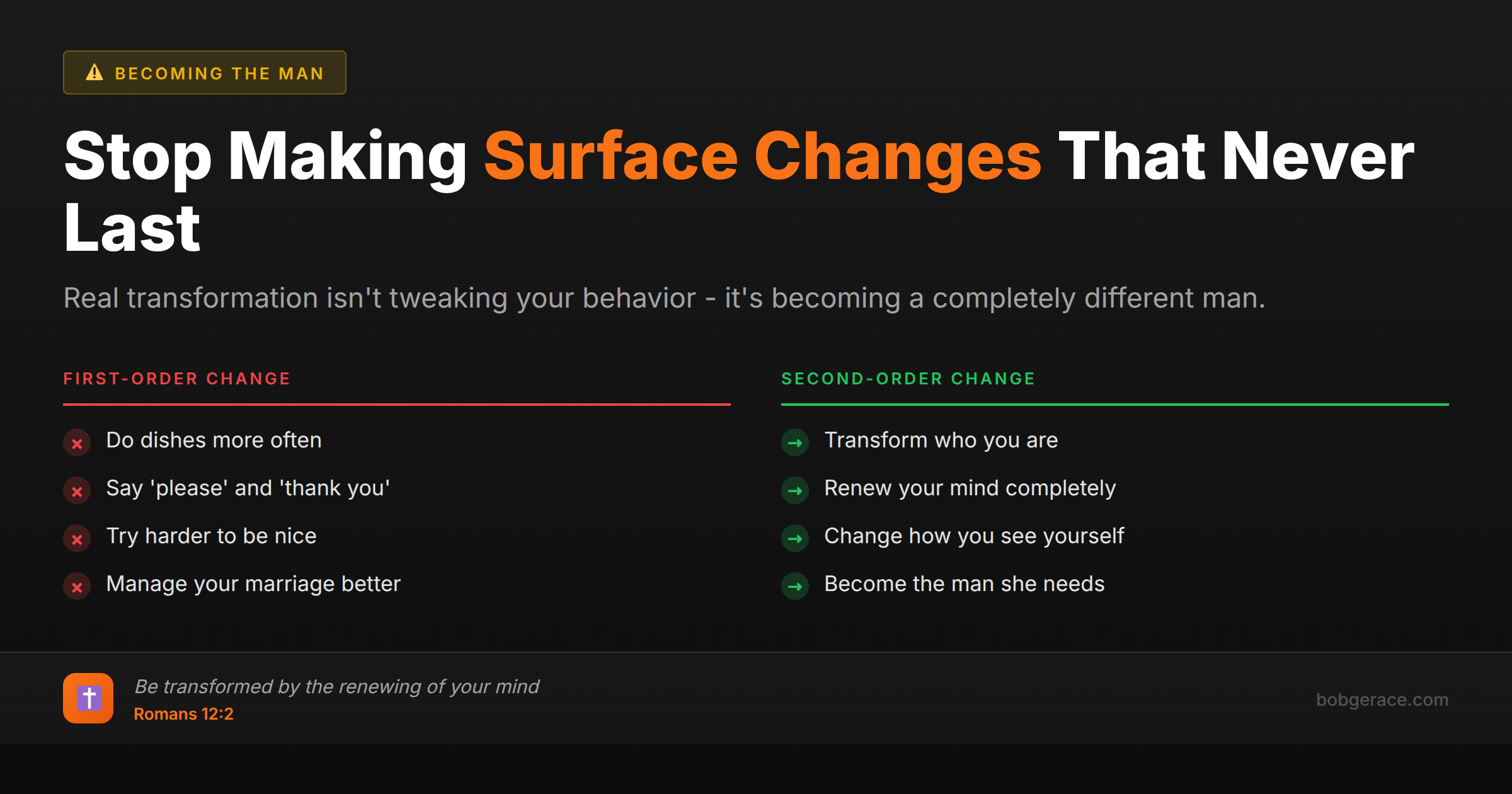
First-order change is like rearranging deck chairs on the Titanic - you're making adjustments within the existing system without changing the system itself. You might start doing dishes more often or saying 'please' and 'thank you,' but your fundamental approach to marriage remains the same. Second-order change transforms the entire system. It's not just changing what you do, but changing who you are and how you see yourself, your wife, and your marriage. This is where the real breakthrough happens - when you stop trying to manage your marriage and start becoming the man your marriage needs.
The Full Picture
Most men get stuck in what therapists call first-order change - making surface-level adjustments that feel like progress but don't create lasting transformation. You clean the house more, buy flowers, or try to argue less. These aren't bad things, but they're modifications within your existing framework of thinking and being.
First-order change operates like this: *'I need to do X differently to get Y result.'* You're essentially trying to optimize a broken system. The problem is that your fundamental operating system - your beliefs about yourself, your role, and your marriage - remains unchanged.
Second-order change is entirely different. It's a complete shift in your operating system. Instead of asking 'How can I get my wife to respond better?' you ask 'Who do I need to become?' This isn't about technique or strategy - it's about transformation at the identity level.
Here's why this matters in your marriage: When you make first-order changes, you're still operating from the same mindset that created your problems. You might see temporary improvement, but eventually, you'll default back to old patterns because the underlying system hasn't changed. Your wife can sense this too - she knows the difference between behavioral compliance and genuine transformation.
Second-order change happens when you fundamentally alter your approach to being a husband. You stop trying to manage outcomes and start focusing on becoming. This is where breakthrough happens - not because you're doing marriage differently, but because you're being different in your marriage.
What's Really Happening
From a systems theory perspective, first-order change maintains homeostasis - the family system's tendency to resist change and maintain stability. When a husband makes surface-level behavioral adjustments, the system often pushes back to restore the familiar dynamic, even if that dynamic is dysfunctional.
Second-order change disrupts the entire system. It's what we call a 'phase transition' - like water becoming steam. The molecular structure fundamentally changes. In marriage therapy, I see this when a man stops trying to fix his marriage and starts examining his core beliefs about masculinity, leadership, and love.
Neurologically, first-order change engages your prefrontal cortex - you're consciously managing behavior through willpower. This is exhausting and unsustainable. Second-order change rewires deeper neural pathways, creating new automatic responses that don't require constant conscious effort.
The key indicator of second-order change is this: your wife starts responding differently without you asking her to. When you genuinely transform at the identity level, it shifts the entire relational dynamic. She's not responding to your new techniques - she's responding to your new being. This is why behavioral marriage advice often fails long-term, while identity-based transformation creates lasting change.
What Scripture Says
Scripture calls us to transformation that goes far beyond behavioral modification. Romans 12:2 commands us: *'Do not conform to the pattern of this world, but be transformed by the renewing of your mind.'* The Greek word 'metamorphoo' means complete transformation - like a caterpillar becoming a butterfly.
This is second-order change in biblical terms. God isn't interested in you becoming a better version of your old self. He's calling you to complete transformation. 2 Corinthians 5:17 declares: *'Therefore, if anyone is in Christ, the new creation has come: The old has gone, the new is here!'*
Jesus addressed this directly when He said in Matthew 9:17: *'Neither do people pour new wine into old wineskins. If they do, the skins will burst; the wine will run out and the wineskins will be ruined. No, they pour new wine into new wineskins, and both are preserved.'* You can't put God's new work into your old frameworks.
For husbands specifically, Ephesians 5:25-27 calls us to love our wives *'just as Christ loved the church and gave himself up for her to make her holy, cleansing her by the washing with water through the word, and to present her to himself as a radiant church.'* This isn't about doing loving things - it's about becoming a man who embodies Christ's sacrificial love.
1 Peter 3:7 instructs husbands to *'live with your wives in an understanding way.'* This requires fundamental change in how you see and approach your wife, not just behavioral adjustments.
What To Do Right Now
-
1
Stop asking 'What should I do?' and start asking 'Who do I need to become?' Write down the difference between these two questions in your marriage.
-
2
Identify three first-order changes you've tried that didn't create lasting results. Acknowledge that behavioral fixes alone aren't sufficient.
-
3
Examine your core beliefs about masculinity, leadership, and marriage. What lies are you believing that keep you stuck in the same patterns?
-
4
Choose one fundamental belief about yourself as a husband that needs to change. Focus on identity transformation, not behavior modification.
-
5
Start each day asking God to transform your heart and mind, not just your actions. Pray for second-order change in your character.
-
6
Find one man who has experienced genuine transformation in his marriage and ask him to help you understand the difference between doing and becoming.
Related Questions
Ready for Second-Order Transformation?
Most men stay stuck trying to fix their marriages with first-order changes. I'll show you how to create the deep, lasting transformation your marriage actually needs.
Start Transforming →