How long until new behaviors become automatic?
6 min read
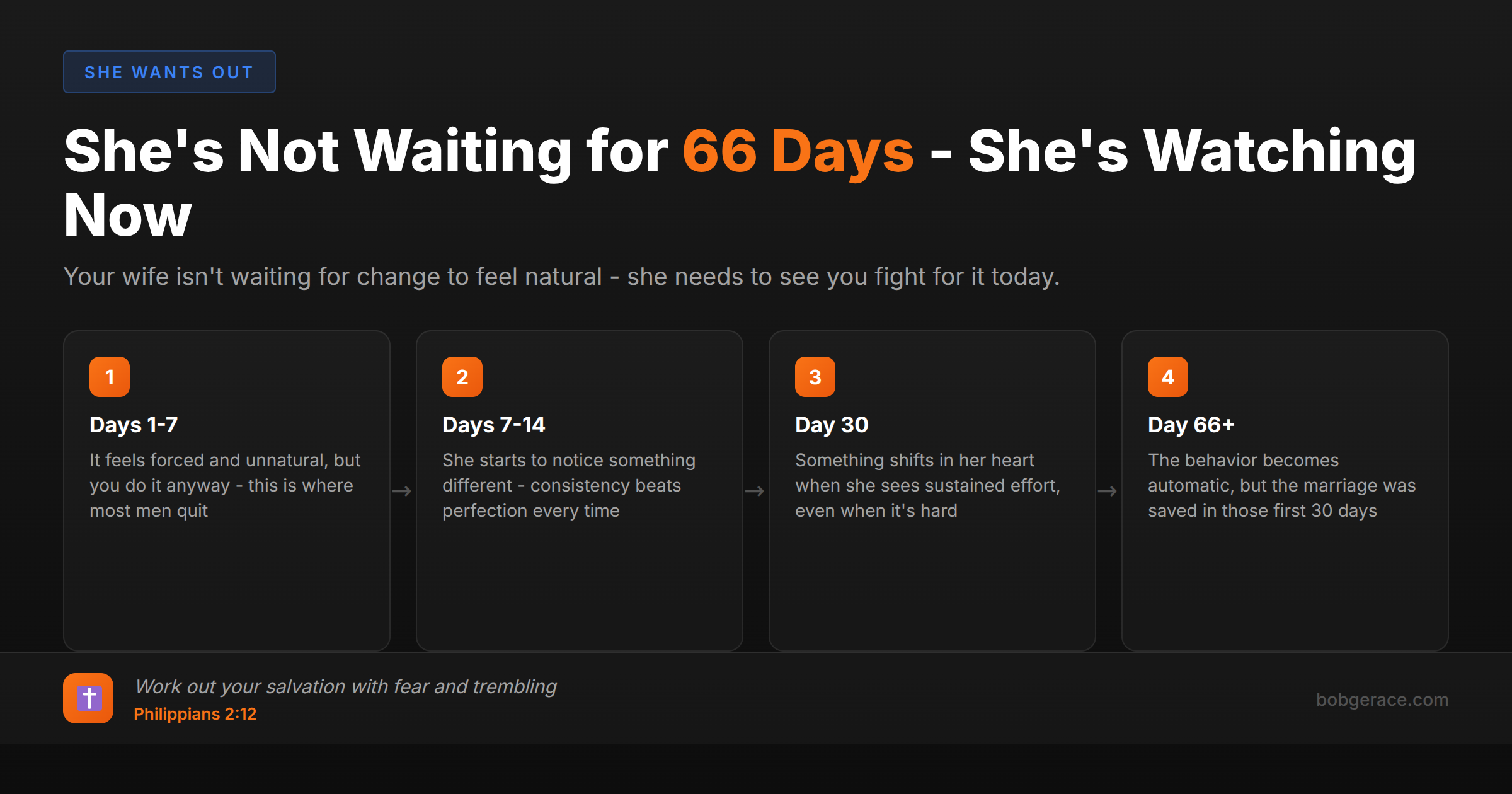
Here's the truth: research shows it takes anywhere from 21 to 254 days for a new behavior to become automatic, with the average being 66 days. But here's what matters more - your wife isn't waiting for your behaviors to become automatic. She's watching to see if you can sustain change right now, when it's still hard. The men who save their marriages understand this: consistency beats perfection every time. You don't need to wait two months to see results. When you show up differently for 7-14 consecutive days, she starts to notice. When you hit that 30-day mark of consistent new behavior, even when it feels forced, something shifts in her heart. The key isn't waiting for it to feel natural - it's doing it anyway, especially when it doesn't.
The Full Picture
The journey from conscious effort to automatic behavior follows a predictable pattern, but most men get it wrong. They think they need to fake it until they make it, but that's not what transforms marriages. Your wife can sense when you're just going through the motions.
The Three Stages of Behavior Change:
• Stage 1 (Days 1-21): Pure willpower. Everything feels forced and unnatural. This is where most men quit because it's exhausting and your wife might not even acknowledge the effort.
• Stage 2 (Days 22-66): The behavior starts feeling less foreign. You catch yourself doing it without thinking, but it still requires conscious choice.
• Stage 3 (Day 67+): True automaticity. The behavior becomes part of who you are, not something you do.
Here's what complicates this timeline: emotional stakes. When your marriage is on the line, your nervous system is activated. Stress hormones make habit formation harder. Simple behaviors like listening without defending might take longer than usual to stick.
Common mistakes men make: - Focusing on too many behaviors at once - Expecting immediate emotional rewards - Quitting when their wife doesn't immediately respond positively - Thinking automatic means effortless (it doesn't)
The behaviors that become automatic fastest are the ones tied to identity, not just action. When you shift from "I'm trying to be a better listener" to "I am someone who listens," the timeline accelerates dramatically.
What's Really Happening
Neuroplasticity research reveals why behavior change feels so difficult initially. When you attempt a new behavior, your brain literally creates new neural pathways while the old, established pathways remain strong. This creates what we call "neural competition" - your brain defaults to familiar patterns because they require less energy.
The 21-66-254 day range reflects individual differences in several key factors. Cognitive load plays a major role - complex behaviors requiring multiple steps take longer to automate. Emotional regulation is another critical factor. Men in marital crisis often struggle with heightened stress responses that interfere with learning consolidation.
Attachment theory provides crucial insight here. Men with anxious attachment styles often experience more internal resistance to behavior change because their nervous system interprets their wife's initial lack of response as confirmation of rejection. This creates a feedback loop that can extend the automaticity timeline.
Research in implementation intentions shows that behaviors become automatic faster when they're tied to specific environmental cues. Instead of "I'll listen better," the brain responds to "When my wife starts talking, I'll put down my phone and face her." This specificity creates what psychologists call "cue-response binding."
Dopamine patterns also influence this process. In early stages, you need external validation to maintain motivation. As behaviors become more automatic, internal satisfaction increases. Understanding this prevents men from abandoning positive changes when external rewards aren't immediate.
What Scripture Says
Scripture consistently emphasizes that transformation is both a divine work and human cooperation. Philippians 2:12-13 reminds us to "work out your salvation with fear and trembling, for it is God who works in you to will and to act in order to fulfill his good purpose." This perfectly captures the tension of behavior change - we must do the work while trusting God's power.
Romans 12:2 calls us to "be transformed by the renewing of your mind." The Greek word for "transformed" is metamorphoo - the same word used for a caterpillar becoming a butterfly. This isn't quick or easy. It's a complete restructuring that takes time and often feels uncomfortable.
Galatians 6:9 provides crucial encouragement for the long journey: "Let us not become weary in doing good, for at the proper time we will reap a harvest if we do not give up." God acknowledges that doing good - including loving your wife well - becomes wearying before it becomes natural.
1 Corinthians 9:27 shows Paul's understanding of the discipline required: "I strike a blow to my body and make it my slave so that after I have preached to others, I myself will not be disqualified." Even spiritual giants had to consciously choose right behaviors until they became ingrained.
Proverbs 27:17 reminds us that "iron sharpens iron, so one person sharpens another." The friction of behavior change, including your wife's initial skepticism, is actually part of God's refining process.
The biblical timeline isn't focused on when it gets easy, but on faithfulness during the difficulty. James 1:4 teaches that we should "let perseverance finish its work so that you may be mature and complete, not lacking anything."
What To Do Right Now
-
1
Choose ONE specific behavior to change and write it down with a specific environmental cue ("When she starts talking, I put down my phone")
-
2
Track your consistency for 30 days without focusing on her response - use a simple calendar check mark system
-
3
Identify your biggest obstacle to consistency and create a specific plan to overcome it before it happens
-
4
Set a daily reminder at the same time each day to consciously practice this behavior, even if no natural opportunity arises
-
5
Find an accountability partner who will check in weekly on your progress without letting you make excuses
-
6
Prepare a specific response for when you fail - write down exactly what you'll do the next day to get back on track
Related Questions
- What is 'white-knuckling' vs. real transformation?
- Why do old patterns come back when I'm triggered?
- What is 'neuroplasticity' and how do I leverage it?
- How do I rewire trauma responses?
- What are the 'stages of change' and where am I?
- Why do most change attempts fail?
- How long does it take to rewire the brain?
- What does neuroplasticity mean for adult change?
- What makes change sustainable vs. temporary?
- What role does repetition play?
Also find Bob on
Subscribe for weekly videos on Christian marriage.
Your Marriage Won't Wait for Automatic
A coach who knows your specific situation can tell you which behaviors to prioritize and how to stay consistent when it still feels forced. You don't have to guess what matters most to her.
Talk to Bob →