What's the difference between explaining and validating?
6 min read
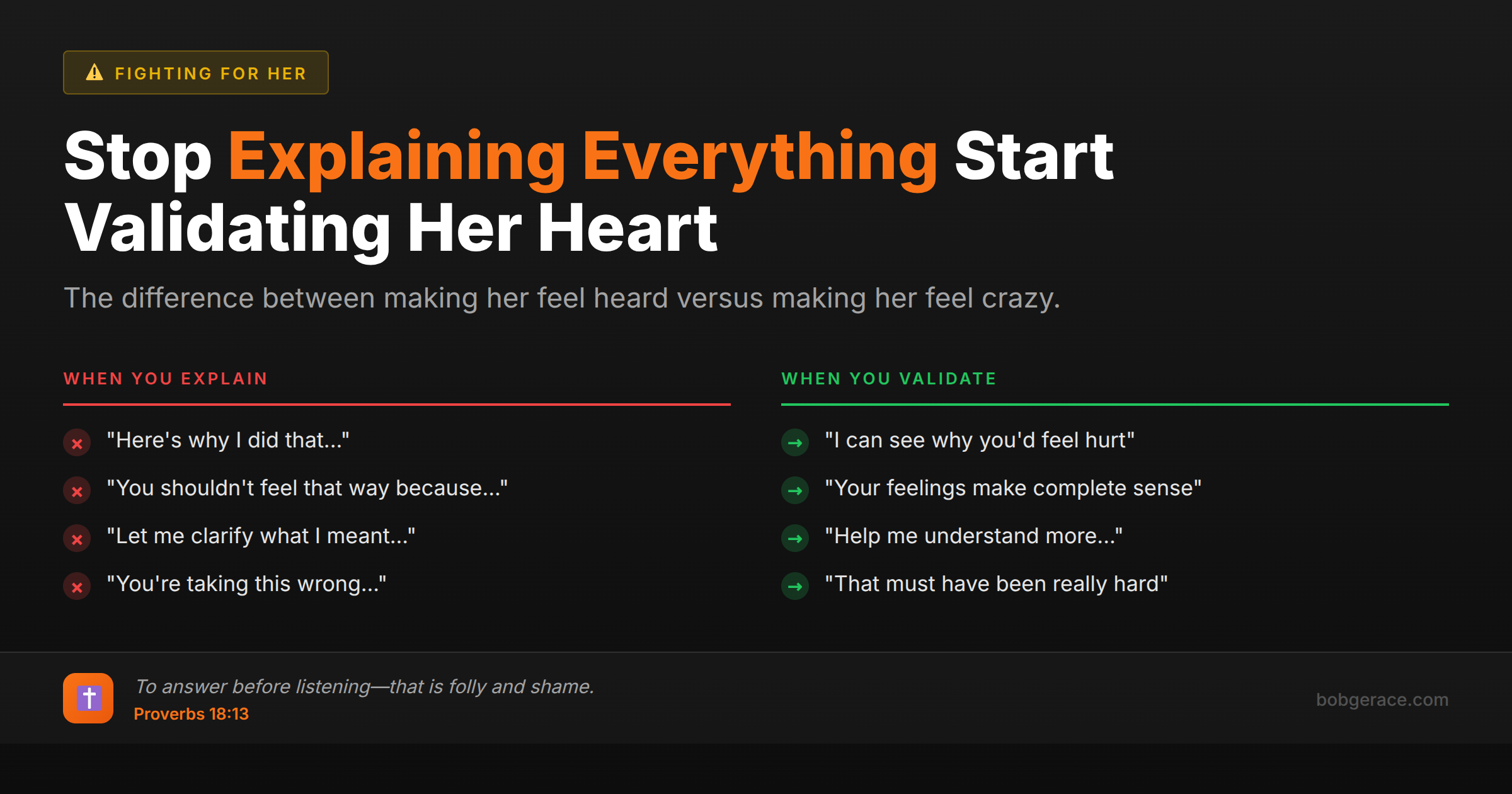
Explaining focuses on defending your actions or making your wife understand your perspective, while validation focuses on acknowledging and understanding her emotional experience. When you explain, you're essentially saying 'Here's why I did what I did' or 'You shouldn't feel that way because...' When you validate, you're saying 'I can see why you'd feel hurt by that' or 'Your feelings make complete sense given what happened.' The difference is crucial because explaining often makes your wife feel unheard and defensive, while validation helps her feel understood and opens the door for real connection and resolution.
The Full Picture
Here's what most husbands get wrong: they think their wife's emotional responses are problems to be solved with logic rather than hearts crying out to be understood. When your wife expresses hurt, disappointment, or frustration, your natural instinct might be to explain why she shouldn't feel that way or to defend your actions that led to her feelings.
Explaining sounds like: - "I didn't mean it that way" - "You're misunderstanding what happened" - "I was just trying to help when I..." - "That's not what I said" - "You're being too sensitive"
Validation sounds like: - "I can see how that hurt you" - "Your feelings make sense" - "I understand why you'd be frustrated" - "That must have felt really disappointing" - "Help me understand more about how that affected you"
The fundamental difference is this: explaining is about being right, while validation is about being connected. Explaining puts you in opposition to your wife's emotional experience, essentially arguing with her feelings. Validation puts you on the same team, working together to understand what happened and how to move forward.
When your wife feels invalidated repeatedly, she starts to shut down emotionally. She learns that sharing her feelings leads to arguments rather than understanding. This is often how wives begin to check out of marriages - not because of any single big event, but because of the accumulated weight of feeling chronically misunderstood and unheard.
What's Really Happening
From a clinical perspective, the difference between explaining and validating reflects two completely different neurological and emotional processes. When someone feels emotionally activated, their brain's limbic system is engaged, and they're not primarily seeking logical solutions - they're seeking emotional safety and connection.
Explaining activates what we call 'cognitive override' - you're essentially asking your wife's rational brain to override her emotional experience. This creates internal conflict and often intensifies the emotional activation rather than soothing it. It sends the message that her emotional reality is wrong or invalid.
Validation, on the other hand, works with the brain's natural emotional processing system. When someone feels truly heard and understood, it activates the parasympathetic nervous system, which naturally calms emotional arousal. This is why validation often leads to de-escalation, while explaining tends to escalate conflicts.
In attachment theory, we understand that validation builds secure connection while invalidation creates insecure attachment patterns. When wives consistently experience invalidation, they often develop what we call 'protest behaviors' - becoming more emotional, more demanding, or more critical in an attempt to finally be heard. If that doesn't work, they may move into 'despair and detachment' - which looks like checking out emotionally.
The key insight is that validation doesn't mean agreement. You can validate your wife's emotional experience while still having a different perspective on events. Validation is about emotional attunement, not factual agreement.
What Scripture Says
Scripture consistently emphasizes the importance of understanding and gentleness over being right or defending ourselves. Proverbs 18:13 warns us: "To answer before listening—that is folly and shame." When we rush to explain without first validating, we're answering before we've truly listened to our wife's heart.
James 1:19 gives us the perfect framework: "Be quick to listen, slow to speak and slow to become angry." Validation requires us to be quick to listen - not just to words, but to emotions and heart cries. Explaining often makes us quick to speak and defend ourselves.
The call to love our wives sacrificially means prioritizing their emotional well-being over our need to be understood or vindicated. 1 Peter 3:7 instructs husbands to "be considerate as you live with your wives, and treat them with respect as the weaker partner and as heirs with you of the gracious gift of life, so that nothing will hinder your prayers." Being considerate means being attentive to how our words and actions affect our wives emotionally.
Ephesians 4:29 reminds us that our words should "build others up according to their needs, that it may benefit those who listen." When your wife is hurting, what she needs is validation and understanding, not explanation and defense. Philippians 2:3-4 calls us to "consider others better than yourselves" and to look "not only to your own interests, but also to the interests of others."
Jesus himself modeled this perfectly - he didn't explain away people's pain or defend himself when criticized. Instead, he met people in their emotional reality with compassion and understanding.
What To Do Right Now
-
1
Stop explaining immediately - When your wife expresses hurt or frustration, resist the urge to defend or clarify. Just listen.
-
2
Reflect what you hear - Say back what you think she's feeling: 'It sounds like you felt really alone when that happened.'
-
3
Ask clarifying questions - 'Help me understand more about how that affected you' or 'What was the hardest part about that for you?'
-
4
Acknowledge impact without defending intent - 'I can see that my words hurt you, even though that wasn't my intention.'
-
5
Take responsibility for your part - After validating, own what you contributed: 'I was wrong to speak to you that way.'
-
6
Focus on moving forward together - 'What can I do differently next time?' or 'How can we handle this better in the future?'
Related Questions
- What is an 'apology' vs. 'repair' vs. 'attunement'?
- What is 'felt understanding' and how do I give it?
- Why didn't my past apologies work?
- What does she need to hear that I haven't said?
- What does genuine repair look like for old wounds?
- How do I address years of built-up hurt?
- How do I hear her without defending myself?
- What does 'taking responsibility' actually look like?
- How do I receive feedback without counter-attacking?
- What does non-defensive response look like?
Also find Bob on
Subscribe for weekly videos on Christian marriage.
Validation is hard when you're hurting too
A coach who knows your marriage can help you figure out what validation actually sounds like in your specific fights—not just the theory.
Talk to Bob →