What is the 'hero's journey' structure of change?
6 min read
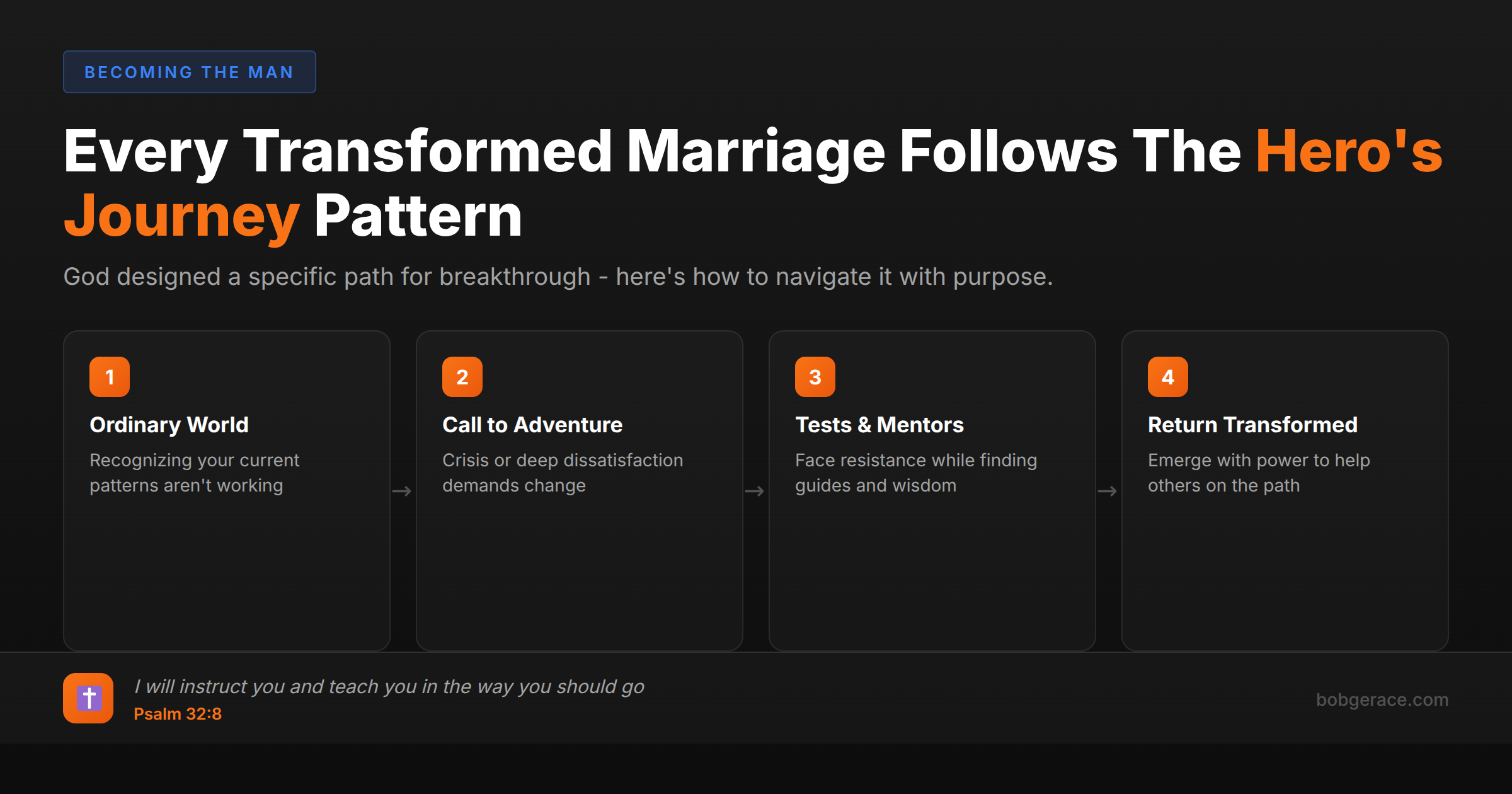
The hero's journey is a universal framework for transformation that perfectly describes how real change happens in marriage and personal growth. It starts with recognizing you're living in an ordinary world that isn't working, then receiving a call to adventure - usually through crisis or deep dissatisfaction. You'll face resistance, meet guides, encounter tests, experience a dark night of the soul, and ultimately return transformed with wisdom to help others. This isn't just storytelling theory - it's the actual pattern of how God designed us to grow. Every man who's transformed his marriage has walked this path, whether he knew it or not. Understanding these stages helps you navigate change with purpose instead of wandering aimlessly through your struggles.
The Full Picture
The hero's journey, identified by Joseph Campbell, is the universal pattern found in every great story - and more importantly, it's the pattern of how real transformation happens in your life and marriage.
Stage 1: The Ordinary World - This is your current reality. Maybe your marriage feels stuck, you're going through the motions, or you're constantly fighting. It's familiar but unsatisfying.
Stage 2: The Call to Adventure - Something disrupts your ordinary world. Your wife threatens divorce, you realize you're becoming someone you don't respect, or you simply can't tolerate the status quo anymore.
Stage 3: Refusal of the Call - Your first instinct is to resist. "It's not that bad," "She's the problem," "I don't have time for this." This resistance is normal but keeps you stuck.
Stage 4: Meeting the Mentor - You encounter wisdom - a coach, a book, a friend, Scripture - that shows you a different path forward.
Stage 5: Crossing the Threshold - You commit to change. You join a program, start counseling, or make a declaration that things will be different.
Stage 6: Tests, Allies, and Enemies - The real work begins. You'll face setbacks, find supporters, and confront internal and external opposition.
Stage 7: The Ordeal - This is your darkest moment when everything feels impossible and you want to quit.
Stage 8: The Reward - You breakthrough and gain new understanding, skills, or perspective.
Stage 9: The Road Back - You begin applying what you've learned in your daily life.
Stage 10: Return Transformed - You're no longer the same person who started this journey, and your marriage reflects this transformation.
What's Really Happening
From a psychological perspective, the hero's journey maps perfectly onto what we see in successful therapy and personal development. The 'ordinary world' represents homeostasis - the psychological state where you maintain familiar patterns, even dysfunctional ones, because they're predictable.
The 'call to adventure' is often a crisis that disrupts this homeostasis, creating what we call 'cognitive dissonance' - the uncomfortable tension between your current reality and your desired reality. This discomfort is actually essential for motivation to change.
The 'refusal of the call' reflects our natural resistance to change. The brain is wired to conserve energy and maintain familiar patterns. Even positive change requires tremendous mental and emotional resources, so resistance is neurologically normal.
The 'ordeal' stage corresponds to what therapists call the 'extinction burst' - when old patterns get worse before they get better as your psyche fights to maintain familiar dynamics. This is why many people quit right before breakthrough.
What makes this framework powerful is that it normalizes the difficulty of change while providing a roadmap. When clients understand they're in the 'ordeal' stage rather than failing at change, they're more likely to persist through the discomfort toward genuine transformation.
What Scripture Says
The hero's journey is woven throughout Scripture because it's how God transforms His people. Every major biblical figure follows this pattern.
Moses lived in comfort in Pharaoh's house (ordinary world) until he witnessed injustice and fled to the wilderness (call to adventure). When God called him from the burning bush, he refused repeatedly (refusal of the call) before finally accepting his mission to lead Israel to freedom.
*"But Moses said to God, 'Who am I that I should go to Pharaoh and bring the Israelites out of Egypt?'"* - Exodus 3:11
David was just a shepherd boy (ordinary world) when Samuel anointed him as the future king (call to adventure). He spent years fleeing from Saul, facing tests and trials, before finally becoming the king God intended.
*"The Lord will vindicate me; your love, Lord, endures forever - do not abandon the works of your hands."* - Psalm 138:8
Paul lived confidently as a Pharisee (ordinary world) until his dramatic encounter with Jesus on the Damascus road (call to adventure). His transformation required years in the wilderness before he emerged as Christianity's greatest evangelist.
*"Therefore, if anyone is in Christ, the new creation has come: The old has gone, the new is here!"* - 2 Corinthians 5:17
God doesn't just improve us - He transforms us completely. This requires leaving the familiar behind and trusting Him through the journey.
*"And we all, who with unveiled faces contemplate the Lord's glory, are being transformed into his image with ever-increasing glory, which comes from the Lord, who is the Spirit."* - 2 Corinthians 3:18
*"Do not conform to the pattern of this world, but be transformed by the renewing of your mind."* - Romans 12:2
*"Consider it pure joy, my brothers and sisters, whenever you face trials of many kinds, because you know that the testing of your faith produces perseverance."* - James 1:2-3
What To Do Right Now
-
1
Identify your current stage - Where are you in the hero's journey? Still in the ordinary world? Refusing the call? In the middle of tests?
-
2
Stop romanticizing the ordinary world - Write down specifically what's not working about your current patterns and why staying the same isn't acceptable
-
3
Answer the call clearly - Define what transformation looks like for you and your marriage in concrete, specific terms
-
4
Find your mentors - Identify books, coaches, counselors, or wise friends who can guide you through this journey
-
5
Prepare for the ordeal - Expect the darkest moment and commit now to pushing through when everything feels impossible
-
6
Plan your return - Envision how you'll use your transformation to help your wife, children, and other men on their own hero's journey
Related Questions
- What is 'transformational learning'?
- What role does crisis play in transformation?
- What does moving from unconscious incompetence to unconscious competence look like?
- What makes change sustainable vs. temporary?
- What's the difference between first-order and second-order change?
- What is 'identity-based change'?
- What is 'post-traumatic growth'?
- What can I learn from this crisis?
- Is this suffering formative or just painful?
- What legacy am I leaving them through this crisis?
Also find Bob on
Subscribe for weekly videos on Christian marriage.
Don't Navigate This Alone
You know the framework. A coach helps you apply it to your actual marriage—where you are right now, what's blocking you, what comes next.
Talk to Bob →