What parts of me resist change?
6 min read
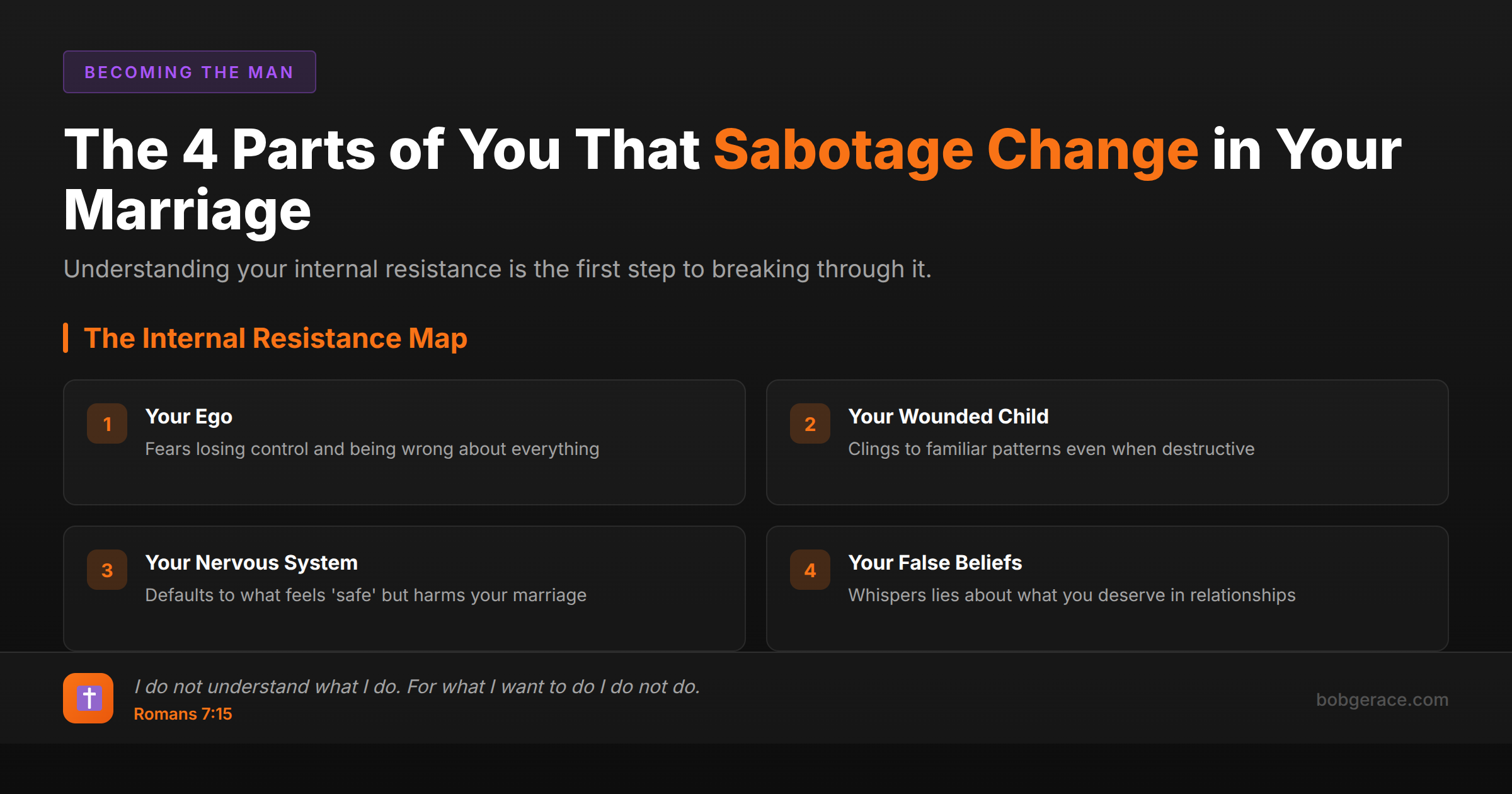
The parts of you that resist change are usually protective mechanisms developed over years of experience. Your ego fears losing control, your wounded inner child clings to familiar patterns even when they're destructive, and your nervous system automatically defaults to what feels 'safe' - even if that safety is actually harmful to your marriage. These resistant parts include your fear-based thinking patterns, your attachment to being 'right,' your comfort with predictable dysfunction, and your subconscious beliefs about what you deserve in relationships. Understanding these internal opponents isn't about shame - it's about gaining the awareness needed to move forward with intention rather than being hijacked by unconscious patterns.
The Full Picture
Change resistance isn't a character flaw - it's a normal human response that becomes problematic when it keeps you stuck in marriage-damaging patterns. Think of your psyche as having different 'parts,' each with its own agenda and survival strategy.
Your Ego desperately wants to maintain its sense of being right, competent, and in control. When change threatens this identity, your ego will manufacture justifications for why change is unnecessary, impossible, or someone else's responsibility. It whispers things like 'You're fine the way you are' or 'She's the one who needs to change.'
Your Inner Critic paradoxically resists change by convincing you that you're too fundamentally flawed to succeed. This part says 'You always mess up anyway, so why try?' It's protection through preemptive defeat - if you don't try, you can't fail.
Your Comfort-Seeking System craves predictability, even when that predictability is misery. Known misery feels safer than unknown possibilities. This part of you would rather stay in familiar dysfunction than risk the vulnerability required for growth.
Your Attachment System carries forward relationship patterns from childhood. If you learned that love comes with conditions, criticism, or abandonment, part of you may resist creating the healthy relationship you claim to want because it doesn't match your internal template for what love 'feels' like.
Your Nervous System has been conditioned by years of stress responses. If conflict, criticism, or emotional intensity has been your normal, your body literally doesn't know how to relax into peace and connection. It creates familiar chaos to return to a known state.
Recognizing these resistant parts isn't about judgment - it's about compassion and strategy. You can't change what you won't acknowledge.
What's Really Happening
From a clinical perspective, resistance to change operates through several psychological mechanisms that we can identify and address systematically. The most significant is what we call 'psychological homeostasis' - your mind's tendency to maintain equilibrium, even when that equilibrium is dysfunctional.
Your brain has literally wired itself around current patterns through repeated neural pathways. When you attempt change, you're essentially asking your brain to abandon superhighways of thought and behavior for barely-traveled dirt roads. The neurological 'cost' feels enormous, so your system rebels.
Secondary gain is another major factor. Despite conscious complaints about your patterns, these behaviors often serve hidden psychological needs. Maybe your anger gives you a sense of power, your withdrawal provides safety, or your criticism offers a feeling of superiority. Giving up these patterns means losing these secondary benefits, which creates subconscious resistance.
Trauma responses also create change resistance. If your nervous system learned that relationships equal danger, vulnerability feels life-threatening rather than growth-promoting. Your protective mechanisms aren't trying to sabotage your marriage - they're trying to keep you alive based on outdated threat assessments.
The key insight is that resistance isn't your enemy - it's information. Each resistant part is trying to protect something valuable: your sense of safety, identity, or worth. Effective change happens when we honor these protective impulses while gradually expanding their capacity to support rather than sabotage your growth. This requires patience, self-compassion, and often professional support to navigate the complexity of your internal landscape.
What Scripture Says
Scripture acknowledges the internal battle between our old nature and our new identity in Christ. Romans 7:15 captures this perfectly: *'I do not understand what I do. For what I want to do I do not do, but what I hate I do.'* Even Paul experienced the frustration of internal resistance to doing what he knew was right.
The Bible calls this our 'flesh' - not just physical desires, but the entire system of self-protective, self-centered patterns that resist God's transforming work. Galatians 5:17 explains: *'For the flesh desires what is contrary to the Spirit, and the Spirit what is contrary to the flesh. They are in conflict with each other, so that you are not to do whatever you want.'*
But God doesn't leave us powerless against this resistance. Romans 12:2 provides the pathway: *'Do not conform to the pattern of this world, but be transformed by the renewing of your mind. Then you will be able to test and approve what God's will is - his good, pleasing and perfect will.'* Transformation happens through mind renewal, not willpower alone.
Ezekiel 36:26 reveals God's ultimate solution: *'I will give you a new heart and put a new spirit in you; I will remove from you your heart of stone and give you a heart of flesh.'* God doesn't just command change - He provides the internal transformation that makes change possible.
2 Corinthians 5:17 reminds us of our new identity: *'Therefore, if anyone is in Christ, the new creation has come: The old has gone, the new is here!'* Your resistant parts aren't your truest identity - they're remnants of who you used to be.
Philippians 2:13 offers the ultimate encouragement: *'For it is God who works in you to will and to act in order to fulfill his good purpose.'* God isn't just asking you to change - He's working within you to create both the desire and the ability to transform.
What To Do Right Now
-
1
Map your resistance patterns by identifying which situations trigger your strongest internal pushback against positive change
-
2
Name your resistant parts with compassion - acknowledge what each protective mechanism is trying to accomplish for you
-
3
Start micro-changes that feel manageable rather than overwhelming your system with dramatic transformation attempts
-
4
Practice the 'pause and choose' technique when you feel resistance arising - create space between impulse and action
-
5
Invite God into your transformation process through daily prayer for a willing heart and renewed mind
-
6
Consider professional counseling to navigate complex trauma responses or deeply entrenched patterns that resist self-help approaches
Related Questions
- What is 'repetition compulsion'?
- What is the 'inner critic' and why does it sabotage?
- What is 'secondary gain' from destructive behavior?
- What does my pattern protect me from?
- What would I have to face if I actually changed?
- Why does 'trying harder' often backfire?
- What role did my childhood play in my anger patterns?
- What attachment injuries did I experience?
- What unmet needs from childhood am I still seeking?
- What is the role of the flesh vs. spirit?
Also find Bob on
Subscribe for weekly videos on Christian marriage.
Your resistance has a story
A coach who knows your marriage can help you see what's actually blocking you—and why those blocks made sense until now.
Talk to Bob →