What is the 'inner critic' and why does it sabotage?
6 min read
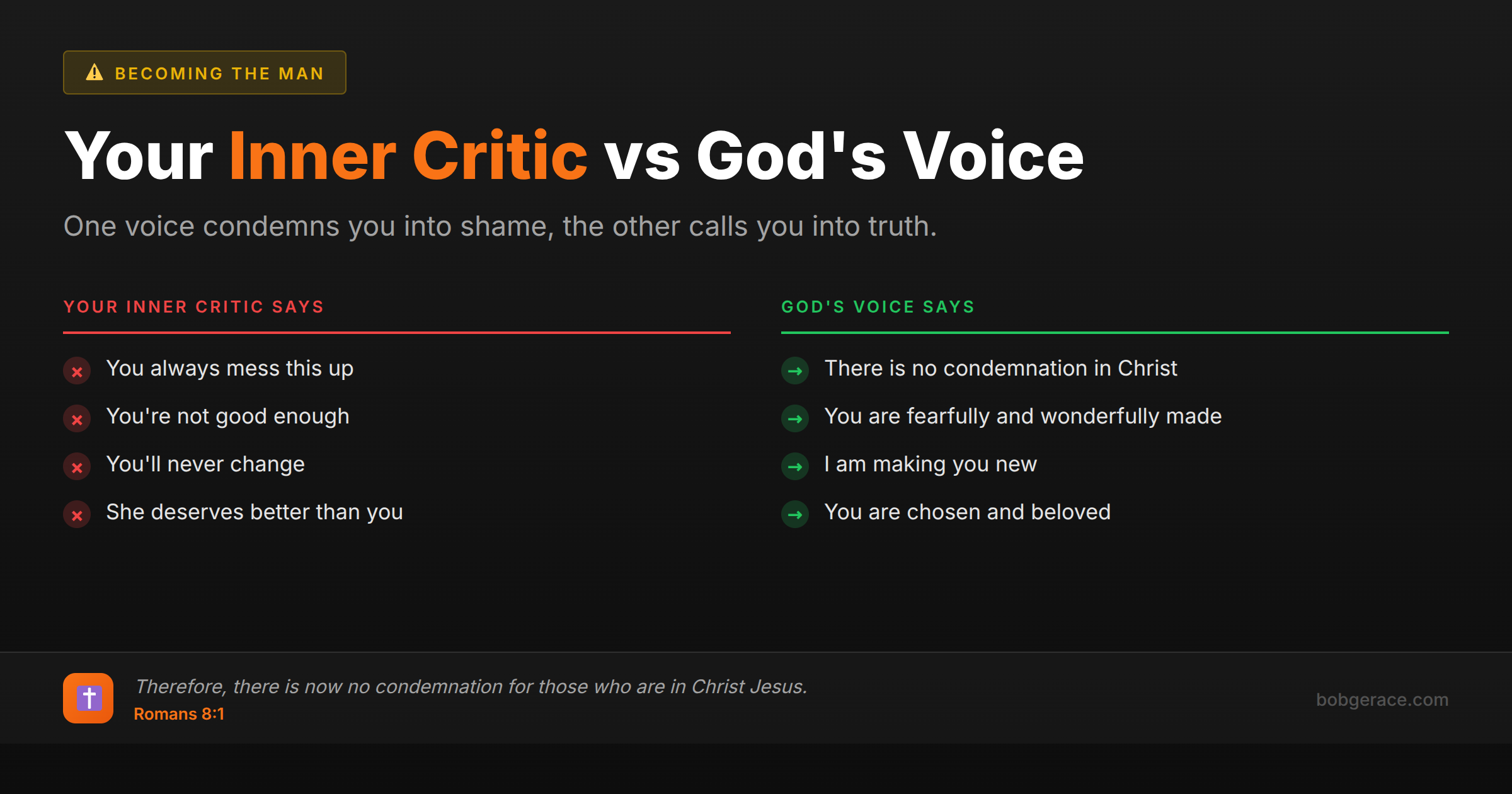
Your inner critic is that harsh internal voice that constantly judges, criticizes, and undermines your efforts - especially in marriage. It's the voice saying 'You always mess this up' or 'You're not good enough for your spouse.' This psychological mechanism developed as a misguided attempt to protect you from failure or rejection by pointing out flaws first. The inner critic sabotages because it operates from fear and shame rather than truth. It convinces you that harsh self-judgment will somehow make you better, but instead it creates a cycle of self-defeating behaviors. In marriage, this voice can cause you to withdraw when you need to connect, attack when you should listen, or give up when you should persevere.
The Full Picture
The inner critic isn't just occasional self-doubt - it's a persistent, often ruthless internal voice that has become your default way of relating to yourself. It sounds like this: 'You always say the wrong thing,' 'Your spouse deserves better,' 'You'll never change,' or 'Why even try?'
This voice typically formed early in life as a survival mechanism. Maybe you had critical parents, experienced rejection, or learned that being hard on yourself somehow kept you safe from others' criticism. The problem is, what once seemed protective has become destructive.
In marriage, the inner critic operates through several sabotaging patterns:
- Perfectionism paralysis - You avoid trying because nothing you do will be good enough - Defensive attacks - You criticize your spouse first to deflect anticipated criticism - Emotional withdrawal - You shut down to avoid the risk of being judged - Self-fulfilling prophecies - You act in ways that confirm your worst fears about yourself
The cruel irony is that the inner critic promises to make you better but actually makes you worse. It creates the very problems it claims to solve. When you believe its harsh assessments, you show up in your marriage from a place of shame and fear rather than love and confidence.
Understanding this pattern is crucial because you can't fight an enemy you don't recognize. Your inner critic has probably been so present for so long that you mistake its voice for objective truth rather than recognizing it as a distorted, fear-based commentary that needs to be challenged and replaced.
What's Really Happening
From a clinical perspective, the inner critic represents an internalized critical parent voice - what we call an 'introject' in psychotherapy. This isn't simply negative thinking; it's a complex psychological defense mechanism that developed to help you survive difficult relational environments.
The inner critic serves three primary psychological functions: First, it attempts to control outcomes by identifying problems before others do. Second, it maintains familiar patterns even when they're destructive - because familiar feels safe to our nervous system. Third, it keeps you small to avoid the perceived risk of standing out or being vulnerable.
Neurologically, chronic self-criticism activates your brain's threat detection system, keeping you in a state of hypervigilance that makes intimate connection nearly impossible. When your amygdala is constantly firing due to internal threats, you can't access the prefrontal cortex functions needed for empathy, perspective-taking, and emotional regulation.
In marriage therapy, I see how the inner critic creates what we call 'negative sentiment override' - where everything your spouse does gets filtered through a lens of criticism and suspicion. This happens because you're already doing it to yourself. We project our internal relationship patterns onto our external relationships.
The healing process requires understanding that the inner critic isn't 'you' - it's a learned voice that can be recognized, challenged, and gradually replaced with a more compassionate internal dialogue. This work is essential for marriage healing because you cannot love others well when you're at war with yourself.
What Scripture Says
Scripture reveals a radically different voice than your inner critic - the voice of a loving Father who speaks truth in love rather than condemnation in shame.
Romans 8:1 declares: *'Therefore, there is now no condemnation for those who are in Christ Jesus.'* This isn't just theological theory - it's meant to replace the condemning voice in your head. God's voice doesn't shame you into change; it calls you into your true identity.
1 John 3:20 offers profound insight: *'If our hearts condemn us, we know that God is greater than our hearts, and he knows everything.'* Your inner critic's harsh judgments don't represent God's heart toward you. When internal condemnation rises up, you can remember that God's knowledge of you is complete and His love remains unwavering.
Ephesians 4:29 provides the standard for internal dialogue: *'Do not let any unwholesome talk come out of your mouths, but only what is helpful for building others up according to their needs, that it may benefit those who listen.'* This principle applies to how you speak to yourself. Unwholesome self-talk grieves the Spirit just as much as unwholesome speech toward others.
Philippians 4:8 gives us the filter for healthy thinking: *'Finally, brothers and sisters, whatever is true, whatever is noble, whatever is right, whatever is pure, whatever is lovely, whatever is admirable—if anything is excellent or praiseworthy—think about such things.'* Your inner critic fails every one of these tests.
2 Corinthians 10:5 calls us to *'take captive every thought to make it obedient to Christ.'* This means actively challenging the inner critic's voice and replacing it with Christ's voice of truth, love, and hope.
The goal isn't positive self-talk - it's learning to hear and trust the voice of your loving Father who calls you beloved, chosen, and equipped for the good works He's prepared for you, including loving your spouse well.
What To Do Right Now
-
1
Identify your inner critic's specific phrases - Write down the exact words it uses most often (like 'You always...' or 'You never...')
-
2
Challenge its accuracy - Ask 'Is this completely true?' and 'Would I say this to someone I love?' whenever you notice the critical voice
-
3
Replace criticism with truth - For each critical statement, write a truthful, balanced alternative based on God's Word and reality
-
4
Practice self-compassion - Speak to yourself the way a loving parent would speak to a struggling child
-
5
Confess the pattern to your spouse - Share how your inner critic affects your marriage and ask for their patience as you work to change
-
6
Seek professional help - Consider counseling to address the root sources of your inner critic, especially if it's severely impacting your marriage
Related Questions
Ready to Silence the Inner Critic?
Don't let self-sabotage destroy your marriage. Get the personalized guidance you need to break free from destructive patterns.
Get Help Now →