What's the difference between fixing and transforming?
6 min read
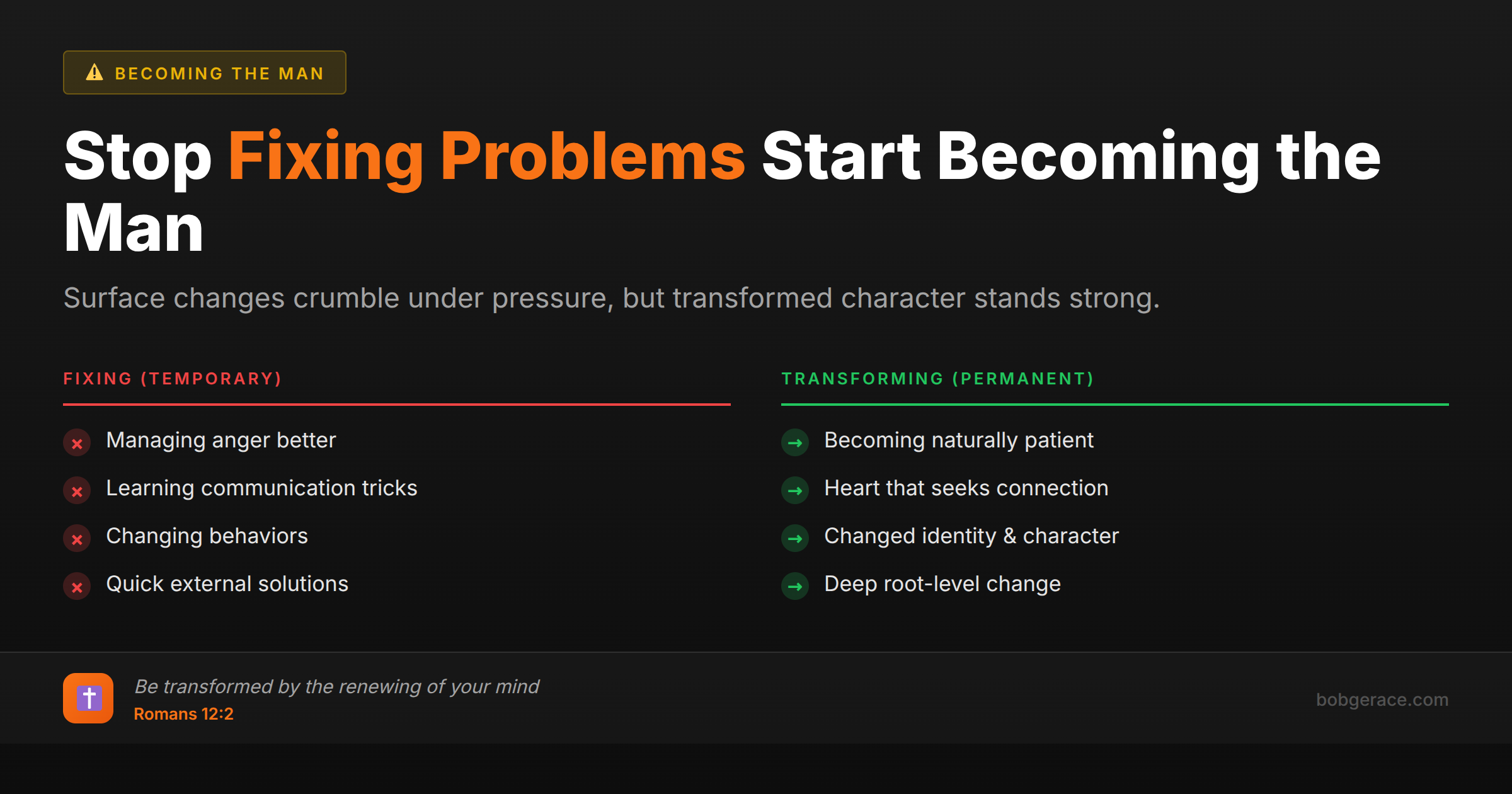
Fixing focuses on external behaviors and quick solutions - like putting a bandage on a wound. You might fix your communication skills or fix your anger problem, but the core issues remain untouched. It's surface-level change that often doesn't last because the root hasn't changed. Transformation goes to your identity and character. Instead of just managing anger better, transformation changes you into a man who naturally responds with patience. Instead of learning communication techniques, you become a man whose heart naturally seeks to understand and connect. Fixing asks 'How do I stop doing this?' Transformation asks 'Who do I need to become?' The difference is the depth and permanence of change.
The Full Picture
Most men come to marriage coaching wanting to fix their relationship problems. They want techniques, strategies, and quick solutions. They think if they can just stop arguing, start communicating better, or manage their emotions more effectively, everything will be fine. But here's what I've learned after coaching hundreds of men: fixing rarely creates lasting change.
Fixing is external and temporary. It's like painting over rust - it looks better for a while, but the corrosion is still eating away underneath. You might successfully implement new communication rules or anger management techniques, but when stress hits or circumstances change, you default back to your old patterns because the core of who you are hasn't changed.
Transformation is internal and permanent. It's about becoming a different kind of man at the identity level. When you transform, you don't just learn new behaviors - you develop a new nature that naturally produces different behaviors. A transformed man doesn't need to remember to be patient; patience flows from who he's become.
Think of it this way: fixing is like teaching a pig to act like a eagle. You might get some temporary flight, but eventually, the pig's nature takes over. Transformation actually changes the pig into an eagle. The behaviors change because the nature has changed.
This is why so many marriage improvement efforts fail. Couples go to workshops, learn new techniques, see temporary improvement, then gradually slide back into old patterns. They were trying to fix when they needed to transform. The good news? Transformation is absolutely possible, but it requires a different approach than most men expect.
What's Really Happening
From a psychological perspective, the difference between fixing and transforming lies in where change occurs in the brain and personality structure. Fixing typically engages our prefrontal cortex - the conscious, rational part of our brain. This is where we learn new techniques, apply willpower, and make conscious behavioral adjustments. While this can produce short-term changes, it's exhausting and unsustainable because it requires constant conscious effort.
Transformation, however, involves deeper neuroplasticity changes that reach our limbic system and automatic response patterns. This is where our core beliefs, emotional reactions, and unconscious habits reside. When transformation occurs at this level, new behaviors become automatic and natural rather than forced.
Research in attachment theory shows us that our relational patterns are often established in early childhood and become part of our implicit memory system. Simply learning new communication skills (fixing) doesn't address these deep-seated patterns. True transformation requires what we call 'earned security' - a process where new relational experiences literally rewire our attachment system.
This is why transformation takes time and often involves emotional processing, not just behavioral modification. The men who experience lasting change in their marriages are those who allow themselves to examine and reshape their core beliefs about themselves, relationships, and their role as husbands. They don't just learn new skills; they develop new internal working models that automatically generate healthier responses.
What Scripture Says
Scripture consistently points us toward transformation rather than mere behavioral modification. The Bible calls this process sanctification - the ongoing work of becoming more like Christ in character, not just in actions.
Romans 12:2 says, *"Do not conform to the pattern of this world, but be transformed by the renewing of your mind."* The Greek word for transformed here is *metamorphoo* - the same word used to describe a caterpillar becoming a butterfly. It's not improvement; it's complete change of nature.
2 Corinthians 3:18 tells us, *"And we all, who with unveiled faces contemplate the Lord's glory, are being transformed into his image with ever-increasing glory."* This is identity-level change - becoming a different kind of person, not just behaving differently.
Ezekiel 36:26 reveals God's method: *"I will give you a new heart and put a new spirit in you; I will remove from you your heart of stone and give you a heart of flesh."* God doesn't just modify our behavior; He changes our hearts - the core of who we are.
Galatians 5:22-23 describes the *"fruit of the Spirit: love, joy, peace, patience, kindness, goodness, faithfulness, gentleness, self-control."* Notice these aren't techniques to practice but character qualities that naturally flow from a transformed heart.
The biblical pattern is clear: God works from the inside out. He changes our nature, which then produces changed behavior. This is why Jesus focused on heart transformation, saying in Matthew 15:19, *"For out of the heart come evil thoughts, murder, adultery, sexual immorality, theft, false testimony, slander."* Change the heart, change the life.
What To Do Right Now
-
1
Stop asking 'How can I fix this?' and start asking 'Who do I need to become?' when facing marriage challenges
-
2
Identify one character quality you need to develop (patience, kindness, faithfulness) rather than just a behavior to change
-
3
Spend time in prayer asking God to reveal the heart issues behind your surface behaviors
-
4
Begin studying the life of Christ to understand what transformed masculinity actually looks like
-
5
Find other men who are pursuing transformation and build accountability around becoming, not just doing
-
6
Commit to the long-term process, knowing that transformation takes time but produces lasting results
Related Questions
- How do I change from the inside out?
- What does real transformation look like?
- Why do behavior changes alone not work?
- What is 'identity-based change'?
- What makes change sustainable vs. temporary?
- What is sanctification?
- What does genuine repair look like for old wounds?
- How do I know if he's really changing?
- What are the markers of genuine behavior change?
- What is 'white-knuckling' vs. real transformation?
Also find Bob on
Subscribe for weekly videos on Christian marriage.
You Don't Have to Figure This Out Alone
Coaching means a human who knows your marriage, sees where you actually are, and helps you become the man this situation needs. Not generic advice.
Talk to Bob →