What does 'sins of the fathers' mean?
6 min read
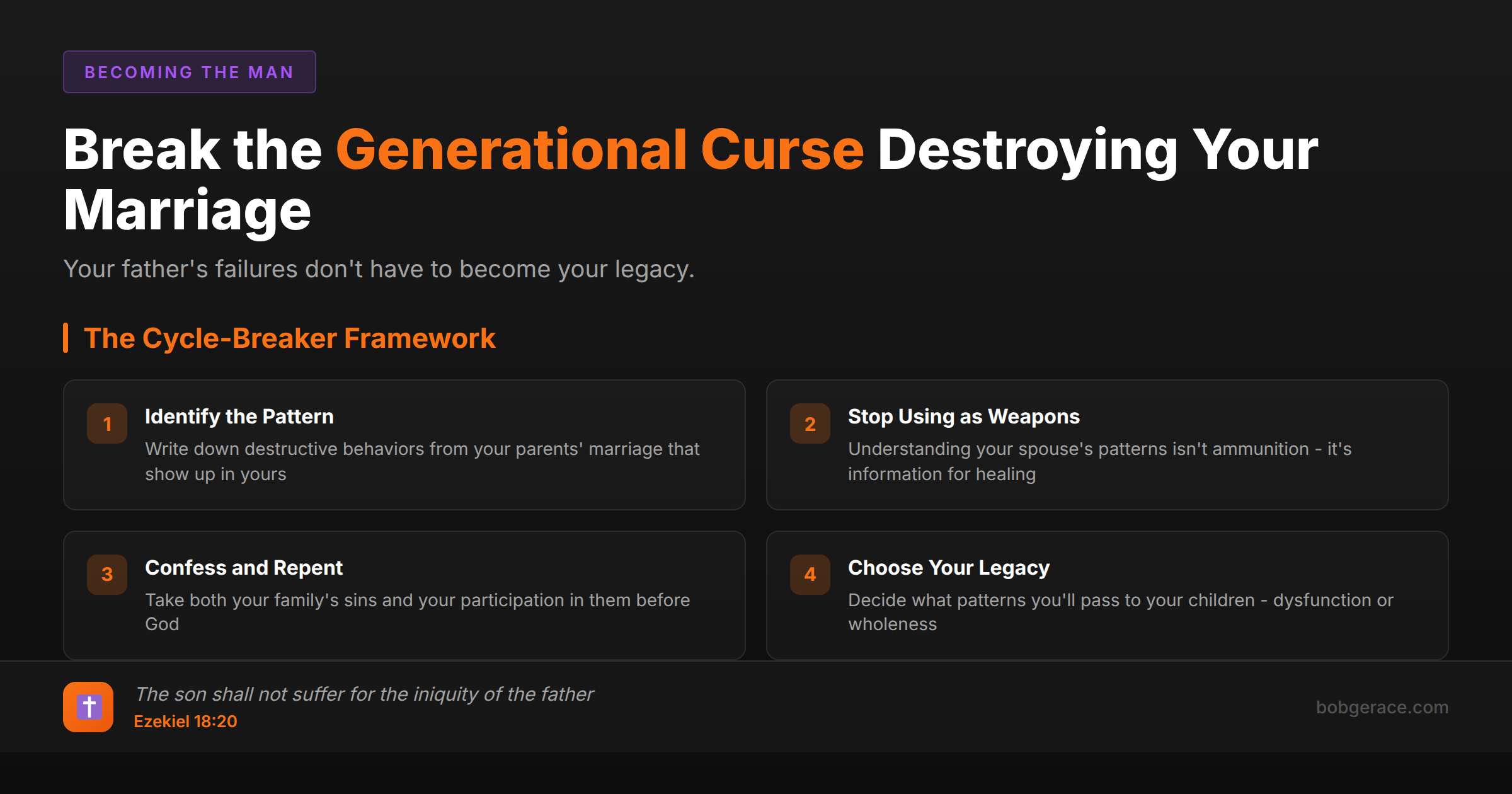
The 'sins of the fathers' refers to destructive patterns, behaviors, and spiritual bondages that get passed down through family lines. It's not about God punishing innocent children for their parents' mistakes - it's about the reality that dysfunction breeds dysfunction. When fathers (and mothers) operate in sin, selfishness, or brokenness, they model and create environments that shape their children in harmful ways. This shows up powerfully in marriage. Maybe your dad was emotionally absent, so you struggle with intimacy. Maybe your mom was controlling, so you either repeat that pattern or swing to the opposite extreme. These aren't excuses - they're explanations that help you understand why you keep sabotaging your marriage despite your best intentions.
The Full Picture
Here's what's really happening: generational patterns are real, but they're not permanent sentences. The biblical concept of 'visiting the iniquity of the fathers upon the children' (Exodus 20:5) isn't about divine vindictiveness - it's about the natural consequences of sin and brokenness rippling through family systems.
Think about it practically. An alcoholic father doesn't just hurt himself - he creates an environment of unpredictability, emotional neglect, and often trauma for his children. Those kids grow up with attachment wounds, trust issues, and often either become alcoholics themselves or marry alcoholics. The sin pattern continues not because God is punishing them, but because hurt people hurt people.
In marriage, these patterns show up everywhere. The man whose father was a workaholic finds himself emotionally unavailable to his wife. The woman whose mother was hypercritical becomes either a people-pleaser or incredibly defensive. The couple whose parents divorced multiple times between them struggle to believe marriage can actually work.
But here's the crucial truth: recognition is the first step to freedom. When you understand that your marriage struggles aren't just 'your fault' but are rooted in generational dysfunction, it gives you both compassion for yourself and a clear target for change. You're not fighting vague 'communication issues' - you're fighting specific inherited patterns that can be identified, confronted, and broken through Christ's power.
What's Really Happening
From a clinical perspective, generational transmission of dysfunction happens through multiple pathways. Attachment theory shows us how early parent-child relationships create internal working models of relationships that we unconsciously carry into marriage. Family systems theory reveals how roles, rules, and patterns get passed down through generations like invisible blueprints.
Neurologically, children's brains literally develop around their family environment. Chronic stress, emotional neglect, or trauma actually shapes brain architecture, affecting everything from emotional regulation to trust capacity. This isn't about blame - it's about understanding how God designed us to be shaped by our relationships.
I see this constantly in my practice. The husband who 'shuts down' during conflict often learned in childhood that expressing emotions led to punishment or abandonment. The wife who becomes anxious when her husband is quiet learned that silence meant danger was coming. These aren't character flaws - they're adaptive strategies that once helped them survive but now sabotage their marriage.
The good news? Adult brains maintain neuroplasticity - the ability to form new neural pathways. Through consistent new experiences in a safe relationship, proper therapy, and spiritual transformation, these patterns can absolutely change. But first, you have to stop treating the symptoms and start addressing the generational roots.
What Scripture Says
Scripture is clear about both the reality of generational patterns and God's power to break them. Exodus 20:5 states that God 'visits the iniquity of the fathers upon the children to the third and fourth generation,' but verse 6 immediately follows with showing 'mercy to thousands of those who love me and keep my commandments.' The emphasis is on God's desire to break these cycles.
Ezekiel 18:20 makes it clear: 'The soul who sins shall die. The son shall not suffer for the iniquity of the father.' You're not doomed by your family history. 1 Corinthians 15:22 shows the contrast: 'As in Adam all die, so in Christ all shall be made alive.' Christ came specifically to break the ultimate generational curse - death itself.
2 Corinthians 5:17 declares that 'if anyone is in Christ, he is a new creation; old things have passed away; behold, all things have become new.' This includes generational bondages. Galatians 3:13-14 tells us 'Christ has redeemed us from the curse of the law... that the blessing of Abraham might come upon the Gentiles in Christ Jesus.'
The key is found in Joshua 24:15: 'Choose for yourselves this day whom you will serve... But as for me and my house, we will serve the Lord.' You have the power to choose differently. Your family history explains your struggles but doesn't excuse your choices. Through Christ's power, you can be the generation that breaks the cycle and establishes a new legacy for your children.
What To Do Right Now
-
1
Identify the patterns: Write down specific destructive behaviors or emotional patterns you see in your parents' marriage and your own. Be honest but not self-condemning.
-
2
Stop the blame game: Recognize these patterns in yourself and your spouse without using them as weapons. Understanding isn't ammunition - it's information for healing.
-
3
Confess and repent: Take your generational patterns before God. Confess both your family's sins and your own participation in continuing them.
-
4
Declare freedom in Christ: Speak Scripture over your marriage. Declare that Christ has broken every generational curse and that you're choosing a new path.
-
5
Create new patterns: Actively practice new behaviors. If your family avoided conflict, learn healthy conflict resolution. If they were emotionally distant, practice vulnerability.
-
6
Get help if needed: Some generational patterns require professional intervention. Don't let pride keep you trapped in cycles that therapy and biblical counseling can help break.
Related Questions
- How do generational patterns work spiritually?
- What is 'intergenerational transmission'?
- What patterns did I inherit vs. choose?
- What role did my childhood play in my anger patterns?
- How do I honor my parents while breaking from their patterns?
- What is the role of deliverance vs. sanctification?
- What does healing from the past require spiritually?
- What legacy am I leaving them through this crisis?
- What is 'family of origin' work?
Also find Bob on
Subscribe for weekly videos on Christian marriage.
Breaking the Pattern in Your Marriage
You see the cycle. A coach who knows your story can help you interrupt it where it's actually showing up—in your specific marriage, with your wife, today.
Talk to Bob →