What is a 'natural consequence' vs. 'punishment'?
6 min read
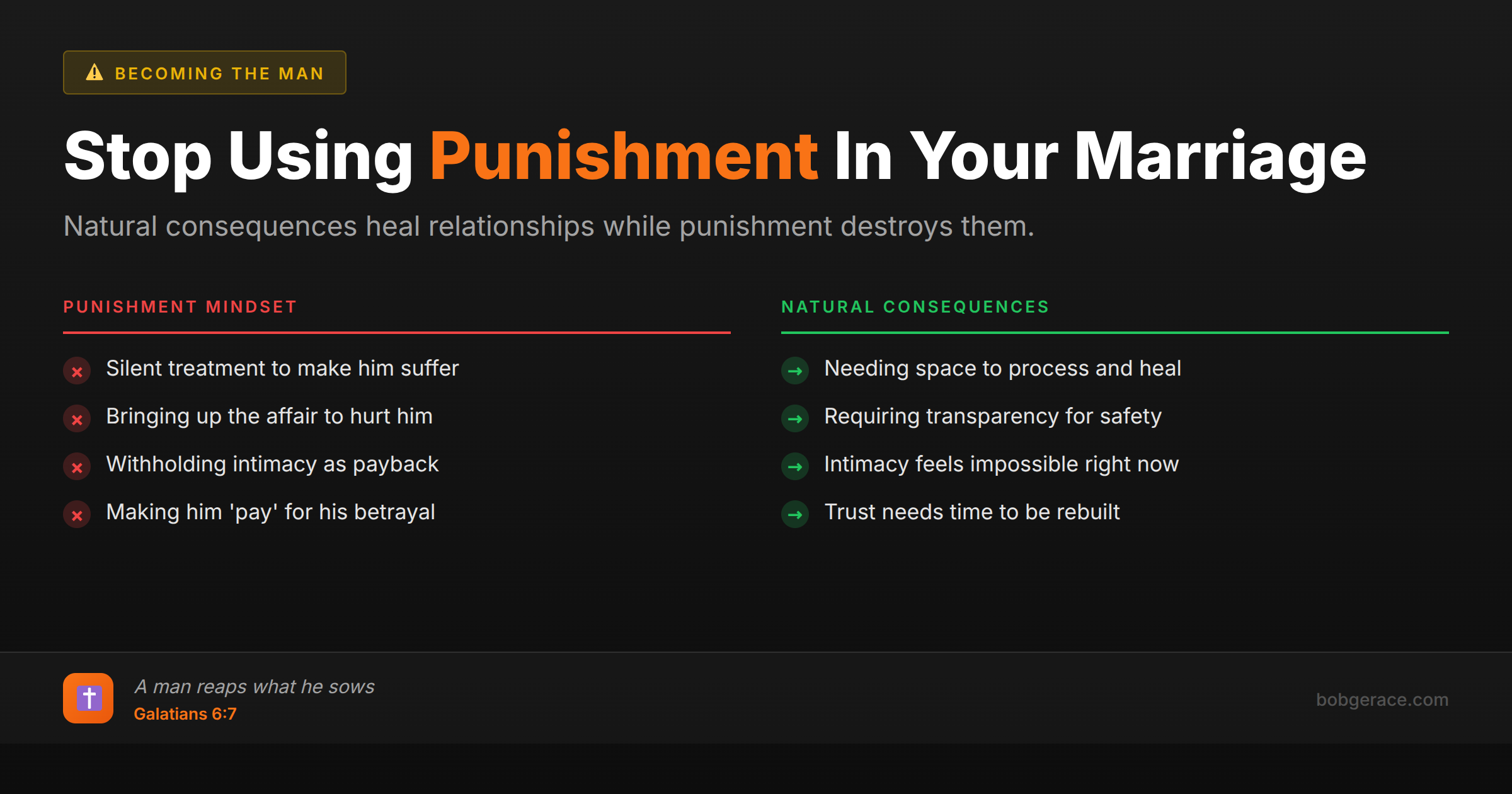
A natural consequence flows directly from someone's choices - it's what happens naturally when trust is broken. If your husband chooses to have an affair, the natural consequence might be that you need space to process, or that intimacy feels impossible right now. You're not creating these consequences; they're the organic result of his actions. Punishment, on the other hand, is something you impose to make him suffer or 'pay' for what he's done. It's driven by anger and aims to cause pain. Natural consequences protect you and your marriage; punishment seeks revenge. Understanding this difference is crucial because natural consequences actually help restore trust and safety, while punishment usually pushes people further apart and prevents genuine healing.
The Full Picture
When your marriage is rocked by infidelity, one of the hardest things to navigate is how to respond. You're hurt, angry, and rightfully so. But there's a world of difference between allowing natural consequences to unfold and punishing your spouse - and that difference can determine whether your marriage heals or dies.
Natural consequences are automatic. They happen because trust has been broken, not because you're trying to make someone pay. When your husband has an affair, you naturally feel unsafe. You might not want to be intimate. You might need him to sleep in another room. You might feel like you can't share vulnerable parts of your heart right now. These aren't punishments you're imposing - they're the natural fallout of broken trust.
Punishment, however, is intentional payback. It's withholding affection specifically to hurt him. It's bringing up his failure in unrelated arguments. It's making him grovel or jump through hoops not because it rebuilds safety, but because you want him to suffer. Punishment says, "You hurt me, so now I'm going to hurt you."
Here's what makes this so tricky: both can look identical from the outside. In both cases, you might be sleeping separately, withholding intimacy, or keeping emotional distance. The difference is in your heart and your intention.
Natural consequences protect and restore. They create the space needed for healing. They're temporary boundaries that allow trust to be rebuilt safely. Punishment, on the other hand, often becomes a permanent way of relating that slowly kills whatever chance the marriage had of recovery.
The key question isn't "What is he experiencing?" but "Why am I doing this?" Are you creating distance because you genuinely need safety and space to heal? Or are you creating distance because you want him to hurt the way you hurt? Your motivation matters more than you might think.
What's Really Happening
From a therapeutic standpoint, the distinction between natural consequences and punishment represents two fundamentally different neurological and emotional processes. When we operate from natural consequences, we're engaging our prefrontal cortex - the part of the brain responsible for rational decision-making and long-term planning. When we punish, we're typically operating from our limbic system - the emotional, reactive part of the brain.
Natural consequences emerge from what we call 'authentic emotional responses.' If you can't be intimate because you don't feel safe, that's your nervous system protecting you. It's adaptive and healthy. Your body and mind are responding appropriately to a threat to your emotional and relational safety.
Punishment, however, often stems from what we term 'strategic emotional responses' - using your emotions and reactions to manipulate or control your partner's behavior. This creates what psychologists call a 'pursuer-distancer' dynamic that actually reinforces the very behaviors you're trying to eliminate.
The neurological difference is significant. Natural consequences allow both partners' nervous systems to gradually regulate and return to baseline. The betrayed spouse gets the safety they need, and the unfaithful spouse experiences the authentic impact of their choices without feeling manipulated or controlled.
Punishment, conversely, keeps both partners' nervous systems dysregulated. It creates a cycle of reactivity that prevents the deeper emotional processing necessary for genuine recovery. The betrayed spouse remains stuck in fight-or-flight mode, and the unfaithful spouse often becomes defensive or withdrawn, making authentic remorse and behavior change less likely.
Recovery requires both partners to move from reactive patterns to responsive ones. Natural consequences facilitate this shift; punishment prevents it.
What Scripture Says
Scripture gives us clear guidance on how to handle wrongdoing in relationships, and it consistently points us toward restoration rather than retribution. The Bible acknowledges both justice and mercy, but always with the goal of healing and reconciliation.
Galatians 6:7 reminds us that "a man reaps what he sows." This is the biblical foundation for natural consequences - actions have organic, God-ordained results. When someone breaks trust, the natural harvest of that choice is broken relationship, lost intimacy, and damaged connection. You don't need to manufacture these consequences; they're built into God's design for how relationships work.
Romans 12:19 warns us against taking revenge: "Do not take revenge, my dear friends, but leave room for God's wrath, for it is written: 'It is mine to avenge; I will repay,' says the Lord." This doesn't mean there are no consequences, but it means the consequences should serve restoration, not retribution. God handles the justice; we handle the healing.
Matthew 18:15-17 gives us the framework for addressing sin in relationships. Notice that each step is designed to restore the relationship, not to punish the wrongdoer. Even the final step - treating them "as you would a pagan or tax collector" - is about protecting yourself and the community, not about making them suffer.
1 Corinthians 13:5 tells us that love "keeps no record of wrongs." This doesn't mean we ignore wrongdoing or pretend it didn't happen. It means we don't stockpile ammunition for future punishment. Natural consequences address the present reality; punishment dwells in past pain.
Ephesians 4:26-27 instructs us to "be angry and do not sin; do not let the sun go down on your anger." Anger is appropriate when trust is violated, but we're called to handle that anger in ways that don't give the devil a foothold. Punishment often becomes that foothold - a way for bitterness and revenge to take root in our hearts.
God's heart is always toward redemption and restoration. Natural consequences serve that purpose; punishment usually opposes it.
What To Do Right Now
-
1
Pause before every boundary decision and ask: 'Am I doing this to protect myself and our marriage, or to hurt him?'
-
2
Identify what you genuinely need to feel safe right now - separate sleeping arrangements, access to his phone, counseling - and communicate these as needs, not demands
-
3
Stop any behaviors motivated by making him 'pay' for his betrayal - silent treatment, bringing up the affair in unrelated arguments, deliberate coldness
-
4
Set a time limit on major consequences like sleeping separately - 'I need two weeks to process' rather than indefinite punishment
-
5
Communicate your authentic feelings without threats: 'I don't feel emotionally safe being intimate right now' instead of 'You'll never touch me again'
-
6
Pray daily for your own heart, asking God to help you distinguish between protecting yourself and punishing him
Related Questions
- What boundaries should I set?
- What's the difference between boundary and ultimatum?
- What makes boundaries effective vs. empty threats?
- How do I set boundaries without controlling?
- What does 'holding space' while 'holding boundary' look like?
- How do I stay connected while enforcing boundaries?
- What does forgiveness require regarding consequences?
- What does grace look like practically?
- What is redemptive discipline vs. punitive discipline?
- Does forgiveness mean no consequences?
Also find Bob on
Subscribe for weekly videos on Christian marriage.
Not Sure Where the Line Is in Your Marriage?
A coach who knows your story can help you see what's a boundary and what's retaliation — and how to hold the line without becoming someone you don't recognize.
Talk to Bob →