Is she triggered or is this a rational decision?
6 min read
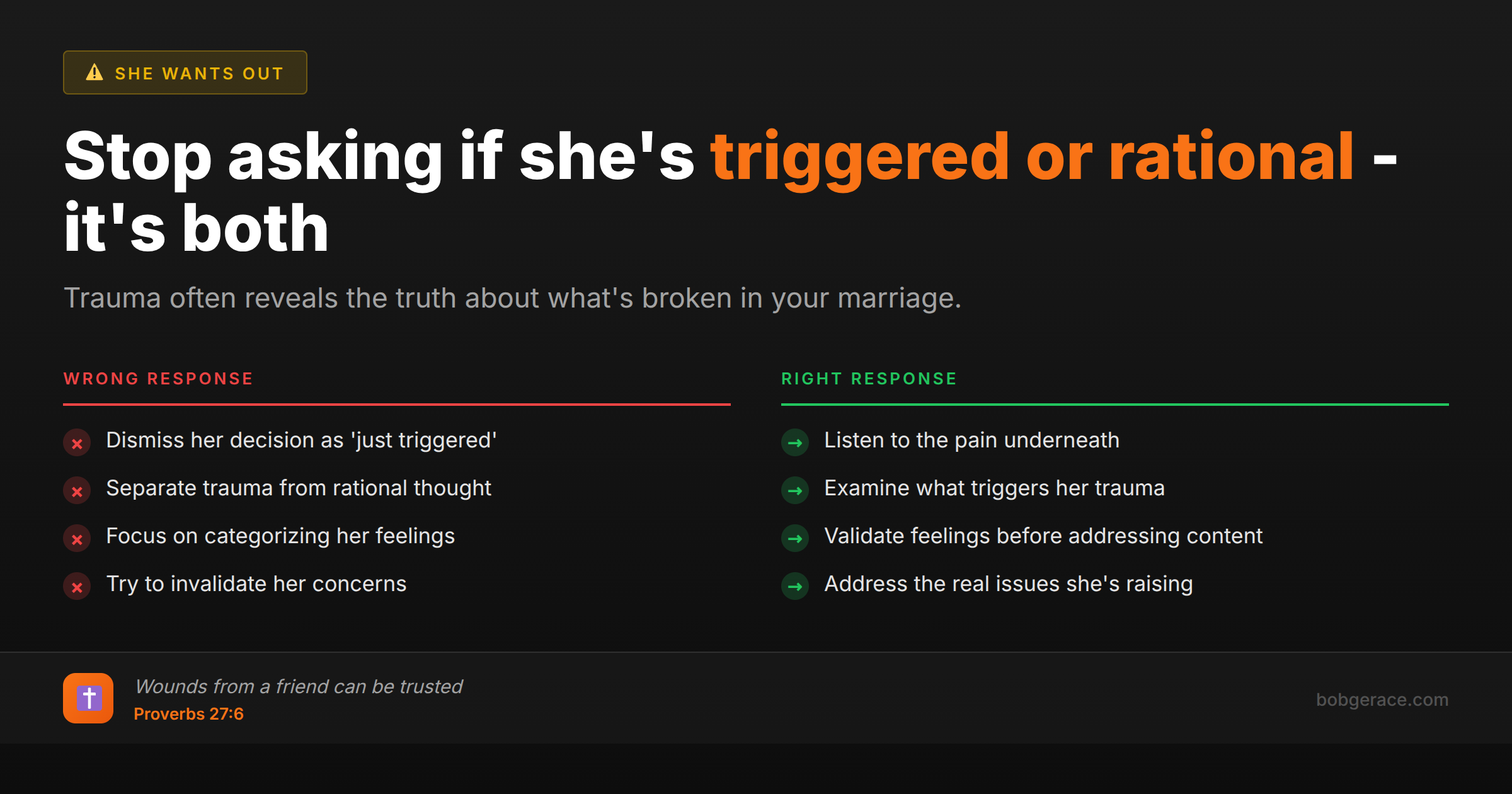
Here's the hard truth: it's probably both. Your wife's decision likely has elements of trauma response AND rational thought, and trying to separate them completely misses the point. Even if trauma is influencing her decision, that doesn't make her feelings invalid or her concerns untrue. What matters more than whether she's "triggered" is understanding that trauma often reveals truths about what she's experienced in your marriage. If past wounds are being activated, ask yourself what in your relationship is creating that activation. The goal isn't to dismiss her decision as "just trauma" but to understand the deeper pain driving it and address the real issues underneath.
The Full Picture
The question of whether your wife is triggered or making a rational decision creates a false dichotomy. Most major life decisions, especially those involving relationships, combine emotional, psychological, and rational elements. When trauma is involved, it doesn't negate the validity of her concerns—it often amplifies awareness of real problems.
Trauma responses can include: • Hypervigilance about relationship threats • Intense emotional reactions to perceived abandonment • Fight-or-flight responses during conflict • Difficulty trusting or feeling safe • Overwhelming need for control or escape
Rational decision-making might involve: • Careful evaluation of relationship patterns • Consideration of long-term consequences • Assessment of personal values and boundaries • Logical analysis of whether needs are being met
Here's what most men miss: trauma often makes people MORE aware of dysfunction, not less. If your wife has trauma history, she may be quicker to recognize patterns that feel unsafe or unhealthy. Rather than dismissing this as "overreaction," consider that her heightened sensitivity might be detecting real problems you've been blind to.
The mistake many husbands make is using the "she's just triggered" explanation to avoid accountability. Yes, trauma can create intense reactions, but those reactions are usually pointing to something real that needs addressing. Instead of asking whether she's triggered or rational, ask: "What is her pain—triggered or not—trying to tell me about our marriage?"
What's Really Happening
From a clinical perspective, trauma doesn't eliminate rational thinking—it changes how the brain processes information and threat assessment. When someone has trauma history, their nervous system becomes more sensitive to danger cues, which can actually enhance their ability to detect relationship dysfunction.
Trauma responses involve the limbic system's alarm bells going off, but this doesn't mean the person has lost their rational faculties. Research shows that trauma survivors often develop heightened awareness of interpersonal dynamics as a survival mechanism. What appears as "overreaction" may actually be pattern recognition based on previous harmful experiences.
The concept of "window of tolerance" is crucial here. When someone is within their window, they can access both emotional awareness AND rational thinking simultaneously. When they're outside it—either hyperaroused or hypoaroused—their ability to integrate these systems is compromised.
Rather than viewing trauma responses as irrational, we should understand them as adaptive attempts to maintain safety. If your wife is having trauma responses in your marriage, this indicates that something in the relationship dynamic is activating her threat detection system. The clinical question isn't whether she's being rational, but what environmental factors are triggering her nervous system's protective responses.
Effective intervention focuses on creating safety within the relationship so that both emotional and rational processing can occur simultaneously. This requires addressing the underlying relational patterns that activate trauma responses while validating the legitimate concerns those responses may be highlighting.
What Scripture Says
Scripture acknowledges both the reality of emotional wounds and the importance of wise decision-making. Proverbs 27:6 tells us "Wounds from a friend can be trusted, but an enemy multiplies kisses." This suggests that painful responses can sometimes reveal important truths.
Psalm 147:3 reminds us that "He heals the brokenhearted and binds up their wounds." God takes emotional and spiritual wounds seriously, and so should we. Dismissing your wife's pain as "just trauma" contradicts God's heart for the wounded.
Proverbs 18:13 warns: "To answer before listening—that is folly and shame." Before determining whether your wife is triggered or rational, you need to listen deeply to understand her heart. Often what appears as an emotional reaction contains wisdom we need to receive.
1 Corinthians 13:7 tells us love "always protects, always trusts, always hopes, always perseveres." This doesn't mean enabling dysfunction, but it does mean creating safety for your wife to process both her emotions and her thoughts without fear of dismissal or retaliation.
James 1:19 instructs us to be "quick to listen, slow to speak and slow to become angry." Whether your wife is responding from trauma or rational assessment, your role is to listen with patience and seek to understand rather than quickly categorizing her response.
Biblical wisdom holds space for both emotional reality and careful discernment, recognizing that God often speaks through our deepest wounds to reveal areas needing healing and change.
What To Do Right Now
-
1
Stop trying to categorize her decision as triggered versus rational and start listening to the pain underneath
-
2
Examine what relationship patterns might be activating her trauma responses or confirming her rational concerns
-
3
Create safety in conversations by validating her feelings before addressing the content of her concerns
-
4
Ask yourself honestly what behaviors or dynamics you've contributed that might feel threatening or harmful to her
-
5
Focus on addressing the underlying issues she's raising rather than debating whether her response is proportional
-
6
Seek professional help to understand both trauma dynamics and relationship patterns that need healing
Related Questions
- Is her leaving connected to past trauma?
- What is 'stacked trauma' and does she have it?
- How does PTSD affect her perception of our marriage?
- What does 'survival brain' look like in her right now?
- How do I know if this is trauma response or true clarity?
- What's the difference between trauma-driven leaving and conscious uncoupling?
- What is 'betrayal trauma' and do I have it?
- What does betrayal do to the brain?
- What is 'window of tolerance' and how do I widen mine?
- What is 'complex trauma' and do I have it?
Also find Bob on
Subscribe for weekly videos on Christian marriage.
You Don't Have to Decode This Alone
A coach who knows your marriage can help you see what's actually happening—and what to do about it. This isn't guesswork when someone's in your corner.
Talk to Bob →