What does 'survival brain' look like in her right now?
6 min read
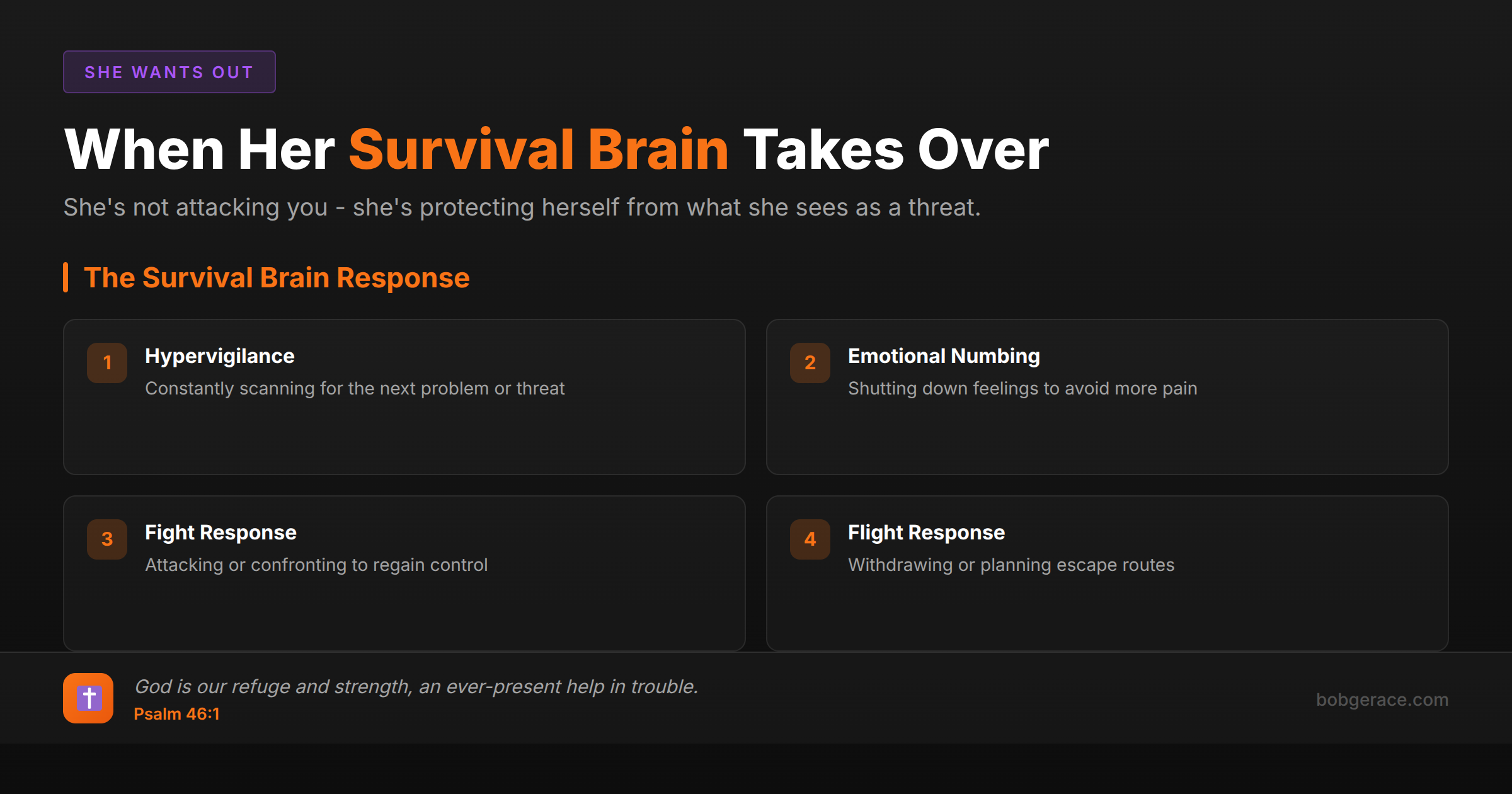
When your wife's brain is in survival mode, she's operating from a place of perceived threat - and often, you're seen as that threat. This isn't about logic or fairness; it's about her nervous system's ancient programming to protect her from harm. You'll see this as emotional walls going up, extreme reactions to small things, and decisions that seem to come from nowhere but have been building for months or years. Survival brain shows up as hypervigilance (watching for the next problem), emotional numbing (shutting down to avoid pain), or fight-or-flight responses (attacking or running). She might seem like a different person because, neurologically, she is. The thinking, reasoning part of her brain has taken a backseat to the part that's focused solely on getting to safety.
The Full Picture
Survival brain is your wife's nervous system's response to what it perceives as ongoing threat or accumulated stress. This isn't dramatic - it's basic human neurobiology. When someone feels unsafe (physically, emotionally, or relationally), their brain shifts resources away from higher-level thinking toward basic survival functions.
Here's what this actually looks like in your marriage:
• Hypervigilance - She's constantly scanning for signs of conflict, criticism, or problems. Small comments feel like major attacks.
• Emotional flooding - She has extreme reactions that seem disproportionate to the situation because her nervous system is already maxed out.
• Memory fog - She can't remember good times or your efforts because stressed brains focus on threats, not positives.
• Decision fatigue - Even small choices feel overwhelming because all her mental energy is going toward managing perceived threats.
• Physical symptoms - Headaches, sleep problems, digestive issues, or chronic fatigue as her body stays in high alert.
• Emotional numbing - She might seem cold or disconnected because feeling nothing is safer than feeling vulnerable.
The key thing you need to understand: this isn't a choice she's making. When someone's brain is in survival mode, they literally cannot access the parts of their brain responsible for empathy, connection, and rational problem-solving. Trying to logic your way through this or convince her she's overreacting will only confirm to her nervous system that you don't understand and therefore aren't safe.
This often develops gradually. Maybe years of feeling unheard, unseen, or unsafe have accumulated into a nervous system that's chronically activated. The final straw might seem small to you, but to her brain, it was just the last piece of evidence that staying in this relationship equals danger.
What's Really Happening
From a neurobiological perspective, survival brain involves the activation of the sympathetic nervous system and the downregulation of the prefrontal cortex - the area responsible for executive functioning, empathy, and complex reasoning. This is often called 'amygdala hijack,' where the brain's alarm system takes over from its thinking system.
Polyvagal theory helps us understand this further. When someone perceives ongoing threat, their nervous system moves through predictable states: first hyperarousal (fight or flight), then hypoarousal (shutdown or freeze). Many wives in struggling marriages are cycling between these states or stuck in chronic hypervigilance.
Trauma-informed research shows us that emotional and relational trauma can be just as activating as physical trauma. Repeated experiences of feeling dismissed, criticized, or emotionally abandoned create what we call 'complex trauma' - the nervous system learns that this relationship equals danger.
Neuroplasticity research gives us hope: brains can change and heal. However, this requires consistent experiences of safety over time. The challenge in marriage therapy is that often the person trying to provide safety (the husband) is also the person the nervous system has learned to see as a threat.
Attachment theory adds another layer. If someone's early attachment experiences were insecure, they're more likely to have a sensitive threat-detection system in intimate relationships. Past betrayals, whether in childhood or previous relationships, can make the current situation feel existentially dangerous even when it's 'just' emotionally difficult.
The therapeutic approach focuses on nervous system regulation first, relationship dynamics second. You can't reason with survival brain, but you can help someone's nervous system learn safety through consistent, predictable, non-threatening interactions.
What Scripture Says
Scripture acknowledges the reality of fear and our need for safety, while pointing us toward God as our ultimate refuge. Psalm 46:1-2 reminds us: "God is our refuge and strength, an ever-present help in trouble. Therefore we will not fear, though the earth give way and the mountains fall into the heart of the sea." Even in survival mode, God remains our source of peace.
Proverbs 18:14 speaks to the power of emotional wounds: "The human spirit can endure in sickness, but a crushed spirit who can bear?" This validates how deep relational pain can affect someone's entire being, including their ability to think clearly and feel safe.
As husbands, we're called to be sources of safety, not threat. 1 Peter 3:7 instructs: "Husbands, in the same way be considerate as you live with your wives, and treat them with respect as the weaker partner and as heirs with you of the gracious gift of life, so that nothing will hinder your prayers." The word 'considerate' means understanding and accommodating her needs, including her need for emotional safety.
Isaiah 32:2 gives us a beautiful picture of godly leadership: "Each one will be like a shelter from the wind and a refuge from the storm, like streams of water in the desert and the shadow of a great rock in a thirsty land." This is what we're called to be in our marriages - places of refuge, not sources of storm.
Romans 12:18 acknowledges that peace isn't always possible but is always our goal: "If it is possible, as far as it depends on you, live at peace with everyone." Sometimes someone's survival brain makes peace temporarily impossible, but we can still do our part to create conditions for safety.
Galatians 6:1 guides our approach: "Brothers and sisters, if someone is caught in a sin, you who live by the Spirit should restore that person gently." Gentleness isn't weakness - it's the strength to respond to fear with patience rather than force.
What To Do Right Now
-
1
Lower your voice and slow down your movements - fast, loud, or sudden actions trigger survival brain responses
-
2
Stop trying to convince her of anything - survival brain can't process logic, only safety or threat signals
-
3
Create predictable, non-threatening interactions - consistency helps nervous systems begin to regulate
-
4
Acknowledge her experience without defending yourself - validation doesn't mean agreement, but it signals safety
-
5
Give her space to regulate without pursuing or pressuring - pushing someone in survival mode always backfires
-
6
Focus on your own regulation first - your calm nervous system can help hers begin to settle over time
Related Questions
- Is she triggered or is this a rational decision?
- How does PTSD affect her perception of our marriage?
- Is her leaving connected to past trauma?
- What is 'stacked trauma' and does she have it?
- How do I know if this is trauma response or true clarity?
- What's the difference between trauma-driven leaving and conscious uncoupling?
- What is 'betrayal trauma' and do I have it?
- What's happening to my nervous system right now?
- What does nervous system regulation look like?
- What is 'window of tolerance' and how do I widen mine?
Also find Bob on
Subscribe for weekly videos on Christian marriage.
You Can't Decode This Alone
Her survival brain isn't textbook—it's shaped by your specific history, her wounds, what you did or didn't do. A coach who knows your marriage can tell you what you're actually dealing with and what move comes next.
Talk to Bob →