What is 'hypervigilance' and why am I doing it?
6 min read
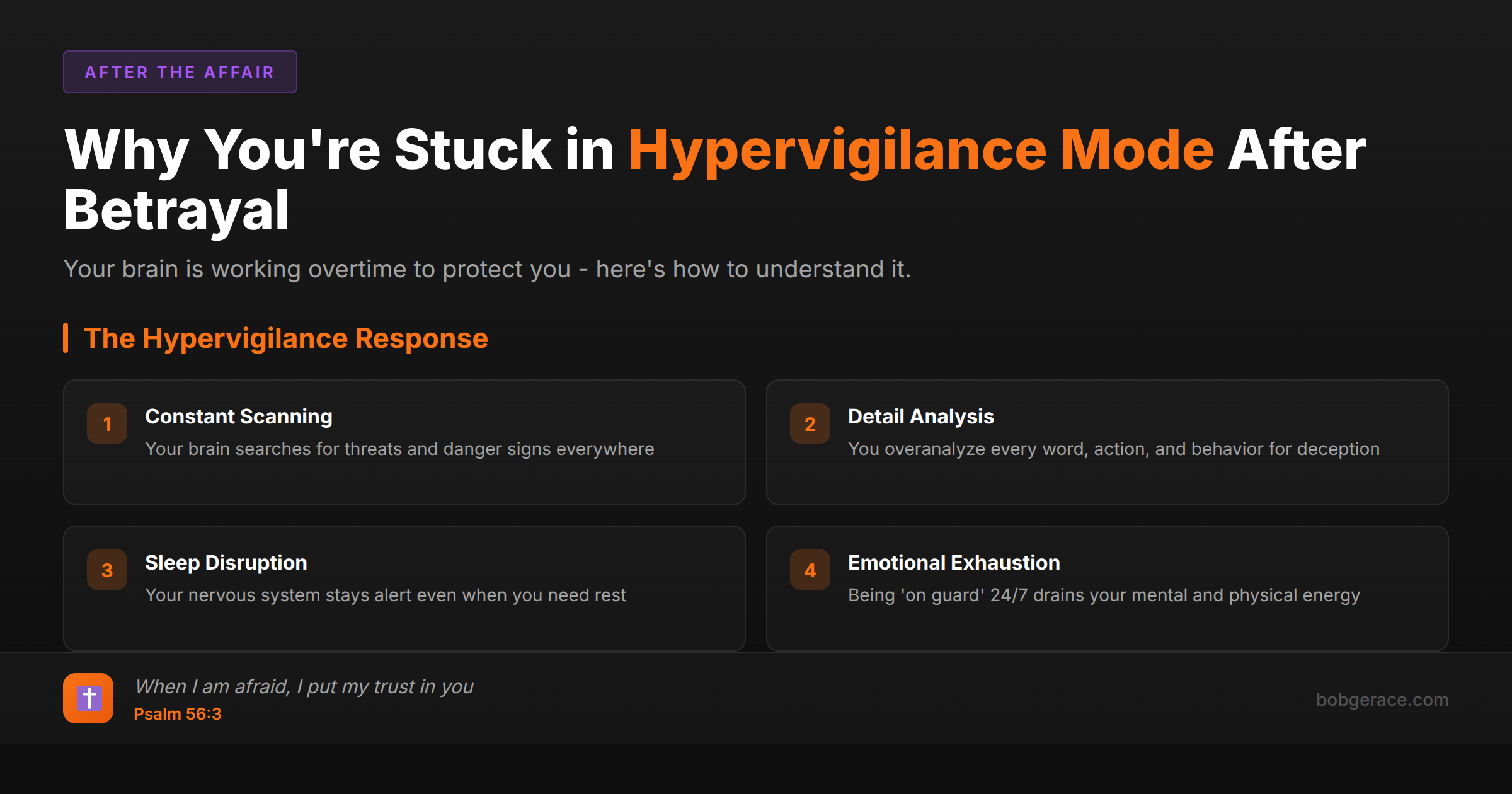
Hypervigilance is your brain's protective response to betrayal trauma. It's that constant state of being 'on guard' - scanning for threats, analyzing every detail, and staying alert for signs of deception or danger. You're doing it because your brain is trying to protect you from being blindsided again. When your spouse betrayed your trust, your nervous system learned that your environment isn't safe. Now it's working overtime to detect any potential threats. This isn't weakness or paranoia - it's a normal trauma response. Your brain is essentially saying, 'I won't let this happen again without warning signs.' While exhausting, this response shows your mind is fighting to protect you and your marriage.
The Full Picture
Hypervigilance feels like living with your internal alarm system stuck in the 'on' position. You might find yourself checking phones, analyzing conversations for hidden meanings, or noticing details you never paid attention to before. Your heart races at innocent interactions. You scan crowds for potential threats to your marriage. Sleep becomes elusive because your mind won't stop processing and analyzing.
This is trauma in action. When betrayal shattered your sense of safety, your nervous system adapted by becoming hyperaware of your surroundings. It's the same response soldiers develop in combat zones - except your battlefield is your marriage and daily life.
The exhaustion is real. Hypervigilance burns enormous amounts of mental and physical energy. You might feel drained, irritable, or overwhelmed. Simple tasks become harder because your brain is constantly running threat-detection software in the background.
But here's what's important to understand: This response served a purpose. It helped you discover the truth about your situation. It's been protecting you from further harm. The challenge is that what once protected you can now imprison you if it continues unchecked.
Recognize that hypervigilance often comes in waves. You might have good days where you feel more relaxed, followed by days where every nerve feels exposed. This ebb and flow is normal in trauma recovery. Your nervous system is slowly learning to recalibrate, but it takes time and intentional healing work.
What's Really Happening
From a clinical perspective, hypervigilance represents a dysregulated nervous system responding to perceived threat. When betrayal occurs, the brain's threat-detection system - primarily the amygdala - becomes overactive while the prefrontal cortex's ability to provide rational perspective becomes compromised.
This creates a biological state where your body remains in 'fight or flight' mode long after the initial threat. Stress hormones like cortisol and adrenaline stay elevated, keeping you in a state of heightened alertness. Your brain is essentially pattern-matching, constantly comparing current experiences to the traumatic betrayal to identify potential dangers.
The challenging aspect is that this hyperactivated state can actually impair your ability to accurately assess real threats. When everything feels dangerous, it becomes difficult to distinguish between genuine red flags and normal marital interactions. This can lead to false alarms that strain the recovery process.
Neuroplasticity research shows us that these trauma responses can be rewired through //blog.bobgerace.com/marriage-consistency-christian-husband-stop-excuses/:consistent, therapeutic intervention. The goal isn't to eliminate all protective instincts but to help your nervous system recalibrate to appropriate threat levels. This requires both top-down approaches (cognitive work) and bottom-up approaches (somatic and nervous system regulation techniques). Recovery involves gradually expanding your window of tolerance so you can remain present and grounded even when triggered.
What Scripture Says
Scripture acknowledges that we live in a fallen world where betrayal and pain are real. Psalm 55:12-14 captures the unique anguish of betrayal: *'If an enemy were insulting me, I could endure it; if a foe were rising against me, I could hide. But it is you, a man like myself, my companion, my close friend, with whom I once enjoyed sweet fellowship at the house of God.'* Your hypervigilance makes sense in light of this deep wound.
Yet God calls us toward healing and trust. Psalm 56:3-4 offers a path forward: *'When I am afraid, I put my trust in you. In God, whose word I praise—in God I trust and am not afraid. What can mere mortals do to me?'* This doesn't minimize your pain but points toward ultimate security in God's faithfulness.
Isaiah 26:3 promises: *'You will keep in perfect peace those whose minds are steadfast, because they trust in you.'* This 'perfect peace' isn't denial of danger but confidence in God's sovereignty over your circumstances. Your healing journey involves learning to anchor your security in God's unchanging character rather than your ability to control outcomes.
Philippians 4:6-7 provides practical guidance: *'Do not be anxious about anything, but in every situation, by prayer and petition, with thanksgiving, present your requests to God. And the peace of God, which transcends all understanding, will guard your hearts and your minds in Christ Jesus.'* God's peace can guard your heart more effectively than hypervigilance ever could.
Remember, seeking healing and learning to trust again doesn't mean being naive. Matthew 10:16 calls us to be 'shrewd as snakes and innocent as doves' - wise but not hardened, discerning but not cynical.
What To Do Right Now
-
1
Practice grounding techniques - Use the 5-4-3-2-1 method: identify 5 things you see, 4 you can touch, 3 you hear, 2 you smell, 1 you taste
-
2
Regulate your nervous system - Try box breathing (inhale 4 counts, hold 4, exhale 4, hold 4) when you feel hyperalert
-
3
Create safety anchors - Identify specific times, places, or activities where you feel most grounded and incorporate them daily
-
4
Communicate your experience - Let your spouse know when you're feeling triggered so they can respond with patience and understanding
-
5
Limit information gathering - Set specific times for checking or discussing concerns rather than constant monitoring
-
6
Seek professional support - Work with a trauma-informed therapist who understands betrayal trauma and nervous system regulation
Related Questions
- Why can't I stop obsessing over details?
- Why do I keep replaying the discovery?
- How do I stop the mental movies?
- What is 'betrayal trauma' and do I have it?
- Is this PTSD?
- How do I function when my body won't calm down?
- What's happening in my nervous system right now?
- What is 'amygdala hijack' and how do I interrupt it?
- How do I know if my hypervigilance is appropriate or pathological?
- What does trauma recovery look like?
Also find Bob on
Subscribe for weekly videos on Christian marriage.
Your Hypervigilance Has a Story
A coach who knows your marriage can help you understand what's driving it in your specific situation—and what actually helps your nervous system settle.
Talk to Bob →