What is 'stacked trauma' and does she have it?
5 min read
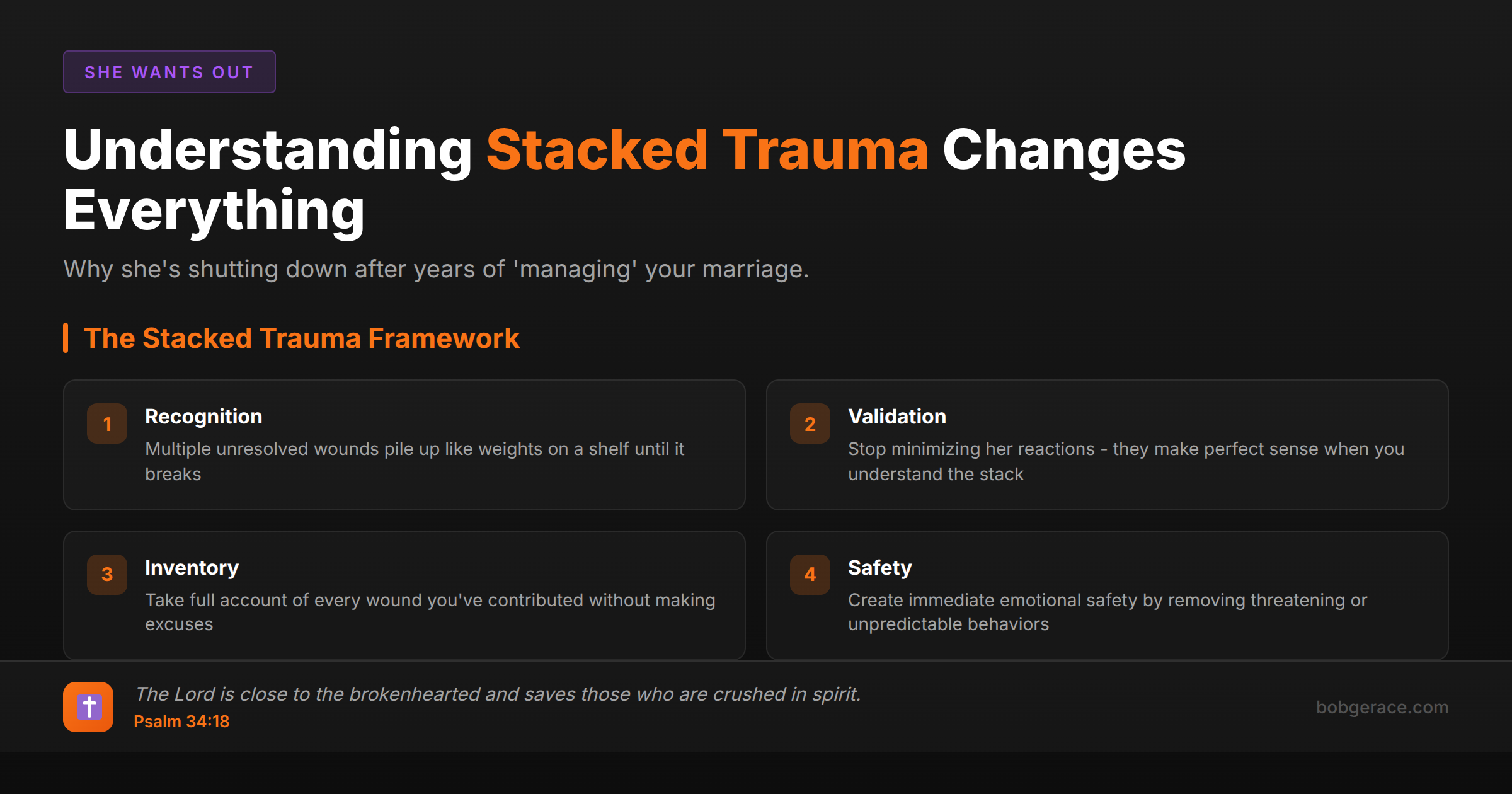
Stacked trauma is exactly what it sounds like - multiple unresolved emotional wounds that pile up over time until they become unbearable. Think of it like adding weight to a shelf until it finally breaks. Each incident might seem manageable alone, but together they create an overwhelming burden. Your wife likely has stacked trauma if she's shutting down emotionally, seems triggered by things that never bothered her before, or suddenly wants out after years of 'managing.' This isn't about one big event - it's about a thousand paper cuts that never healed. The affair, the broken promises, the times you dismissed her feelings, the financial stress, the in-law conflicts - they've all stacked up. Understanding this changes everything about how you approach rebuilding your marriage.
The Full Picture
Stacked trauma happens when emotional wounds accumulate faster than they can heal. Your wife might have experienced:
Relationship-specific traumas: • Broken promises and unmet commitments • Emotional or physical affairs • Financial betrayals or hidden spending • Dismissive responses to her concerns • Chronic emotional neglect
Life circumstance traumas: • Job loss or career setbacks • Health crises or chronic illness • Loss of parents or close family • Children's struggles or special needs • Extended family conflicts
Historical traumas: • Childhood abuse or neglect • Previous relationship betrayals • Family dysfunction growing up • Sexual assault or harassment • Chronic criticism or emotional abuse
Here's what most men miss: each new wound reactivates all the old ones. When you broke another promise last month, it didn't just hurt in isolation - it triggered the pain from every other broken promise. This is why her reaction seemed 'disproportionate' to you.
Women often carry trauma differently than men. They tend to internalize and manage until they literally can't anymore. Then they make what appears to be a sudden decision to leave, but it's actually been building for years.
The danger signs include: emotional numbness, hypervigilance about your behavior, extreme reactions to minor issues, physical symptoms without medical cause, and the devastating phrase 'I just can't do this anymore.'
What's Really Happening
From a clinical perspective, stacked trauma creates what we call 'allostatic load' - the cumulative physiological wear and tear from chronic stress. When someone experiences repeated emotional wounds without adequate recovery time, their nervous system becomes dysregulated.
The brain's threat detection system (amygdala) becomes hyperactive, while the rational processing center (prefrontal cortex) goes offline. This explains why your wife might seem 'irrational' or why normal conversations escalate quickly. She's literally operating from a trauma response, not from her thinking brain.
Research shows that unresolved relational trauma creates attachment injuries that compound over time. Each betrayal or disappointment reinforces negative working models of relationships: 'I'm not safe,' 'I can't trust,' 'I'm not worthy of love.' These beliefs become self-fulfilling prophecies.
Women with stacked trauma often experience: • Hypervigilance about their partner's behavior • Emotional numbing as a protective mechanism • Somatic symptoms (headaches, digestive issues, chronic pain) • Sleep disturbances and anxiety • Depression and feelings of hopelessness • Difficulty accessing positive memories of the relationship
The neurobiological reality is that trauma literally changes brain structure. The good news? The brain's neuroplasticity means healing is possible with consistent safety, validation, and time. However, this requires the traumatized person to feel genuinely safe - which means significant behavioral change from their partner, not just promises or explanations.
What Scripture Says
Scripture acknowledges the reality of accumulated wounds and God's heart for the burdened. Psalm 34:18 reminds us: 'The Lord is close to the brokenhearted and saves those who are crushed in spirit.' Your wife's broken heart matters deeply to God.
Matthew 11:28-30 offers hope: 'Come to me, all you who are weary and burdened, and I will give you rest. Take my yoke upon you and learn from me, for I am gentle and lowly in heart, and you will find rest for your souls.' Christ understands the weight of accumulated pain.
Galatians 6:2 calls us to 'carry each other's burdens, and in this way you will fulfill the law of Christ.' As her husband, you're called to help bear her burdens, not add to them. This means taking responsibility for the wounds you've contributed to the stack.
Ephesians 4:29 provides guidance: 'Do not let any unwholesome talk come out of your mouths, but only what is helpful for building others up according to their needs, that it may benefit those who listen.' Every word either adds to her trauma stack or helps heal it.
Isaiah 61:1 speaks of Christ's mission to 'bind up the brokenhearted' and 'comfort all who mourn.' God is in the business of healing stacked trauma. Jeremiah 30:17 promises: 'I will restore you to health and heal your wounds,' declares the Lord.
The biblical response isn't to minimize her pain or rush her healing, but to create the safety and consistency that allows God's healing work to take place.
What To Do Right Now
-
1
Stop minimizing or dismissing her reactions - they make perfect sense when you understand stacked trauma
-
2
Take full inventory of every wound you've contributed to her trauma stack without making excuses
-
3
Create immediate emotional and physical safety by removing any threatening or unpredictable behaviors
-
4
Validate her pain explicitly: 'I see how much I've hurt you and I understand why you want to leave'
-
5
Commit to professional help - both individual therapy for yourself and couples counseling with a trauma-informed therapist
-
6
Give her space to process without pressuring her for forgiveness, decisions, or emotional connection
Related Questions
- Is her leaving connected to past trauma?
- How does PTSD affect her perception of our marriage?
- Is she triggered or is this a rational decision?
- What does 'survival brain' look like in her right now?
- How do I know if this is trauma response or true clarity?
- Did I retraumatize her without knowing?
- What is 'betrayal trauma' and do I have it?
- What does chronic stress do to her capacity for connection?
- What is 'complex trauma' and do I have it?
- What does trauma recovery look like?
Also find Bob on
Subscribe for weekly videos on Christian marriage.
Your Marriage Has Its Own Stack
A coach who knows your specific history can help you see which wounds matter most and what safety looks like in your actual marriage.
Talk to Bob →