Is her leaving connected to past trauma?
6 min read
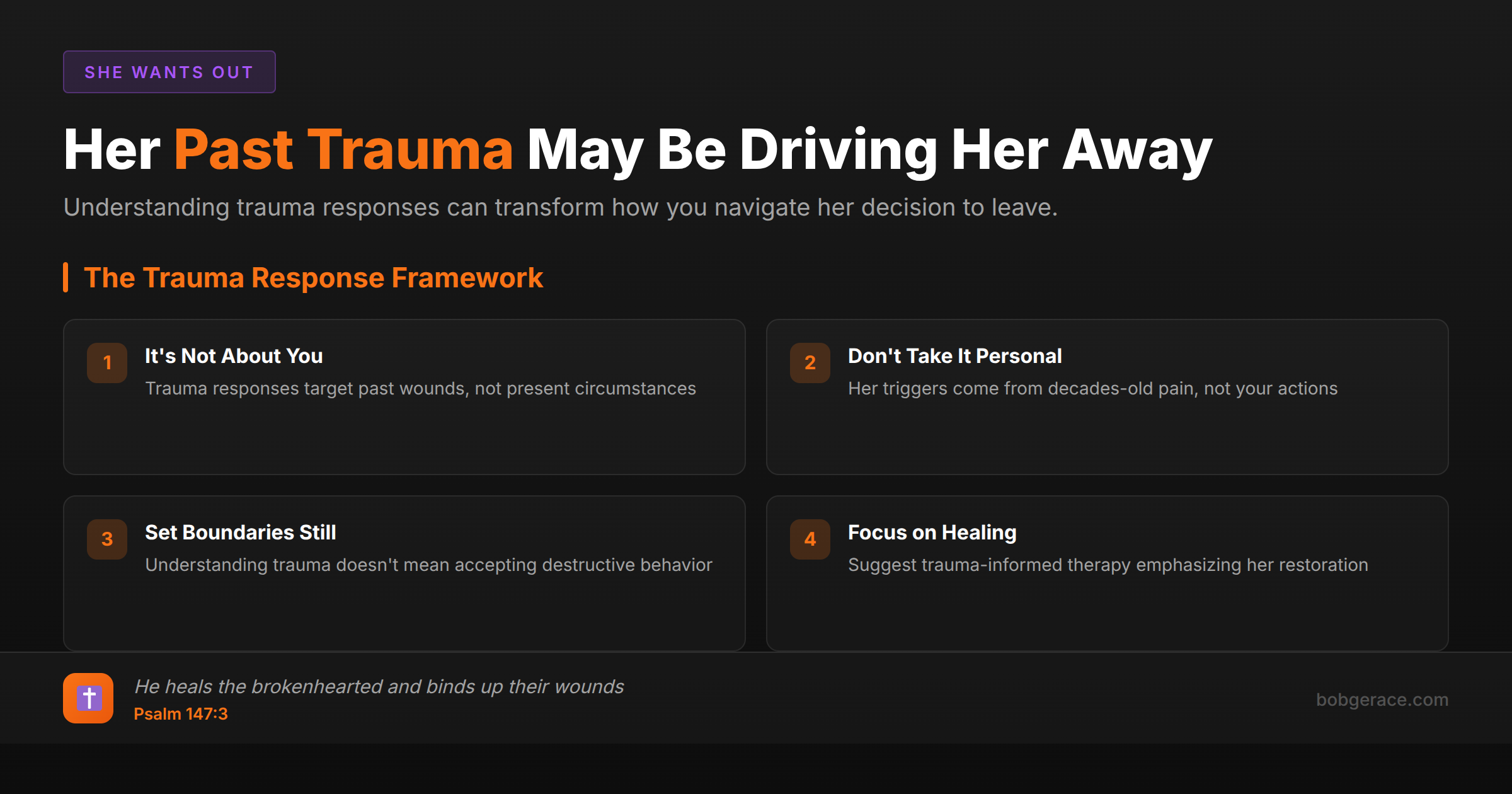
Yes, past trauma could absolutely be connected to her decision to leave, but it's more complex than you might think. Trauma doesn't excuse destructive behavior, but it does create powerful patterns that can drive someone away from the very relationships they need most. If your wife experienced childhood abuse, neglect, abandonment, or other significant wounds, those experiences literally rewired her brain's threat detection system. What feels safe to you might feel dangerous to her. Here's what matters: trauma-driven responses aren't about you personally, but they absolutely affect you. She might be running from triggers you can't see, or protecting herself from pain she experienced decades ago. Understanding this doesn't mean accepting destructive behavior, but it does give you a framework for responding with both wisdom and strength.
The Full Picture
Trauma creates what I call "invisible drivers" – powerful forces that shape behavior in ways that seem irrational from the outside. When your wife experienced trauma, especially in childhood, it changed how her brain processes safety, trust, and connection.
Common trauma responses that affect marriage: • Hypervigilance – constantly scanning for threats, even in safe relationships • Emotional flooding – overwhelming feelings that shut down rational thinking • Avoidance patterns – running from situations that trigger traumatic memories • Control mechanisms – needing to control environments to feel safe • Attachment wounds – difficulty trusting or maintaining close bonds
The tricky part is that trauma responses often get activated by the very intimacy marriage requires. The closer you try to get, the more her trauma-wired brain might scream "danger." This creates a cruel irony where the love and security you're offering feels threatening to her nervous system.
This shows up as: - Pulling away when you try to connect emotionally - Explosive reactions to seemingly minor issues - Inability to feel safe or settled in the relationship - Patterns of sabotaging good moments - Chronic feelings of being trapped or suffocated
Most men make the mistake of taking these responses personally or trying to logic their wife out of trauma patterns. That's like trying to convince someone having a heart attack that their chest pain isn't real. The pain is real – it's just not about what's happening right now.
What's Really Happening
From a clinical perspective, trauma creates lasting changes in the brain's architecture, particularly in areas responsible for threat detection and emotional regulation. When someone experiences significant trauma, their amygdala (the brain's alarm system) becomes hyperactive, while the prefrontal cortex (responsible for rational thinking) becomes less effective at managing emotional responses.
This neurobiological reality means that trauma survivors often experience what we call "emotional hijacking" – moments where past trauma literally takes control of their present-moment responses. In marriage, this can manifest as seemingly irrational decisions to leave or create distance.
Research shows that unresolved trauma, particularly complex trauma from childhood, significantly increases divorce rates. The Adverse Childhood Experiences (ACE) study revealed that individuals with higher trauma scores struggle more with intimate relationships, not because they don't want connection, but because their nervous systems interpret intimacy as potentially dangerous.
What's particularly challenging is that trauma responses are often unconscious. Your wife may not even recognize that her decision to leave is connected to past wounds. She might genuinely believe the problem is entirely about your current relationship, when in reality, historical pain is amplifying present-day challenges.
Trauma-informed therapy approaches like EMDR, somatic experiencing, and Internal Family Systems have shown remarkable success in helping individuals process these wounds. However, healing requires the trauma survivor to recognize the connection and commit to the difficult work of processing their pain – something that can't be forced from the outside.
What Scripture Says
Scripture acknowledges the lasting impact of wounds and the complex process of healing. Psalm 147:3 tells us that God "heals the brokenhearted and binds up their wounds." This verse recognizes that wounds – whether physical, emotional, or spiritual – require intentional healing, not just time.
Proverbs 27:6 reminds us that "wounds from a friend can be trusted, but an enemy multiplies kisses." Sometimes the very people who love us most can inadvertently trigger our deepest wounds, not through malice but through the vulnerability that intimacy requires.
The story of Hagar in Genesis 16 shows how past trauma affects present relationships. After experiencing abuse and abandonment, Hagar runs into the wilderness rather than staying in a difficult but potentially restorative situation. God meets her there with compassion, not condemnation, showing us how to respond to those whose trauma drives them to run.
Isaiah 61:1 speaks of God's heart to "bind up the brokenhearted" and "proclaim freedom for the captives." Trauma literally holds people captive to past pain, but healing is possible through God's restorative power working through relationship, therapy, and spiritual growth.
Ephesians 4:32 calls us to "be kind and compassionate to one another, forgiving each other, just as in Christ God forgave you." This doesn't mean enabling destructive behavior, but it does mean responding to trauma-driven actions with understanding rather than just anger.
As a husband, you're called to love "as Christ loved the church" (Ephesians 5:25) – which includes loving someone through their woundedness while maintaining healthy boundaries and expectations.
What To Do Right Now
-
1
Research her background to understand potential trauma sources without becoming a detective or violating boundaries
-
2
Educate yourself about trauma responses through books like 'The Body Keeps the Score' or trauma-informed resources
-
3
Stop taking trauma-driven behaviors personally while still maintaining appropriate boundaries and expectations
-
4
Suggest trauma-informed therapy or counseling, emphasizing healing rather than fixing the marriage
-
5
Document patterns you observe that might be trauma-related to share with a professional counselor
-
6
Seek your own trauma-informed coaching to learn how to respond effectively to trauma-driven behaviors
Related Questions
- What is 'stacked trauma' and does she have it?
- How does PTSD affect her perception of our marriage?
- Is she triggered or is this a rational decision?
- What does 'survival brain' look like in her right now?
- How do I know if this is trauma response or true clarity?
- Did I retraumatize her without knowing?
- What is 'betrayal trauma' and do I have it?
- What does chronic stress do to her capacity for connection?
- What is 'complex trauma' and do I have it?
- What does trauma recovery look like?
Also find Bob on
Subscribe for weekly videos on Christian marriage.
Bring Your Specific Marriage to Bob
Trauma patterns in your wife's story change what works and what backfires. A coach who knows your situation can help you see what you're actually dealing with.
Talk to Bob →