What would breaking the family cycle require?
6 min read
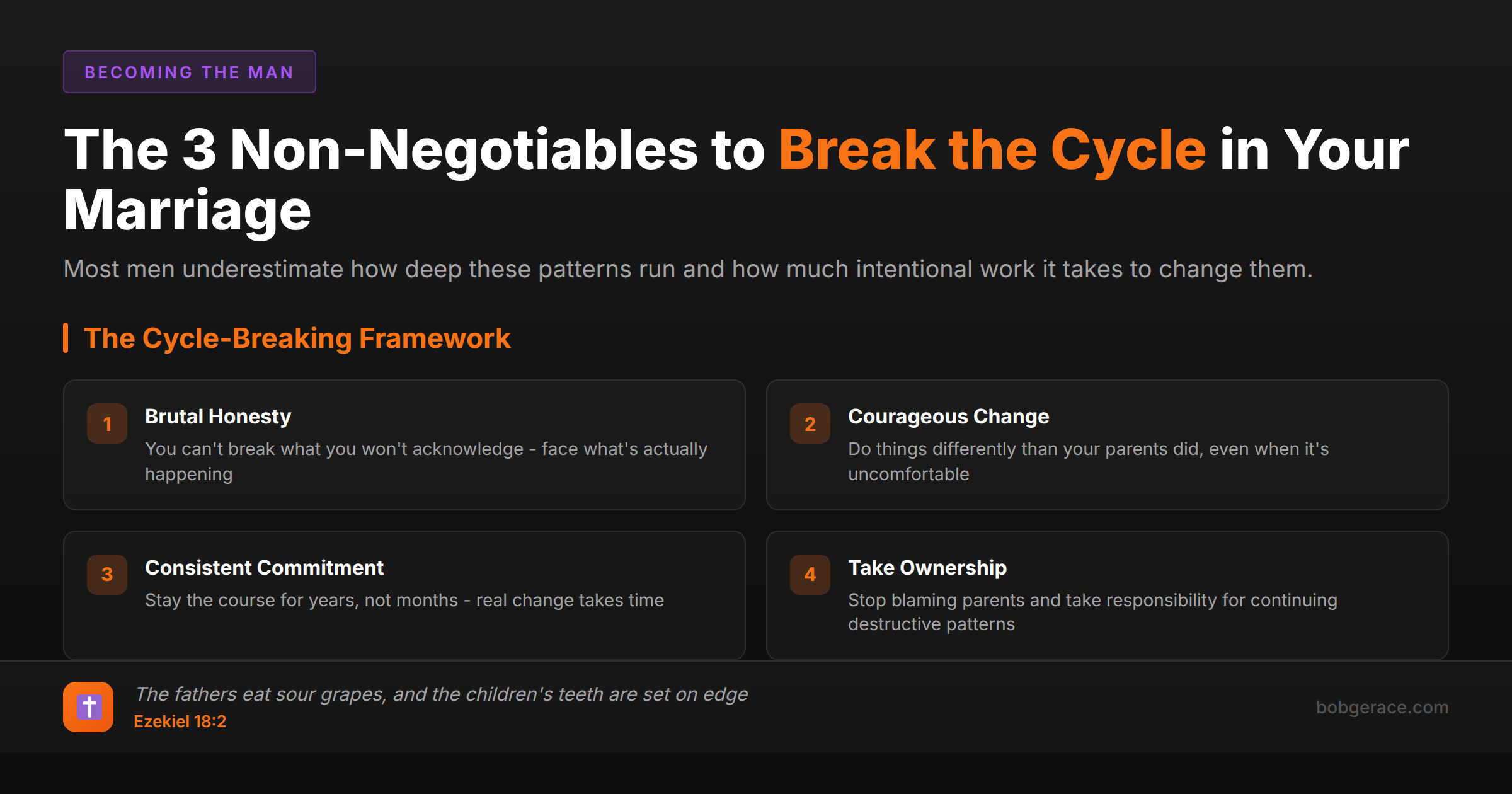
Breaking the family cycle requires three non-negotiables: brutal honesty about what's actually happening, the courage to do things differently than your parents did, and consistent commitment over years, not months. Most people underestimate how deep these patterns run and how much intentional work it takes to change them. You can't break what you won't acknowledge, and you can't change what you're not willing to take responsibility for. This isn't about blaming your parents - it's about taking ownership of your part in continuing patterns that are damaging your marriage. The good news? God specializes in breaking chains and creating new legacies.
The Full Picture
Family cycles are like underground rivers - they flow beneath the surface of your marriage, shaping everything while remaining largely invisible. These patterns include communication styles, conflict resolution approaches, emotional regulation habits, and relationship dynamics that get passed down through generations like genetic traits.
The reality is stark: Most couples unconsciously recreate their family of origin patterns, even when they swore they'd do things differently. You might have promised yourself you'd never yell like your dad did, only to find yourself exploding at your spouse. Or perhaps you watched your mother withdraw during conflict, and now you're doing the same thing.
These cycles persist because they're neurologically wired into us. Your brain learned these patterns when it was most malleable - during childhood - and now operates from these templates automatically. What felt "normal" in your family becomes your default setting in marriage, regardless of whether it's healthy or destructive.
Breaking the cycle isn't just about stopping bad behaviors - it's about creating entirely new patterns that honor God and serve your marriage. This requires understanding that you're not just changing habits; you're rewiring decades of neural pathways and challenging belief systems that have operated unchecked for years.
The stakes are enormous. The patterns you choose to break or continue will directly impact your children and their future marriages. You have the power to be a generational game-changer or a generational pattern-repeater. The choice is yours, but it won't happen accidentally.
What's Really Happening
From a clinical perspective, breaking family cycles involves rewiring what we call "attachment templates" - the unconscious blueprints for how relationships should function that were formed in our earliest years. These templates operate below conscious awareness, which is why people often find themselves acting in ways they consciously reject.
The process requires what I call "dual awareness" - simultaneously observing your automatic responses while choosing different actions. This is neurologically demanding work. Your brain will resist because familiar patterns, even destructive ones, require less energy than creating new neural pathways.
Three critical phases define successful cycle-breaking: First, the recognition phase, where you identify specific patterns and their origins. Second, the intervention phase, where you develop new responses and practice them consistently. Third, the integration phase, where these new patterns become your natural default.
Research shows that sustainable change requires approximately 18-24 months of consistent practice for new patterns to become automatic. During this period, stress will pull you back toward familiar responses. This is why cycle-breaking requires not just individual commitment, but systemic support - including professional guidance, community accountability, and often, healing work around childhood wounds.
The most successful clients understand that breaking family cycles isn't just about behavior modification - it's about identity transformation. You're literally becoming a different kind of spouse and potentially a different kind of parent than the models you received.
What Scripture Says
God's heart for breaking destructive cycles is woven throughout Scripture. He's in the business of ending curses and starting blessings, of healing what's been broken across generations.
"The fathers eat sour grapes, and the children's teeth are set on edge" (Ezekiel 18:2). God addresses this exact issue - the tendency for destructive patterns to pass from generation to generation. But He makes clear that each person has the power and responsibility to choose differently: "The one who sins is the one who will die" (Ezekiel 18:4). You're not doomed to repeat your family's mistakes.
"Therefore, if anyone is in Christ, the new creation has come: The old has gone, the new is here!" (2 Corinthians 5:17). This isn't just spiritual poetry - it's a promise about your capacity for fundamental change. In Christ, you have access to patterns and possibilities that transcend your family history.
"Choose for yourselves this day whom you will serve" (Joshua 24:15). Joshua wasn't just talking about religious worship - he was talking about a fundamental life orientation. Every day, you choose whether to serve the patterns of your past or the purposes God has for your future.
"He took our infirmities and bore our diseases" (Matthew 8:17). Christ didn't just die for your sins - He died to break every form of bondage, including generational patterns that keep you trapped in destructive cycles.
God doesn't just call you to break bad cycles - He empowers you to create godly legacies. "His mercy extends to those who fear him, from generation to generation" (Luke 1:50). The same power that breaks curses establishes blessings that outlast your lifetime.
What To Do Right Now
-
1
Map your family patterns by writing down specific behaviors, communication styles, and relationship dynamics from both sides of your family tree
-
2
Identify the top three patterns you're unconsciously repeating in your marriage and share this list with your spouse
-
3
Create "pattern interrupt" strategies - specific alternative responses you'll use when you catch yourself falling into old cycles
-
4
Establish weekly check-ins with your spouse to discuss when old patterns showed up and how you handled them
-
5
Find a mentor couple who models healthy patterns you want to develop and ask for regular guidance
-
6
Commit to professional counseling or coaching specifically focused on family systems work - this isn't DIY territory
Related Questions
- What is 'intergenerational transmission'?
- What patterns did I inherit vs. choose?
- What roles did I play in my family system?
- What is 'family of origin' work?
- How do I honor my parents while breaking from their patterns?
- What does 'sins of the fathers' mean?
- What role did my childhood play in my anger patterns?
- What attachment injuries did I experience?
- What did I learn about love from my parents?
- What legacy am I leaving them through this crisis?
Also find Bob on
Subscribe for weekly videos on Christian marriage.
You Don't Have to Figure This Out Alone
Breaking patterns that have run in your family for decades isn't something you reverse by reading articles. A coach who knows your specific marriage can help you see what you can't see and do what you've never done.
Talk to Bob →