What roles did I play in my family system?
6 min read
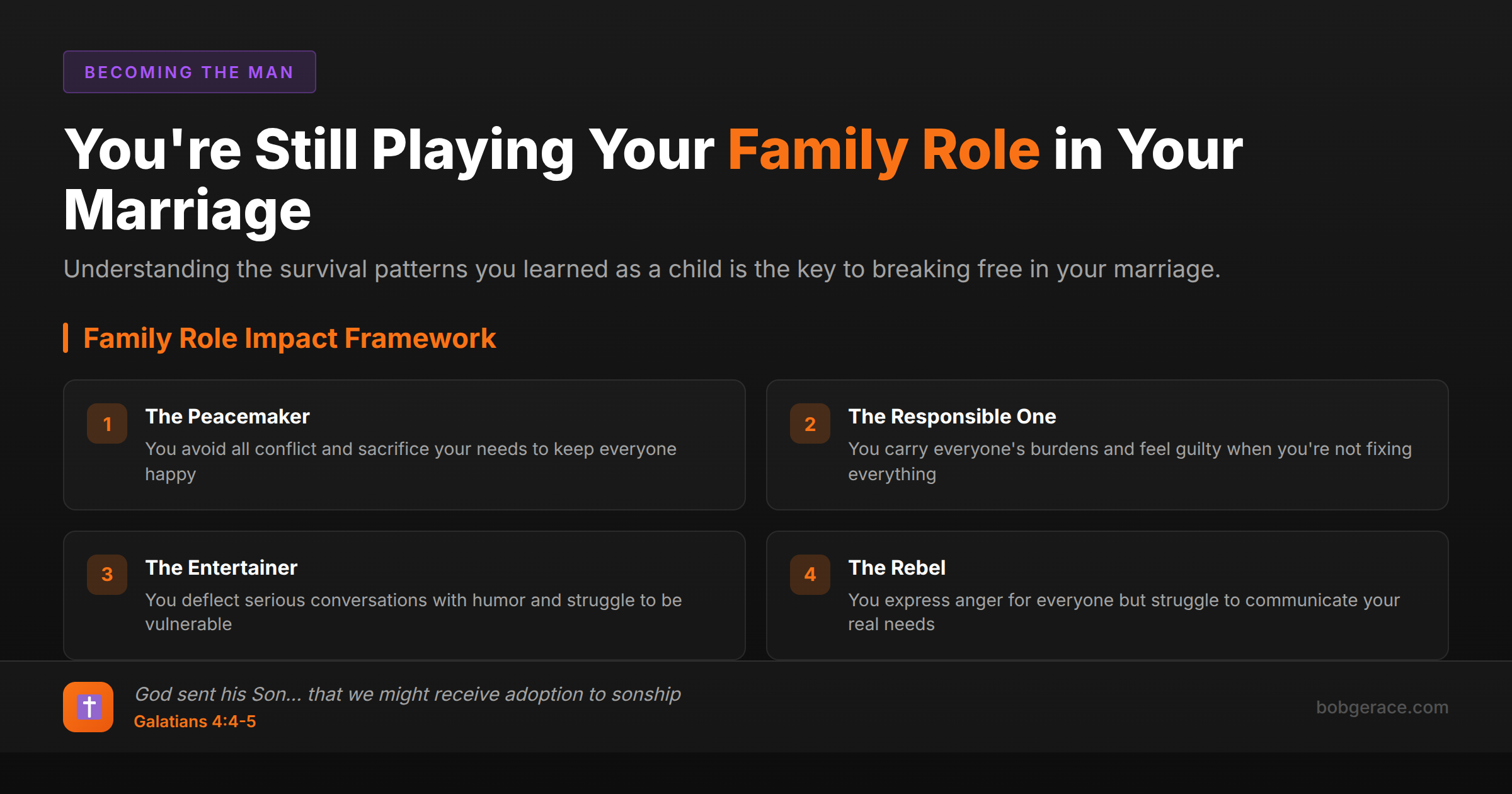
Every family operates like a complex system where each member takes on specific roles to maintain stability and function. You likely played multiple roles - perhaps the peacemaker who smoothed over conflicts, the responsible one who took care of everyone, the entertainer who lightened tense moments, or the rebel who expressed the family's unspoken frustrations. These roles weren't necessarily bad - they helped your family survive and often served important purposes. But here's what matters now: you're probably still playing these same roles in your marriage, even when they don't fit or help. Understanding your family roles gives you the power to choose consciously how you want to show up in your marriage today.
The Full Picture
Family systems theory teaches us that families are interconnected units where everyone adapts to maintain balance. When dysfunction enters the system - through addiction, mental illness, trauma, or even just everyday stress - family members unconsciously take on roles to cope and survive.
Common family roles include:
The Hero/Responsible One - You were the high achiever who made the family look good. You solved problems, took care of siblings, and carried adult responsibilities as a child. In marriage, you might be controlling, perfectionistic, or feel responsible for your spouse's emotions.
The Peacemaker/Mediator - You smoothed over conflicts and kept everyone happy. You learned to read emotional temperatures and intervene before explosions. Now you might avoid conflict at all costs, suppress your own needs, or feel responsible for your spouse's mood.
The Rebel/Scapegoat - You acted out the family's pain through behavior problems or defiance. While everyone focused on "fixing" you, the real family issues stayed hidden. In marriage, you might struggle with authority, have difficulty trusting, or feel like the "problem" in every conflict.
The Lost Child - You stayed quiet and invisible to avoid adding stress. You learned independence early and didn't ask for help. In marriage, you might struggle with intimacy, have difficulty expressing needs, or feel disconnected from your spouse.
The Entertainer/Mascot - You used humor and charm to deflect tension and bring lightness to heavy situations. In marriage, you might use humor to avoid serious conversations, struggle with being taken seriously, or feel responsible for keeping your spouse happy.
Here's the crucial truth: these roles served you then, but they might be limiting you now. You're not stuck in them forever.
What's Really Happening
From a clinical perspective, family roles are survival adaptations that become deeply ingrained neural pathways. Your brain learned these patterns during critical developmental years, making them feel automatic and "right" even when they're not serving your adult relationships.
What's fascinating is that couples often unconsciously recreate their family systems. If you were the responsible one, you might have married someone who needed taking care of. If you were the rebel, you might have chosen someone who tries to control or "fix" you. These patterns feel familiar, even when they're painful.
The good news? Neuroplasticity research shows us that these patterns can change. When you become aware of your family roles, you create space between stimulus and response. Instead of automatically falling into old patterns, you can pause and choose how to respond based on what your marriage actually needs.
I often see clients have breakthrough moments when they realize they're not fundamentally flawed - they're just running outdated programming. The responsible child doesn't need to control everything in marriage. The peacemaker doesn't need to sacrifice their voice for harmony. The rebel doesn't need to push against every boundary.
Recognizing your family roles isn't about blame - it's about reclaiming your power to show up authentically in your marriage. You get to decide which aspects of these roles serve your relationship and which ones need to be retired. This awareness is the first step toward breaking generational patternss and creating the marriage legacy you want to leave.
What Scripture Says
Scripture acknowledges that family patterns deeply shape us, but it also offers hope for transformation and freedom from limiting generational patterns.
God sees beyond our roles to our true identity: "But when the set time had fully come, God sent his Son, born of a woman, born under the law, to redeem those under the law, that we might receive adoption to sonship" (Galatians 4:4-5). You are not defined by the survival role you played - you are God's beloved child.
We can break generational patterns: "The parents eat sour grapes, and the children's teeth are set on edge? As surely as I live, declares the Sovereign Lord, you will no longer quote this proverb in Israel" (Ezekiel 18:2-3). God breaks the cycle of generational dysfunction when we surrender our patterns to Him.
Transformation comes through renewed thinking: "Do not conform to the pattern of this world, but be transformed by the renewing of your mind. Then you will be able to test and approve what God's will is—his good, pleasing and perfect will" (Romans 12:2). Your family patterns are "patterns of this world" - God wants to renew your mind with His truth.
We are called to authentic relationship: "Therefore each of you must put off falsehood and speak truthfully to your neighbor, for we are all members of one body" (Ephesians 4:25). The roles we played often required us to hide parts of ourselves - God calls us to authentic relationship in marriage.
God redeems our past for good: "And we know that in all things God works for the good of those who love him, who have been called according to his purpose" (Romans 8:28). Even the painful family roles you played can become sources of compassion, wisdom, and strength in your marriage when surrendered to God.
We are being made new: "Therefore, if anyone is in Christ, the new creation has come: The old has gone, the new is here!" (2 Corinthians 5:17). You are not stuck in old patterns - you are being transformed into who God created you to be.
What To Do Right Now
-
1
Map your family system - write down each family member and the primary role they played, including yourself
-
2
Identify which family roles you're still playing in your marriage - ask your spouse for their honest observations
-
3
Choose one family role pattern to focus on changing - start with the one causing the most marriage conflict
-
4
Practice pausing before responding in triggering situations - ask "Is this my family role reacting or is this what my marriage needs?"
-
5
Have an honest conversation with your spouse about the family roles you both brought into the marriage
-
6
Pray together, asking God to help you see each other as He sees you, not through the lens of family roles
Related Questions
Ready to Break Free from Limiting Family Patterns?
Understanding your family roles is just the beginning. Let's work together to transform these patterns into strengths for your marriage.
Start Here →