What is 'family of origin' work?
6 min read
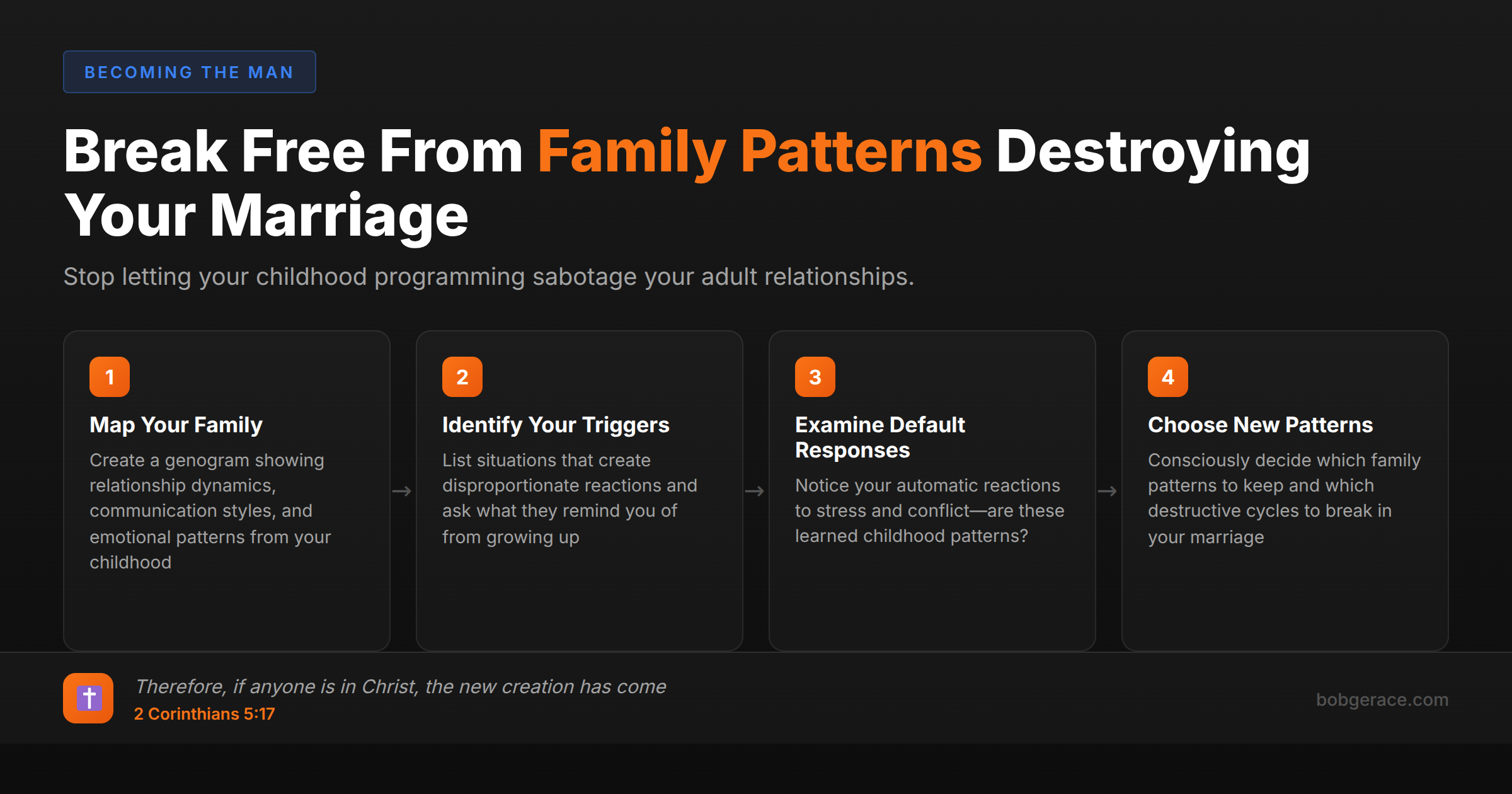
Family of origin work is the process of examining how your childhood family experiences, patterns, and relationships continue to influence your adult marriage and relationships. It's not about blaming your parents or dwelling on the past—it's about understanding the 'family rules,' communication styles, conflict patterns, and emotional dynamics you learned growing up so you can make conscious choices about what to keep and what to change in your current marriage. This work helps you identify why you react certain ways, why specific issues trigger you, and how unconscious patterns from your childhood might be creating problems in your marriage today. The goal is freedom—breaking free from destructive cycles and choosing healthier ways to love and connect with your spouse.
The Full Picture
Think of your family of origin as your first 'school' for relationships. From birth through your teenage years, you absorbed countless lessons about how relationships work, how conflict gets handled, how love gets expressed, how emotions get managed, and what roles people play in families.
You learned these lessons not through formal teaching, but through observation, experience, and survival. If your dad shut down during conflict, you might have learned that's what men do. If your mom handled everything, you might have learned that's what strong people do. If emotions were dangerous in your house, you learned to suppress them. If chaos was normal, you might feel uncomfortable with peace.
Here's what makes this tricky: Most of these patterns operate below conscious awareness. You're not choosing to repeat your father's conflict style—you're just doing what feels "normal" when stress hits. You're not deciding to take on your mother's caretaking role—it's just what your nervous system defaults to when relationships feel unstable.
Family of origin work involves: - Mapping your family patterns: Understanding the spoken and unspoken rules that governed your childhood home - Identifying your triggers: Recognizing when current situations activate old family dynamics - Examining your roles: Understanding the part you played in your family system and how you might be playing similar roles in marriage - Processing unfinished business: Dealing with hurt, disappointment, or trauma that still affects you today - Choosing new patterns: Consciously deciding which family patterns to keep, modify, or completely change
This isn't about creating a list of everything your parents did wrong. It's about understanding your story so you can write a better chapter in your marriage.
What's Really Happening
From a clinical perspective, family of origin work addresses what we call 'intergenerational transmission'—the way patterns, trauma, and coping mechanisms get passed down through family lines, often unconsciously. Your brain developed within your family system, literally wiring itself based on what it experienced as normal and safe.
When couples come to therapy saying 'we keep having the same fight' or 'I don't know why I react this way,' we're often looking at family of origin material. For example, if someone grew up in a family where conflict meant danger, their nervous system will activate fight-or-flight responses during normal marital disagreements. They're not choosing to be reactive—their brain is trying to protect them based on old programming.
Key therapeutic concepts include:
Differentiation: Learning to be yourself within relationship, rather than losing yourself or completely withdrawing. Many people never learned this in their family of origin.
Triangulation: Understanding how three-person dynamics from childhood (like being caught between fighting parents) show up in marriage when stress, in-laws, or children get involved.
Attachment patterns: Recognizing whether you learned secure, anxious, avoidant, or disorganized attachment styles and how these impact your marriage.
Emotional regulation: Examining whether your family taught you healthy ways to handle big emotions or if you're still using childhood coping mechanisms that don't serve your marriage.
The beautiful thing about this work is that your brain remains changeable. Through awareness, new experiences, and intentional practice, you can literally rewire old patterns and create the kind of marriage your family of origin didn't model for you.
What Scripture Says
Scripture acknowledges the powerful influence of family patterns while calling us toward transformation and new life in Christ. The Bible shows us both the reality of generational influence and God's power to create something new.
The reality of generational patterns: *'The Lord, the Lord, the compassionate and gracious God, slow to anger, abounding in love and faithfulness, maintaining love to thousands, and forgiving wickedness, rebellion and sin. Yet he does not leave the guilty unpunished; he punishes the children and their children for the sin of the parents to the third and fourth generation'* (Exodus 34:6-7). This isn't about God punishing innocent people, but acknowledging how sin creates patterns that impact families across generations.
The call to examine and understand: *'The simple believe anything, but the prudent give thought to their steps'* (Proverbs 14:15). Family of origin work is about becoming 'prudent'—thoughtfully examining our patterns rather than simply reacting from them.
The promise of transformation: *'Therefore, if anyone is in Christ, the new creation has come: The old has gone, the new is here!'* (2 Corinthians 5:17). Christ offers us the power to become different from what our family patterns might dictate.
The importance of leaving and cleaving: *'That is why a man leaves his father and mother and is united to his wife, and they become one flesh'* (Genesis 2:24). This 'leaving' isn't just physical—it's emotional and psychological, requiring us to examine what we're carrying from our family of origin.
The call to honor while choosing health: *'Honor your father and your mother, so that you may live long in the land the Lord your God is giving you'* (Exodus 20:12). Honoring parents doesn't mean copying all their patterns—sometimes honoring them means breaking destructive cycles they couldn't break themselves.
The vision for generational blessing: *'But from everlasting to everlasting the Lord's love is with those who fear him, and his righteousness with their children's children'* (Psalm 103:17). God wants to establish patterns of blessing through families willing to do this hard work.
What To Do Right Now
-
1
Create a family genogram: Draw your family tree including relationship dynamics, patterns, and roles. Note communication styles, how conflict was handled, and emotional patterns.
-
2
Identify your triggers: Make a list of situations in your marriage that create disproportionate reactions in you. Ask yourself: 'What does this remind me of from growing up?'
-
3
Examine your automatic responses: Notice your default reactions to stress, conflict, or emotional situations. Ask: 'Is this how someone in my family handled similar situations?'
-
4
Have honest conversations: Talk with your spouse about what you're discovering. Share insights about your family patterns and ask about theirs.
-
5
Choose one pattern to change: Pick one specific family of origin pattern you want to do differently and practice new responses consistently for 30 days.
-
6
Seek professional help: Consider working with a therapist trained in family systems work, especially if you're uncovering trauma, addiction, or deeply entrenched patterns that feel too big to handle alone.
Related Questions
Ready to Break Free From Old Patterns?
Family of origin work can be challenging but incredibly freeing. Let me help you understand your story and create new patterns for your marriage.
Work With Me →