How do I honor my parents while breaking from their patterns?
6 min read
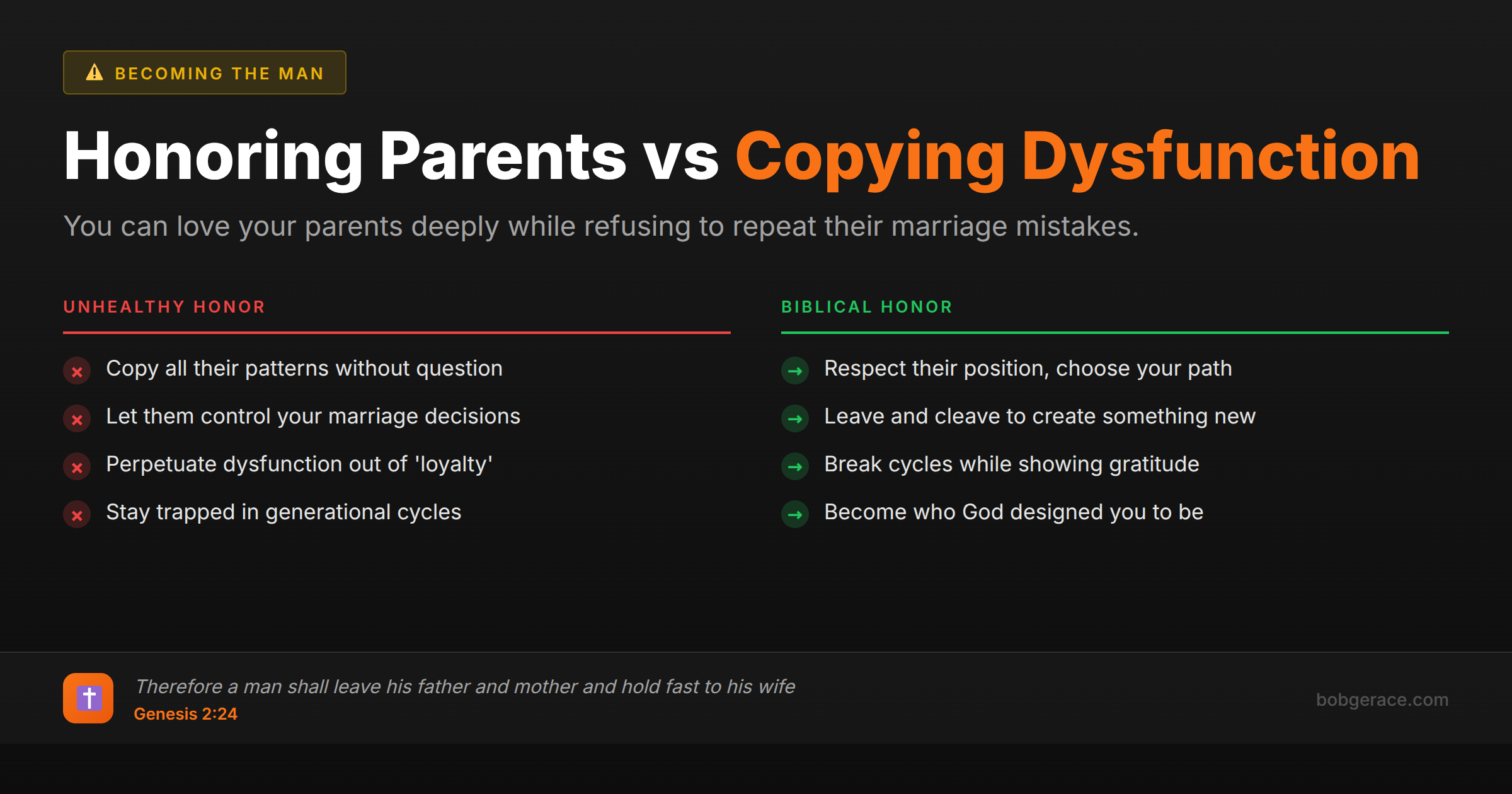
Honoring your parents doesn't mean copying their mistakes or perpetuating dysfunction in your own marriage. Biblical honor means respecting their position while taking responsibility for your own choices. You can love them deeply, appreciate what they gave you, and still choose different patterns for your family. This isn't rebellion—it's maturity. The same God who commands us to honor our parents also calls us to leave and cleave, creating something new. You honor them by becoming the person God designed you to be, not by staying trapped in patterns that damage your marriage.
The Full Picture
This question hits at the heart of one of the most complex dynamics in marriage. You love your parents. You're grateful for the sacrifices they made. But you also see patterns in their relationship—maybe conflict avoidance, emotional distance, poor communication, or unhealthy control dynamics—that you don't want to repeat in your own marriage.
Here's what makes this so difficult: honoring your parents feels like it should mean following their example. But that's not what Scripture teaches. Biblical honor is about respect, gratitude, and care—not blind imitation. Your parents did their best with what they had, but that doesn't make every pattern they established healthy or worth continuing.
The tension you feel is real because you're trying to balance two legitimate biblical commands: honor your father and mother, and leave and cleave to create your own family unit. These aren't contradictory—they're complementary. You can deeply honor your parents while making different choices for your marriage.
This is actually about stewardship. God has given you a marriage, and you're responsible for stewarding it well. Sometimes that means learning from your parents' strengths and growing beyond their limitations. Your parents' patterns were shaped by their own wounds, their generation's limitations, and their unique circumstances. Your marriage faces different challenges and has different opportunities.
The goal isn't to reject everything they taught you or to cut them off. It's to take the gold they gave you and leave behind what doesn't serve your marriage. This requires wisdom, courage, and often some difficult conversations—both with your spouse about what patterns you want to change, and sometimes with your parents about boundaries you need to establish.
What's Really Happening
From a clinical perspective, you're navigating what we call differentiation—the ability to maintain your own identity and values while staying emotionally connected to your family of origin. This is one of the most critical developmental tasks for married adults, and it's where many people get stuck.
What complicates this process is family loyalty—the often unconscious belief that changing family patterns is a betrayal. This loyalty can manifest as guilt when you make different choices, anxiety about disappointing your parents, or even self-sabotage when your marriage starts functioning better than your parents' did.
There's also the challenge of inherited emotional patterns. We learn how to handle conflict, express affection, manage stress, and communicate primarily through observation. These patterns get wired into our nervous system early, making them feel natural and right even when they're destructive.
The key insight is this: true honor actually requires some level of differentiation. Children who never develop beyond their family's patterns often become stuck, resentful, or dysfunctional—hardly an honor to their parents' investment. Parents may initially resist your changes because they can feel threatening, but healthy parents ultimately want their children to thrive.
Breaking patterns requires both conscious choice and skill development. It's not enough to decide you want to be different—you need to learn new ways of communicating, handling conflict, and relating to each other. This is why many couples benefit from coaching or counseling during this process. You're literally rewiring decades of learned responses.
What Scripture Says
Scripture gives us clear guidance on both honoring parents and creating healthy marriages. The command to "Honor your father and mother" (Ephesians 6:2) is absolute, but it doesn't mean blind obedience or pattern replication for adults.
"Therefore a man shall leave his father and mother and hold fast to his wife, and the two shall become one flesh" (Genesis 2:24). This leaving isn't geographical—it's emotional and relational. You're called to create something new, which requires some level of departure from your parents' model.
Jesus himself modeled this balance. When his family tried to interrupt his ministry, he said, "Who are my mother and my brothers? Here are my mother and my brothers! Whoever does the will of God, he is my brother and sister and mother" (Mark 3:33-35). He loved his family but didn't let their expectations override his calling.
"When I was a child, I spoke like a child, I thought like a child, I reasoned like a child. When I became a man, I gave up childish ways" (1 Corinthians 13:11). Part of maturity is outgrowing patterns that worked in childhood but don't serve adult relationships.
The Proverbs repeatedly emphasize wisdom and discernment: "The simple inherit folly, but the prudent are crowned with knowledge" (Proverbs 14:18). You honor your parents by using wisdom to build on their foundation, not by mindlessly repeating their mistakes.
"Above all else, guard your heart, for everything you do flows from it" (Proverbs 4:23). You're responsible for stewarding your own heart and marriage, even when that means making different choices than your parents made.
What To Do Right Now
-
1
Identify specific patterns you want to change - Write down 2-3 patterns from your family that you don't want in your marriage
-
2
Have an honest conversation with your spouse - Discuss what patterns each of you brings and what you want to build together
-
3
Learn new skills - If your parents avoided conflict, learn healthy conflict resolution. If they were emotionally distant, practice vulnerability
-
4
Set appropriate boundaries - You can love your parents while limiting their influence on your marriage decisions
-
5
Express gratitude for what they gave you - Regularly acknowledge the good things you learned from your parents
-
6
Get support - Consider marriage coaching or counseling to help navigate this transition and build new patterns
Related Questions
- What does 'sins of the fathers' mean?
- How do generational patterns work spiritually?
- What patterns did I inherit vs. choose?
- What is 'intergenerational transmission'?
- What did I learn about love from my parents?
- What would breaking the family cycle require?
- What legacy am I leaving them through this crisis?
- How do I teach them about marriage when mine is failing?
- What does 'sins of the fathers' mean and how do I break the cycle?
- What role did my childhood play in my anger patterns?
Also find Bob on
Subscribe for weekly videos on Christian marriage.
Breaking patterns in your actual marriage
A coach who knows your family history, your wife's experience, and where you're stuck can help you build something different without guessing. You don't have to figure this out alone.
Talk to Bob →