How did I learn these patterns?
6 min read
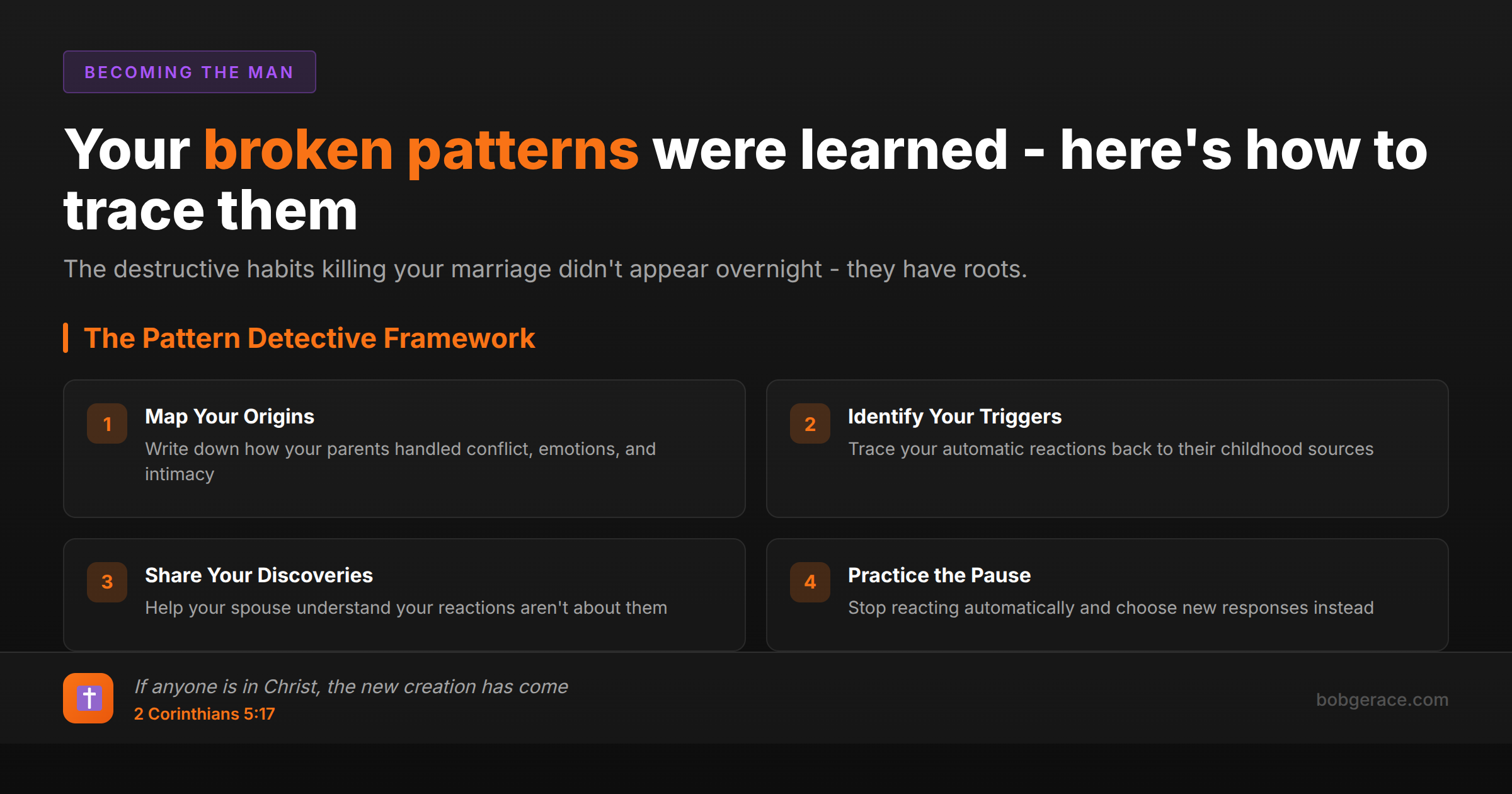
Your destructive patterns didn't appear out of nowhere - they were learned through years of observation, experience, and adaptation. Most of these patterns formed during your childhood as you watched how your parents handled conflict, intimacy, and stress. Your young brain absorbed these lessons as "normal" and filed them away as your operating system for relationships. Every family has unspoken rules about emotions, conflict, and connection. Maybe you learned that anger is dangerous, so you shut down. Maybe you saw that being "perfect" earned love, so you became a people-pleaser. These weren't conscious choices - they were survival strategies that helped you navigate your childhood environment but now sabotage your marriage.
The Full Picture
Understanding where your patterns come from isn't about blame - it's about freedom. When you can trace your reactions back to their source, you stop being a victim of your programming and start becoming the author of your story.
Your family of origin was your first classroom for relationships. Every family has its own emotional climate, communication style, and unwritten rules. If your parents avoided conflict, you likely learned that disagreement equals danger. If one parent was explosive while the other withdrew, you probably picked up one of those strategies as your default.
Generational patterns run deep. The way your grandparents handled marriage influenced your parents, who then influenced you. Patterns of abandonment, control, addiction, or emotional neglect often repeat across generations until someone decides to break the cycle.
Trauma responses also shape your patterns. What might seem like "overreacting" to your spouse could actually be your nervous system responding to old wounds. Your brain doesn't distinguish between past and present threats - it just protects you the way it learned to protect the child you once were.
Cultural and societal influences add another layer. Gender roles, religious upbringing, and cultural expectations all contributed to your blueprint for marriage. Sometimes these influences served you well, but often they created unrealistic expectations or unhealthy dynamics.
The good news? Patterns can be unlearned. Your brain's neuroplasticity means you can literally rewire these automatic responses with intentional practice and new experiences.
What's Really Happening
From a clinical perspective, most destructive relationship patterns are learned adaptations - they made perfect sense in the context where they developed. A child who learned to be hypervigilant around an unpredictable parent will carry that same hypervigilance into marriage, scanning for signs of rejection or anger even when none exist.
Attachment theory explains much of this. Your early relationships with caregivers literally shaped your brain's wiring for connection. Secure attachment creates patterns of trust and effective communication. Insecure attachment - whether anxious, avoidant, or disorganized - creates patterns of fear-based relating that show up decades later in marriage.
Implicit memories are another key factor. These are body-based memories that bypass conscious thought. You might feel sudden panic during a normal conversation because something - a tone of voice, a facial expression - triggered an implicit memory from childhood. Your spouse thinks you're overreacting, but your nervous system is responding to real data from your past.
Family systems theory shows us how families unconsciously assign roles - the peacekeeper, the rebel, the perfect child, the caretaker. These roles become so ingrained that you automatically play them in your marriage, even when they no longer serve you. Breaking free requires conscious recognition and intentional practice of new behaviors.
What Scripture Says
Scripture acknowledges that generational patterns are real and powerful, but it also promises freedom from their grip. Exodus 34:7 warns that "the sins of the fathers" can affect multiple generations, but this isn't a life sentence - it's a call to awareness and repentance.
2 Corinthians 5:17 declares that "if anyone is in Christ, the new creation has come: The old has gone, the new is here!" This doesn't mean your patterns disappear overnight, but it means you have access to God's power to change them. You're not doomed to repeat your family's dysfunction.
Romans 12:2 commands us to "be transformed by the renewing of your mind." This is exactly what breaking destructive patterns requires - literally renewing your mind with new thoughts, new responses, and new ways of relating. God's Spirit enables this transformation as you cooperate with His work in your life.
Ephesians 4:22-24 describes the process: "Put off your old self, which is being corrupted by its deceitful desires; be made new in the attitude of your minds; and put on the new self, created to be like God in true righteousness and holiness." Your old patterns are part of that "old self" that you can choose to put off.
Isaiah 43:18-19 offers hope: "Forget the former things; do not dwell on the past. See, I am doing a new thing! Now it springs up; do you not perceive it?" God specializes in breaking generational cycles and creating new patterns of health and wholeness.
What To Do Right Now
-
1
Map your family patterns by writing down how your parents handled conflict, emotions, and intimacy
-
2
Identify your specific triggers and trace them back to their likely origins in your childhood
-
3
Share your discoveries with your spouse to help them understand your reactions aren't about them
-
4
Practice pausing when triggered instead of reacting automatically from old patterns
-
5
Seek counseling to process deeper trauma or family of origin wounds that drive your patterns
-
6
Pray regularly for God to heal generational patterns and establish new, healthy ways of relating
Related Questions
Ready to Break Free from Old Patterns?
Understanding where your patterns come from is the first step toward freedom. Let's work together to rewire your responses and create the marriage you've always wanted.
Start Here →