Am I like my father?
6 min read
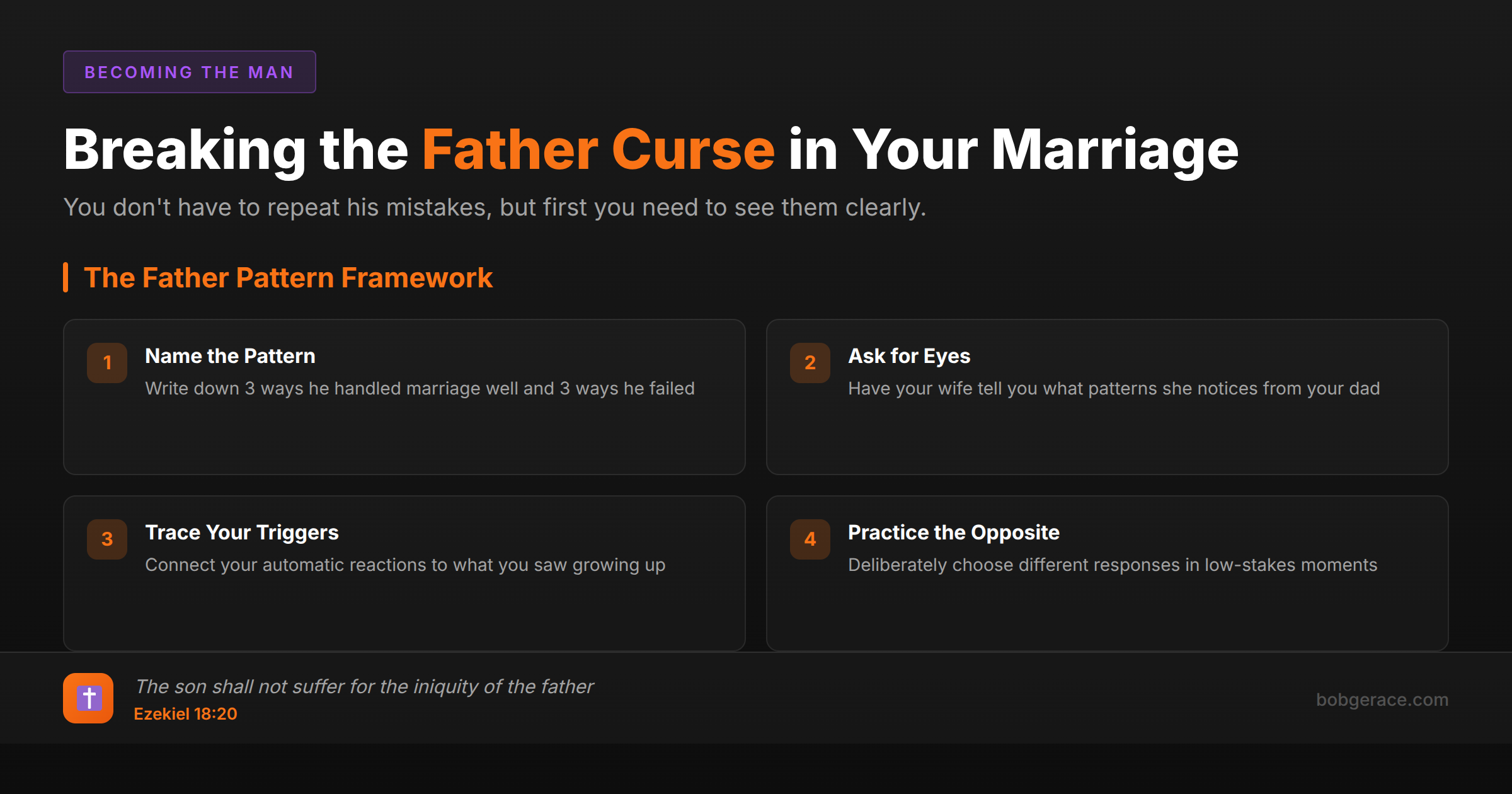
The question 'Am I like my father?' often emerges when we recognize troubling patterns in our marriage that feel familiar yet unwanted. The truth is, we all carry forward elements of our father's influence—both positive and negative—whether we realize it or not. This isn't about blame; it's about awareness and choice. Your father's way of handling conflict, expressing emotions, treating women, and managing stress became your earliest template for manhood and relationships. Even if you consciously rejected his approach, his influence may still show up in your reactions under pressure. The good news? Recognizing these patterns is the first step toward breaking the destructive ones while building on the positive qualities you may have inherited.
The Full Picture
The father-son relationship creates a blueprint that runs deeper than most men realize. Your father was your first model of masculinity, showing you how men handle responsibility, express love, deal with frustration, and interact with their wives. This modeling happened through both his presence and his absence, his words and his silence.
Many men experience what I call the "father echo"—moments when they hear their father's words coming out of their mouth or catch themselves reacting exactly as he did. This can be terrifying when you remember how those reactions affected your childhood home. You might find yourself thinking, "I swore I'd never be like him," yet there you are, repeating familiar patterns.
But here's what's important to understand: similarity to your father isn't inherently good or bad. Many fathers modeled positive qualities—integrity, work ethic, commitment, protection of family. The key is developing the wisdom to recognize which inherited traits serve your marriage well and which ones are sabotaging your relationship.
The influence goes beyond behavior to core beliefs. Your father's relationship with your mother taught you lessons about marriage, whether he intended to or not. You learned about power dynamics, emotional expression, conflict resolution, and intimacy by watching their interactions. These early observations formed neural pathways that now influence your automatic responses in marriage.
Breaking negative cycles while preserving positive qualities requires intentional work. It's not enough to simply "not be like dad"—you need to actively develop new patterns and responses that honor your wife and strengthen your marriage.
What's Really Happening
From a psychological perspective, we call this phenomenon "intergenerational transmission." Research consistently shows that relationship patterns, emotional regulation styles, and even specific behaviors are passed down through families with remarkable consistency. This happens through multiple mechanisms: direct modeling, emotional attunement, and what we call "earned secure attachment."
Your nervous system learned to respond to stress, conflict, and intimacy by watching your father's responses. These patterns become so deeply embedded that they feel automatic and "right" even when they're clearly destructive. The brain prioritizes familiar patterns over healthy ones, which explains why intelligent men can find themselves repeating their father's mistakes despite knowing better intellectually.
Trauma bonding also plays a role. If your father struggled with anger, addiction, or emotional unavailability, you may have developed coping mechanisms that served you as a child but now harm your marriage. You might withdraw during conflict (learned from watching mom shut down), explode when criticized (mirroring dad's defensiveness), or struggle with emotional intimacy (never seeing it modeled).
The hopeful reality is that neuroplasticity allows for change at any age. Through conscious practice, therapy, and new relational experiences, you can literally rewire your brain to respond differently. The key is bringing unconscious patterns into conscious awareness, then practicing new responses until they become natural. This process requires patience and often professional support, but change is absolutely possible.
What Scripture Says
Scripture acknowledges the reality of generational influence while calling us to break destructive cycles. Exodus 20:5 warns that the "iniquities of the fathers" can be visited upon children "to the third and fourth generation," but this isn't deterministic—it's descriptive of how sin patterns naturally perpetuate when left unchecked.
The hope comes in Ezekiel 18:20: "The son shall not suffer for the iniquity of the father." God makes it clear that we're not prisoners of our father's failures. We have both the responsibility and the power to choose a different path.
Ephesians 4:22-24 calls us to "put off your old self, which belongs to your former manner of life" and "put on the new self, created after the likeness of God." This transformation isn't just spiritual—it affects every aspect of how we relate to our wives. The "old self" includes learned patterns from our family of origin that don't align with God's design for marriage.
1 Corinthians 13:11 reminds us: "When I became a man, I gave up childish ways." Part of becoming a man is evaluating what we learned in childhood and choosing to keep what serves love while discarding what harms our relationships. This requires the humility to examine ourselves honestly.
2 Corinthians 5:17 promises that "if anyone is in Christ, he is a new creation. The old has passed away; behold, the new has come." Your father's influence doesn't have to define your marriage. Through Christ, you can become the husband God designed you to be, breaking generational cycles and establishing new patterns of love, honor, and faithfulness.
The goal isn't to dishonor your father, but to "honor your father and mother" (Ephesians 6:2) while also becoming the man God calls you to be in your own marriage.
What To Do Right Now
-
1
Write down three specific ways your father handled marriage well and three ways he struggled—be honest about both lists
-
2
Ask your wife what patterns she's noticed that remind her of stories you've shared about your father—listen without defending
-
3
Identify your automatic responses during conflict and trace them back to what you observed growing up
-
4
Practice doing the opposite of your father's negative patterns in low-stakes situations to build new neural pathways
-
5
Have a conversation with your wife about what kind of legacy you want to leave for your children
-
6
Consider counseling or coaching to help process father-related issues that may be impacting your marriage
Related Questions
- Where does this come from?
- How did I learn these patterns?
- Is this about my childhood?
- What patterns did I inherit vs. choose?
- What is 'intergenerational transmission'?
- What unmet needs from childhood am I still seeking?
- What role did our relationship problems play?
- Why did she cheat?
- What does 'sins of the fathers' mean and how do I break the cycle?
- How do I teach them about marriage when mine is failing?
Also find Bob on
Subscribe for weekly videos on Christian marriage.
Your Marriage Isn't Your Father's
Breaking patterns you inherited takes more than awareness—it takes a coach who knows your specific story and can help you build something different.
Talk to Bob →