How do I share emotion without overwhelming?
6 min read
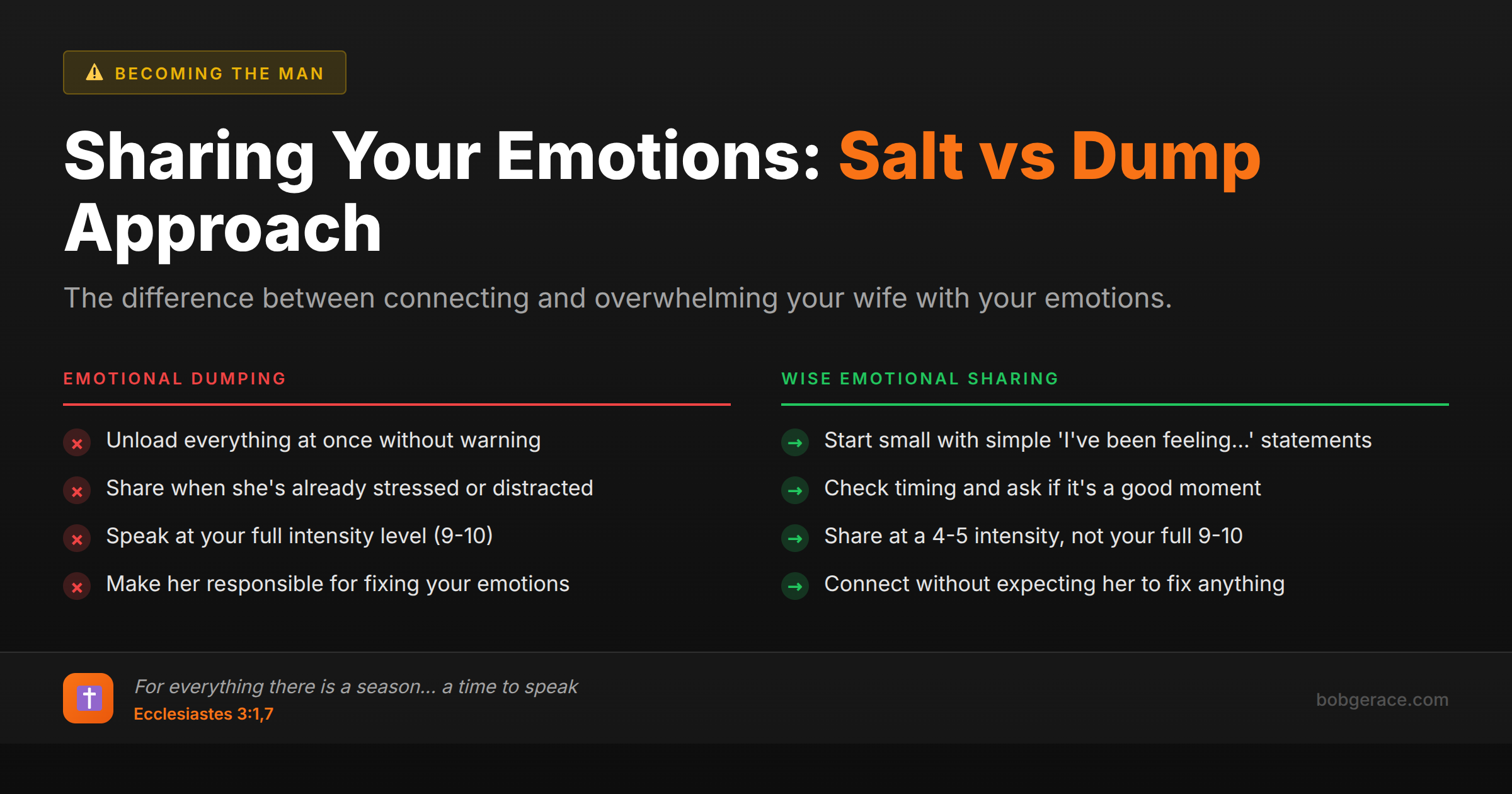
The key to sharing emotion without overwhelming is timing, dosage, and delivery. Start small with simple statements like 'I've been feeling frustrated about work lately' rather than unloading everything at once. Choose moments when your wife has emotional bandwidth - not when she's stressed or distracted. Use 'I' statements, speak calmly, and pause to let her process. Most importantly, don't make her responsible for fixing your emotions. You're sharing to connect, not to dump. Think of it like adding salt to food - a little enhances the flavor, but too much ruins the meal. Your emotions matter and deserve to be shared, but wisdom in how you share them protects both of you.
The Full Picture
Most men struggle with emotional sharing because we've been taught two extremes: shut it down completely or let it all hang out. Both approaches damage marriages. The shutdown creates distance and loneliness. The emotional dump creates chaos and burden. Neither builds the connection you're actually seeking.
The real issue isn't whether to share emotions - it's how to share them responsibly. Your wife wants to know what's going on inside you, but she doesn't want to become your emotional dumping ground or your therapist. She wants connection, not crisis management.
Think about emotional sharing like physical intimacy. There's a difference between meaningful connection and just getting your needs met. Emotional intimacy requires the same consideration, timing, and mutual respect. When you share emotions thoughtfully, you invite her into your inner world without making her carry the weight of fixing it.
The goal is vulnerability that connects, not vulnerability that overwhelms. This means being selective about timing, intentional about delivery, and clear about what you need from her. Sometimes you just need her to listen. Sometimes you want her perspective. Sometimes you need to process something together. But you should never make her responsible for managing your emotional state.
Remember, emotional sharing is a skill that improves with practice. Start with smaller emotions and lower-stakes situations. Build trust through consistent, thoughtful communication. As she learns that your emotional sharing doesn't create chaos or unrealistic demands on her, she'll be more open to deeper conversations.
What's Really Happening
Emotional overwhelm occurs when the recipient feels responsible for managing emotions that aren't theirs to manage. This typically happens through three mechanisms: emotional dumping, timing insensitivity, and unclear expectations.
Emotional dumping involves sharing high-intensity emotions without warning or context. When you've been processing something internally for days or weeks, then suddenly share it all at once, your wife experiences emotional whiplash. She's trying to catch up to where you are emotionally while also managing her own reaction.
Timing insensitivity occurs when we share emotions based on our need to release them, rather than considering our partner's capacity to receive them. Your wife may be dealing with her own stress, fatigue, or emotional load. Adding your emotional content without checking her bandwidth creates overwhelm.
Unclear expectations create anxiety because your wife doesn't know her role. Are you seeking advice? Just venting? Wanting comfort? Needing her to take action? When expectations aren't clear, she may feel responsible for solving problems that aren't hers to solve.
Healthy emotional sharing involves emotional regulation, contextual awareness, and clear communication. You process and regulate the intensity of your emotions before sharing. You assess the timing and your wife's capacity. You clearly communicate what you need from the interaction. This creates safety for both of you - you get the connection you seek without creating burden or chaos.
What Scripture Says
Scripture calls us to wisdom in our words and emotional expression. Proverbs 27:14 warns us: *'Whoever blesses his neighbor with a loud voice, rising early in the morning, will be counted as cursing him.'* Even good intentions can become burdensome when delivered poorly.
Ecclesiastes 3:1,7 reminds us: *'For everything there is a season, and a time for every matter under heaven... a time to keep silence, and a time to speak.'* Emotional sharing requires discernment about timing and appropriateness.
The principle of bearing one another's burdens must be balanced with personal responsibility. Galatians 6:2,5 says: *'Bear one another's burdens, and so fulfill the law of Christ... For each will have to bear his own load.'* There's a difference between appropriate burden-sharing and dumping our responsibilities on others.
Proverbs 18:13 warns against overwhelming communication: *'If one gives an answer before he hears, it is his folly and shame.'* This applies to emotional sharing - we must consider whether our spouse is ready to hear and process what we're sharing.
1 Corinthians 13:5 tells us love *'does not insist on its own way.'* This means considering our wife's emotional capacity and needs, not just our own need to express emotions.
Christ himself modeled selective emotional sharing. He didn't burden his disciples with every emotion or struggle, but shared appropriately and with purpose. Matthew 26:38-39 shows Jesus sharing his anguish with his closest disciples while taking ultimate responsibility before God.
What To Do Right Now
-
1
Check timing - ask 'Is this a good time to share something I've been processing?' before diving into emotional content
-
2
Start with context - give her a brief overview so she knows what kind of conversation this will be and what you need from her
-
3
Use the 'emotional thermometer' - share emotions at a 4-5 intensity level, not at the 9-10 you might be feeling internally
-
4
Take breaks - pause every few minutes to check in and see how she's processing what you've shared
-
5
Be clear about expectations - explicitly state whether you want advice, just listening, prayer, or her perspective
-
6
Own your emotions - use phrases like 'I'm working through this' rather than making her feel responsible for fixing or managing your emotional state
Related Questions
- How do I become emotionally intelligent?
- How do I express emotion without dumping?
- What's healthy vulnerability look like?
- How do I open up without falling apart?
- How do I identify what I'm feeling?
- What does emotional co-regulation look like?
- How do I not lose my mind right now?
- How do I regulate when my body is in fight-or-flight?
- What does nervous system regulation look like?
- How do I stay connected while enforcing boundaries?
Also find Bob on
Subscribe for weekly videos on Christian marriage.
You don't have to guess at this alone
A coach who knows your marriage can help you calibrate what to share, when, and how—so you connect instead of overwhelm. Bring your specific situation to Bob.
Talk to Bob →