Do I have a personality disorder?
6 min read
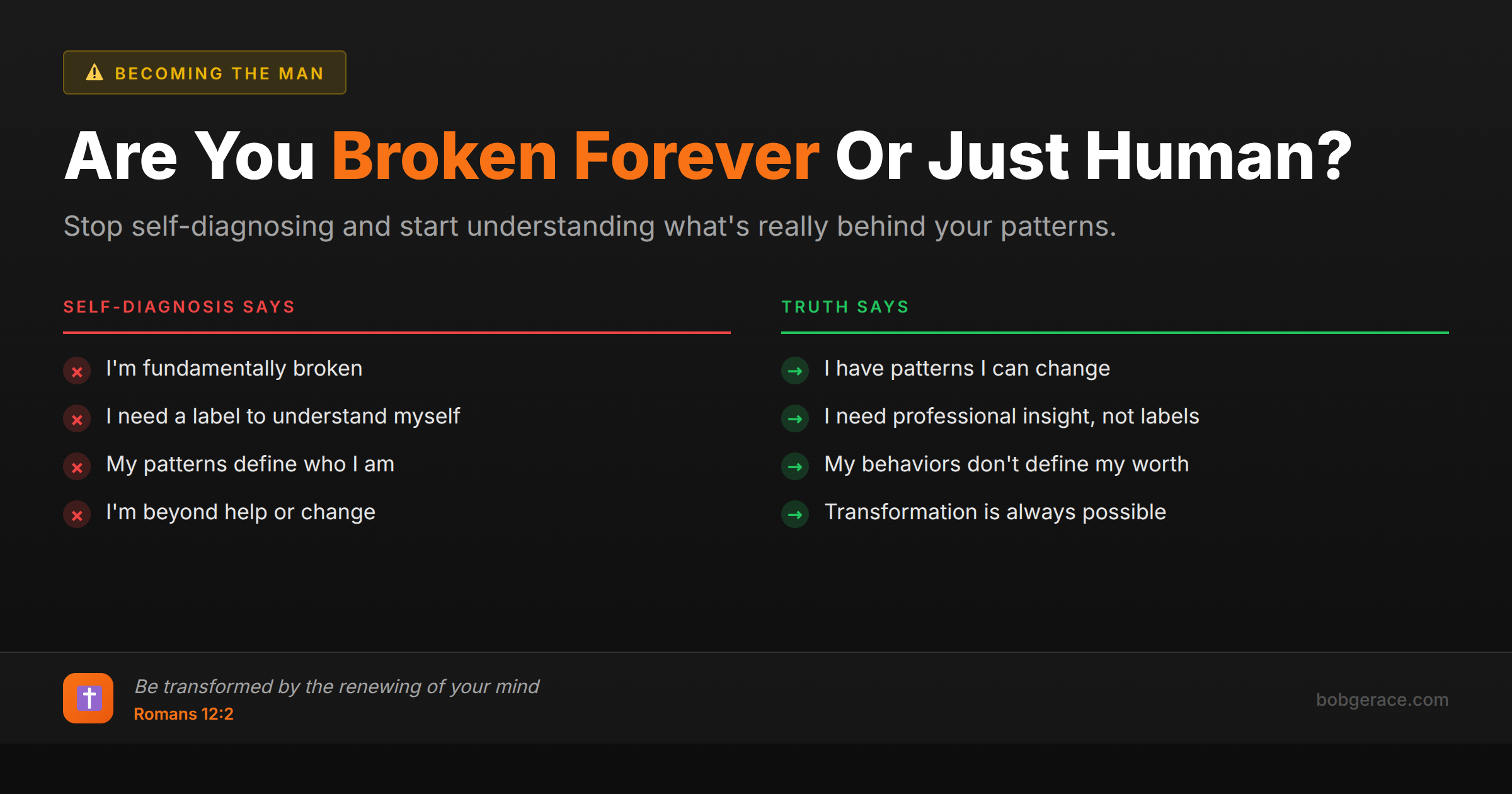
If you're asking this question, you're likely noticing patterns in your behavior that concern you or your spouse. While I can't diagnose personality disorders (only licensed mental health professionals can), I can tell you that wondering about this shows self-awareness - which is actually a positive sign. Many people with actual personality disorders lack this insight. The reality is that we all have personality traits that can become problematic under stress. What matters most isn't getting a label, but understanding your patterns and learning healthier ways to relate to your spouse. Some behaviors that feel 'disordered' are actually trauma responses, learned patterns from childhood, or symptoms of treatable conditions like anxiety or depression.
The Full Picture
Here's what I've learned after years of marriage coaching: most people asking this question don't have a personality disorder. They have patterns - often learned in childhood or developed as coping mechanisms - that are now causing problems in their marriage.
Personality disorders are specific mental health conditions with strict diagnostic criteria. They're characterized by pervasive, long-term patterns of thinking and behaving that are significantly different from cultural norms, cause distress, and impair functioning across multiple areas of life.
What I see more often are people who: - React intensely when they feel criticized or abandoned - Struggle with emotional regulation during conflict - Have difficulty trusting their spouse's motives - Feel 'broken' or 'too much' for their partner - Swing between idealization and disappointment in relationships
These patterns often stem from attachment wounds, unresolved trauma, or growing up in dysfunctional family systems. The good news? Unlike personality disorders, these patterns are very treatable with the right approach.
I've watched hundreds of couples break destructive cycles once they understand what's really driving the behavior. Sometimes it's undiagnosed ADHD, anxiety, or depression. Sometimes it's complex PTSD from childhood experiences. Often, it's simply learned patterns that can be unlearned.
The key difference is this: personality disorders involve a fundamental inability to see one's own role in problems. If you're asking this question with genuine concern about how your behavior affects your marriage, you're already demonstrating the self-awareness that makes change possible.
What's Really Happening
From a clinical perspective, true personality disorders affect only about 10-13% of the population, yet many more people worry they might have one. This concern often arises when individuals recognize their emotional reactions seem 'bigger' than the situation warrants.
What we typically see in marriage counseling are maladaptive coping strategies that developed early in life. For example, someone who grew up with an emotionally unavailable parent might have learned to escalate emotions to get attention - a strategy that worked in childhood but damages adult relationships.
Trauma responses can also mimic personality disorder symptoms. A person with complex PTSD might exhibit emotional dysregulation, fear of abandonment, and unstable relationships - symptoms that overlap with borderline personality disorder but have different underlying causes and treatment approaches.
The most important clinical distinction is insight and motivation to change. Individuals with personality disorders often externalize blame and resist seeing their role in relationship problems. If you're genuinely concerned about your impact on your marriage and motivated to change, this suggests your patterns are likely more treatable than a true personality disorder.
Attachment styles also play a crucial role. Anxious or disorganized attachment can create behaviors that seem 'disordered' but are actually predictable responses to perceived threats to the relationship. Understanding your attachment style can be far more helpful than pursuing a personality disorder diagnosis.
What Scripture Says
Scripture offers profound hope for transformation, regardless of our struggles. Romans 12:2 reminds us: *'Do not conform to the pattern of this world, but be transformed by the renewing of your mind. Then you will be able to test and approve what God's will is—his good, pleasing and perfect will.'* This transformation is available to everyone.
God sees beyond our patterns to our potential. Jeremiah 1:5 declares: *'Before I formed you in the womb I knew you, before you were born I set you apart.'* Your identity isn't defined by your struggles or even a diagnosis - it's rooted in being God's beloved child.
Psalm 139:23-24 gives us the right heart posture: *'Search me, God, and know my heart; test me and know my anxious thoughts. See if there is any offensive way in me, and lead me in the way everlasting.'* This is the humility that leads to healing.
While we take responsibility for our actions, we also recognize that Ephesians 2:10 tells us: *'For we are God's handiwork, created in Christ Jesus to do good works, which God prepared in advance for us to do.'* Even our struggles can become part of God's redemptive work.
2 Corinthians 5:17 offers ultimate hope: *'Therefore, if anyone is in Christ, the new creation has come: The old has gone, the new is here!'* This doesn't mean instant healing, but it does mean that change is possible through God's power working in us.
Finally, Philippians 1:6 assures us: *'Being confident of this, that he who began a good work in you will carry it on to completion until the day of Christ Jesus.'* God isn't finished with you yet.
What To Do Right Now
-
1
Stop self-diagnosing - Focus on observable behaviors and their impact rather than trying to label yourself
-
2
Track your patterns - Note what triggers intense reactions and how you respond when feeling threatened or criticized
-
3
Get professional evaluation - See a licensed therapist who can properly assess what's really going on
-
4
Focus on what you can control - Work on developing emotional regulation skills regardless of any diagnosis
-
5
Communicate with your spouse - Share your concerns and your commitment to change, asking for patience as you work on growth
-
6
Start trauma-informed therapy - Many 'personality issues' are actually unresolved trauma responses that respond well to treatment
Related Questions
- Is there something wrong with me?
- Should I be on medication?
- Do I need therapy, coaching, or both?
- What is 'complex trauma' and do I have it?
- What role might ADHD/depression/anxiety play?
- What does a comprehensive mental health assessment look like?
- I can't control my anger
- Why do I rage at the people I love?
- What is 'betrayal trauma' and do I have it?
- Is this PTSD?
Also find Bob on
Subscribe for weekly videos on Christian marriage.
Your Marriage Needs Your Specific Story
A coach who knows your patterns, your triggers, your actual marriage can help you see what's really happening and what to do about it.
Talk to Bob →