Where does this come from?
6 min read
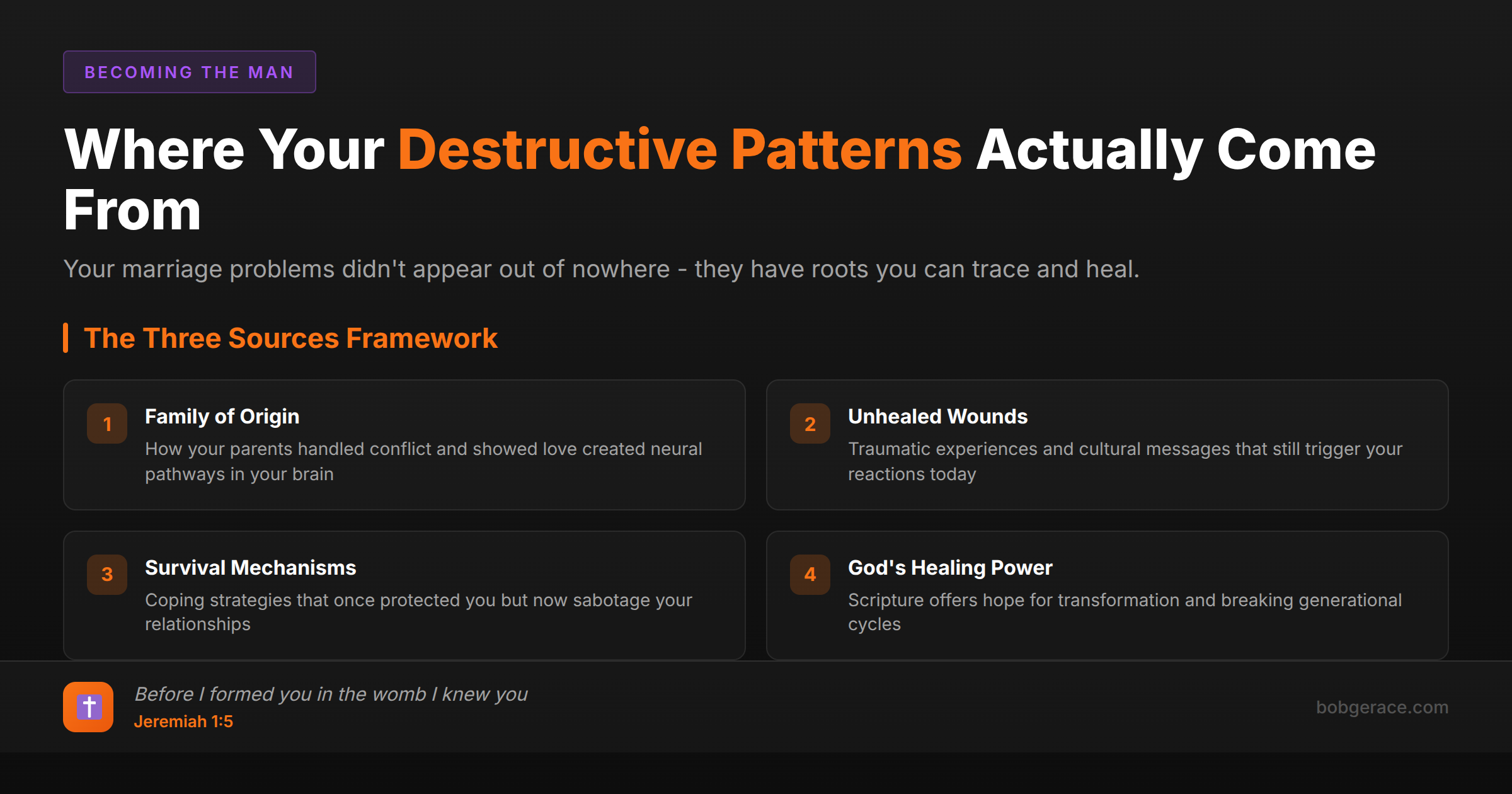
Your destructive marriage patterns didn't appear out of nowhere - they have roots. Most often, they stem from three primary sources: your family of origin, unhealed emotional wounds, and learned behavioral patterns that once served as survival mechanisms but now sabotage your relationships. The way your parents handled conflict, showed affection, or avoided intimacy created neural pathways in your developing brain. Add traumatic experiences, cultural messages about relationships, and your own coping mechanisms, and you get a perfect storm of unconscious patterns. The good news? Once you understand where these patterns come from, you can begin the work of rewiring them through intentional practice and God's healing power.
The Full Picture
Understanding where your destructive patterns come from requires looking at multiple layers of influence that shaped who you are today. Your family of origin is the first and most powerful influence. The way your parents related to each other became your template for marriage - even if you consciously rejected their example, their patterns often show up in your own relationship.
If your father was emotionally distant, you might find yourself shutting down during conflict. If your mother was controlling, you might either become controlling yourself or completely passive. These aren't conscious choices - they're deeply embedded neural pathways formed during your most impressionable years.
Attachment wounds play a massive role. If you experienced abandonment, rejection, or inconsistent care as a child, your nervous system developed strategies to protect you. Maybe you became hyper-vigilant about your spouse's moods, or perhaps you learned to disappear emotionally when things get intense.
Cultural and societal messages about gender roles, success, and relationships also shape your expectations and behaviors. Add in traumatic experiences - whether obvious abuse or subtle emotional neglect - and you have a complex web of influences creating your current patterns.
Your brain's survival mechanisms are also at play. What helped you survive childhood might be destroying your marriage. The people-pleasing that kept you safe with an angry parent now prevents authentic intimacy with your spouse. The emotional walls that protected you from a chaotic home now keep your partner at arm's length.
The key insight is this: your patterns made sense at one point. They served a purpose. Your brain isn't broken - it's doing exactly what it was trained to do. But what once protected you is now sabotaging the very relationship you want to succeed.
What's Really Happening
From a neurobiological perspective, your marriage patterns are the result of implicit memories stored in your limbic system. These memories operate below conscious awareness but drive your automatic responses to relationship stress.
When your partner triggers you, you're not just responding to the current situation - you're responding to every similar situation your nervous system remembers, often going back to early childhood experiences. This is why your reactions sometimes feel disproportionate to the actual trigger.
Attachment theory helps explain this process. If you developed an anxious attachment style due to inconsistent caregiving, you'll likely pursue your partner when they withdraw, often in increasingly desperate ways. If you developed an avoidant style due to emotional neglect, you'll shut down when your partner seeks connection.
The good news is neuroplasticity - your brain's ability to form new neural pathways throughout your life. Through consistent practice of new behaviors, therapy, and intentional rewiring work, you can literally change your brain's default responses.
Trauma-informed therapy approaches like EMDR, somatic experiencing, and Internal Family Systems can help process the underlying wounds that drive these patterns. The goal isn't to blame your past but to understand it so you can make conscious choices rather than operating from unconscious programming.
Healing happens in relationship. While individual therapy helps you understand your patterns, marriage counseling or coaching provides the safe space to practice new ways of relating and create secure attachment with your spouse.
What Scripture Says
Scripture acknowledges that our past shapes us while offering hope for transformation. Jeremiah 1:5 reminds us that God knew us before we were formed, understanding every influence that shaped us: *"Before I formed you in the womb I knew you, before you were born I set you apart."*
The Bible also speaks to generational patterns. Exodus 34:7 mentions how the "iniquity of the fathers" affects children to the third and fourth generation - not as punishment, but as a description of how destructive patterns pass down through families. Yet this same passage emphasizes God's abundant love and faithfulness.
Psalm 139:23-24 gives us the pathway forward: *"Search me, God, and know my heart; test me and know my anxious thoughts. See if there is any offensive way in me, and lead me in the way everlasting."* God wants to reveal the hidden patterns and wounds that drive our behavior.
The promise of transformation is clear in 2 Corinthians 5:17: *"Therefore, if anyone is in Christ, the new creation has come: The old has gone, the new is here!"* Your past doesn't have to determine your future.
Romans 12:2 calls us to renewal: *"Do not conform to the pattern of this world, but be transformed by the renewing of your mind."* This renewal includes the patterns learned in your family of origin.
Finally, Isaiah 61:3 promises that God will give *"a crown of beauty instead of ashes, the oil of joy instead of mourning, and a garment of praise instead of a spirit of despair."* Your painful past can become the very foundation for a beautiful marriage when surrendered to God's healing process.
What To Do Right Now
-
1
Map your family patterns by writing down how your parents handled conflict, showed affection, and dealt with emotions
-
2
Identify your triggers by noting when you react disproportionately to your spouse's behavior
-
3
Connect current reactions to past experiences by asking 'What does this remind me of from childhood?'
-
4
Share your discoveries with your spouse in a non-defensive conversation about your backgrounds
-
5
Seek professional help from a trauma-informed therapist or marriage counselor
-
6
Practice new responses by choosing one pattern to work on and implementing a different behavior for 30 days
Related Questions
Ready to Break Free from Your Past?
Understanding where your patterns come from is the first step. Let's work together to rewire these patterns and create the marriage you've always wanted.
Start Healing →