What is 'parentification' and am I doing it to them?
6 min read
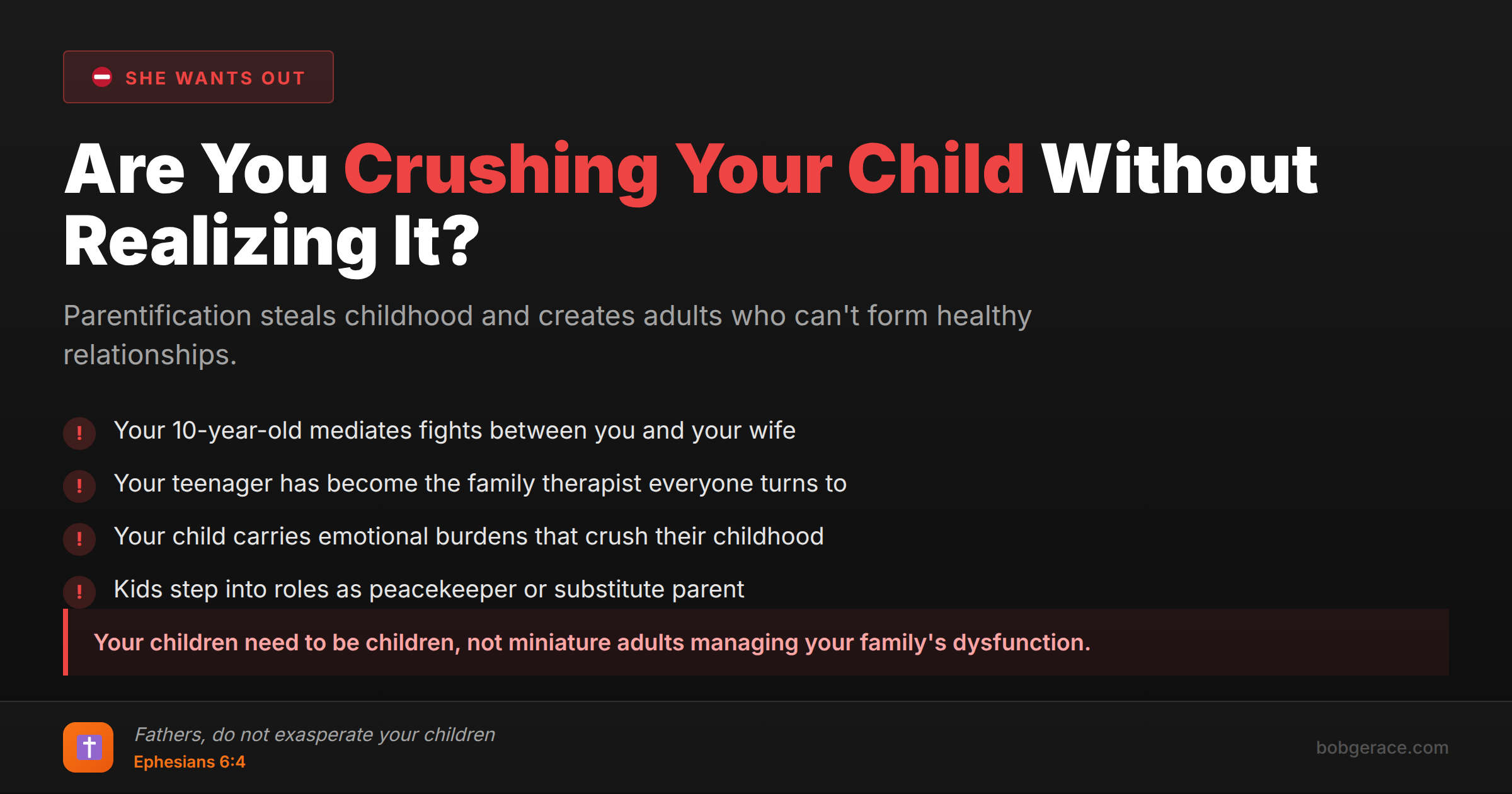
Parentification happens when your child becomes responsible for meeting your emotional needs or handling adult responsibilities that should be yours. If your 10-year-old is mediating fights between you and your wife, or your teenager has become the family therapist everyone turns to, you're parentifying them. This isn't about age-appropriate chores—it's about making your child carry burdens that are crushing their childhood. The brutal truth? When your marriage is struggling, kids often step into roles they were never meant to fill. They become the peacekeeper, the emotional caretaker, or the substitute parent for younger siblings. This robs them of their childhood and sets them up for relationship problems later. Your children need to be children, not miniature adults managing your family's dysfunction.
The Full Picture
Parentification comes in two forms: instrumental and emotional. Instrumental parentification involves giving children adult responsibilities like paying bills, managing household tasks beyond their age, or caring for younger siblings as if they're the parent. Emotional parentification is more subtle but equally damaging—it's when children become their parent's confidant, therapist, or emotional caretaker.
Here's what emotional parentification looks like in practice: • Your child comforts you when you're upset about your marriage • They feel responsible for keeping peace between you and your wife • You share details about your relationship problems with them • They worry about your emotional well-being more than their own needs • Other family members come to them to "fix" problems
The dangerous part? Children who are parentified often seem mature and capable. They get praised for being "so responsible" or "wise beyond their years." But underneath, they're carrying anxiety, resentment, and a distorted sense of responsibility that will follow them into their own relationships.
Parentification typically happens gradually, especially during marital stress. When you and your wife are disconnected, children naturally try to fill the gap. They become hypervigilant to everyone's emotions, trying to manage what the adults can't or won't handle. This creates a family system where the child holds disproportionate power and responsibility—a burden no child should carry.
What's Really Happening
From a clinical perspective, parentification represents a fundamental disruption in healthy family hierarchy. When children assume adult roles, it creates what we call "boundary distortions"—the normal protective barriers between parent and child responsibilities become blurred or reversed.
Research shows parentified children often develop what appears to be advanced emotional intelligence, but it's actually hypervigilance born from survival necessity. They learn to read emotional cues not from curiosity, but from a desperate need to manage family stability. This creates chronic stress responses that can persist into adulthood.
Neurologically, children's brains aren't equipped to handle adult emotional complexities. The prefrontal cortex, responsible for executive functioning and emotional regulation, doesn't fully develop until the mid-twenties. When we ask children to manage adult emotions or responsibilities, we're essentially asking an incomplete system to perform beyond its capacity.
Parentified children often struggle with identity formation because their sense of self becomes enmeshed with caretaking roles. They may have difficulty setting boundaries, experience chronic anxiety about others' well-being, and struggle with intimate relationships as adults because they learned love equals responsibility for others' emotions.
The intergenerational impact is significant. Parentified children often become either over-functioning adults who struggle to receive care, or they may swing to the opposite extreme and become under-functioning, seeking the childhood they never had. Understanding this pattern is crucial for breaking the cycle in your own family.
What Scripture Says
Scripture provides clear guidance on family roles and the protection of children. Ephesians 6:4 instructs, "Fathers, do not exasperate your children; instead, bring them up in the training and instruction of the Lord." Parentification exasperates children by placing impossible burdens on them.
Matthew 18:3 reminds us, "Unless you change and become like little children, you will never enter the kingdom of heaven." Jesus valued the qualities unique to childhood—wonder, trust, and freedom from adult anxieties. When we rob children of these qualities through parentification, we're taking something God intended for them to have.
1 Corinthians 13:11 provides developmental wisdom: "When I was a child, I talked like a child, I thought like a child, I reasoned like a child. When I became a man, I put the ways of childhood behind me." This verse affirms that childhood thinking and reasoning are appropriate and necessary for children. Rushing this process violates God's design for human development.
Psalm 127:3 declares, "Children are a heritage from the Lord, offspring a reward from him." As stewards of this heritage, we're called to protect and nurture, not burden. Proverbs 22:6 tells us to "Start children off on the way they should go," which means age-appropriate responsibilities and emotional safety.
God designed family structure with parents as leaders and protectors. When children become emotional caregivers for adults, it inverts His design and places them in roles they weren't created to fill. Our job is to create an environment where children can develop according to God's timeline, not our family's dysfunction.
What To Do Right Now
-
1
Examine your conversations with your children—stop sharing marriage problems, financial stress, or adult emotional burdens with them immediately
-
2
Identify any household responsibilities your child has that exceed age-appropriate expectations and redistribute them to adults
-
3
Notice if family members turn to your child for emotional support or conflict resolution—interrupt this pattern and redirect to appropriate adults
-
4
Create clear boundaries between adult problems and children's awareness—they should know you're handling adult issues without needing details
-
5
Apologize to your child if you've burdened them inappropriately, acknowledging their right to be a kid without taking on adult responsibilities
-
6
Seek professional help for your marriage issues instead of using your child as a confidant or emotional support system
Related Questions
- What do kids understand at different ages?
- What are signs my kids are struggling?
- How do I tell the kids?
- What do I say when kids ask what's happening?
- How do I be a good dad through this?
- How do I not badmouth her when I'm furious?
- How do I stop the mental movies?
- What does healthy coping look like?
- How do I regulate my own system?
- What is self-care in crisis?
Also find Bob on
Subscribe for weekly videos on Christian marriage.
Your Kids Need You to Get Help
A coach who knows your specific family dynamic can help you stop leaning on your kids and start rebuilding the marriage that protects them. This pattern doesn't fix itself.
Talk to Bob →