What language is appropriate for each developmental stage?
6 min read
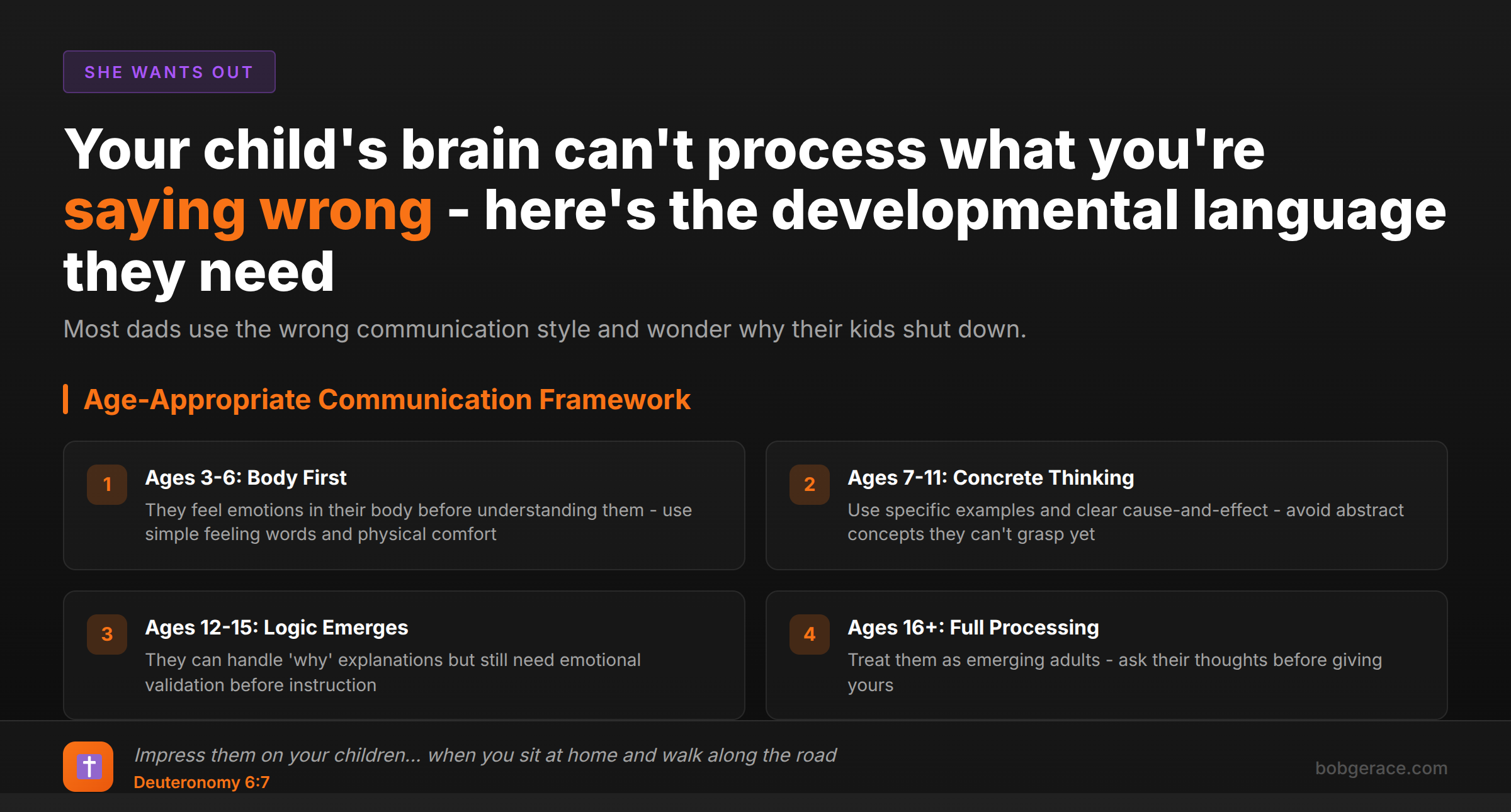
Here's what most men miss: your child's brain literally can't process certain concepts until specific developmental windows open. Using language that's too advanced creates confusion and disconnection. Using language that's too simple feels patronizing and builds resentment. The key isn't just simplifying words—it's matching your communication style to where your child's brain actually is right now. A 4-year-old processes emotions through their body first, then their feelings, then their thoughts. A 12-year-old does the opposite. When you speak their developmental language, you're not just communicating—you're building trust, safety, and connection that will carry your relationship through the teenage years and beyond.
The Full Picture
Your child's ability to understand and process language follows predictable patterns, but most fathers either oversimplify or overcomplicate their communication. Here's what actually works at each stage:
Ages 2-4 (Toddlers): Use concrete, immediate language. "The stove is hot and will hurt you" works better than "dangerous." Name emotions simply: "You feel mad because Tommy took your toy." Keep instructions to 2-3 words: "Shoes on. Time to go."
Ages 5-7 (Early Elementary): They can handle basic cause and effect. "When you hit your sister, she feels hurt and doesn't want to play with you" makes sense now. They're developing moral reasoning, so explain the "why" behind rules. Use concrete examples: "Lying breaks trust, like when someone promises ice cream but doesn't bring it."
Ages 8-11 (Middle Elementary): Abstract thinking emerges. They can understand concepts like fairness, consequences that aren't immediate, and other people's perspectives. You can say, "How do you think Mom felt when she saw the mess?" and they'll actually consider it.
Ages 12-14 (Early Adolescence): Their brains are rewiring for independence and identity. Avoid "because I said so." Instead: "I'm concerned about your safety because teenage brains take more risks. Let's figure out a solution that works for both of us." They need to feel heard and respected, not controlled.
Ages 15-18 (Late Adolescence): Treat them as emerging adults. Share your reasoning: "I've learned that choices at your age can have long-term consequences you can't see yet. What are you thinking about this situation?" Ask questions more than you give answers.
What's Really Happening
The developing brain processes language through three key systems: emotional regulation, cognitive processing, and social understanding. These systems mature at different rates, which explains why age-appropriate communication is so crucial.
Before age 7, children's prefrontal cortex (responsible for logical thinking) is largely offline. They process information through their limbic system first—emotions and body sensations drive their understanding. This is why "You're safe" works better than lengthy explanations about why they shouldn't be afraid.
During middle childhood (ages 7-11), the brain develops executive function capabilities. Children can now hold multiple pieces of information, consider consequences, and understand abstract concepts like fairness and time. This is when collaborative problem-solving becomes possible.
Adolescence brings massive neuroplasticity and pruning. The teenage brain is literally rewiring itself for independence, which creates heightened sensitivity to perceived control or disrespect. Research shows that adolescents' brains light up in the reward centers when they feel autonomy, making collaborative language essential.
Mirror neurons are active throughout all stages, meaning children absorb not just your words but your emotional tone, body language, and underlying attitudes. They're constantly learning "how to be human" by watching how you communicate under stress.
Developmental trauma can delay these stages significantly. A 12-year-old who experienced early trauma might need 6-year-old language during emotional moments, while functioning at grade level academically. Attunement to your individual child's emotional age, not just chronological age, is crucial for effective communication.
What Scripture Says
Scripture provides clear guidance on communicating with children at their level of understanding. Deuteronomy 6:6-7 instructs us: "These commandments that I give you today are to be on your hearts. Impress them on your children. Talk about them when you sit at home and when you walk along the road, when you lie down and when you get up." This reveals that teaching happens through natural, ongoing conversation, not formal lectures.
1 Corinthians 13:11 acknowledges developmental progression: "When I was a child, I talked like a child, I thought like a child, I reasoned like a child. When I became a man, I put the ways of childhood behind me." Paul recognizes that childlike communication is appropriate for children—we shouldn't expect adult reasoning from developing minds.
Ephesians 6:4 gives fathers specific instruction: "Fathers, do not exasperate your children; instead, bring them up in the training and instruction of the Lord." The word "exasperate" (parorgizo) means to provoke to anger through unreasonable demands. Using age-inappropriate language—too complex or too condescending—creates this exact frustration.
Proverbs 22:6 tells us to "Start children off on the way they should go, and even when they are old they will not turn from it." The Hebrew phrase "according to his way" suggests adapting our approach to each child's individual bent and developmental stage.
Matthew 19:14 shows Jesus' heart toward children: "Let the little children come to me, and do not hinder them, for the kingdom of heaven belongs to such as these." Christ didn't speak down to children but welcomed them as they were. Our communication should create invitation, not barriers, helping our children feel safe to approach us with their real thoughts and struggles.
What To Do Right Now
-
1
Observe your child's current comprehension level by asking them to explain back what you just said
-
2
Match your vocabulary to their developmental stage - use concrete words for younger kids, abstract concepts for adolescents
-
3
Get on their physical level when talking - kneel for toddlers, sit beside teenagers rather than standing over them
-
4
Ask "What are you thinking?" instead of "Do you understand?" to gauge their actual processing
-
5
Practice emotional validation before instruction - "You seem frustrated" before "Here's what we need to do"
-
6
Create regular one-on-one conversation time where they lead the topics and you follow their developmental language patterns
Related Questions
- How do I tell the kids?
- What do I say when kids ask what's happening?
- What do kids understand at different ages?
- What are signs my kids are struggling?
- How do I be a good dad through this?
- What do kids need most from dad during divorce?
- How do I not lose my mind right now?
- What is self-care in crisis?
- How do I stay grounded when everything feels adversarial?
- What does healthy coping look like?
Also find Bob on
Subscribe for weekly videos on Christian marriage.
Bring Your Actual Kids to This
Knowing the stages is one thing. Calibrating to your 7-year-old's meltdown or your 14-year-old's shutdown—that's where a coach who knows your family helps you adjust in real time.
Talk to Bob →