What are signs my kids are struggling?
6 min read
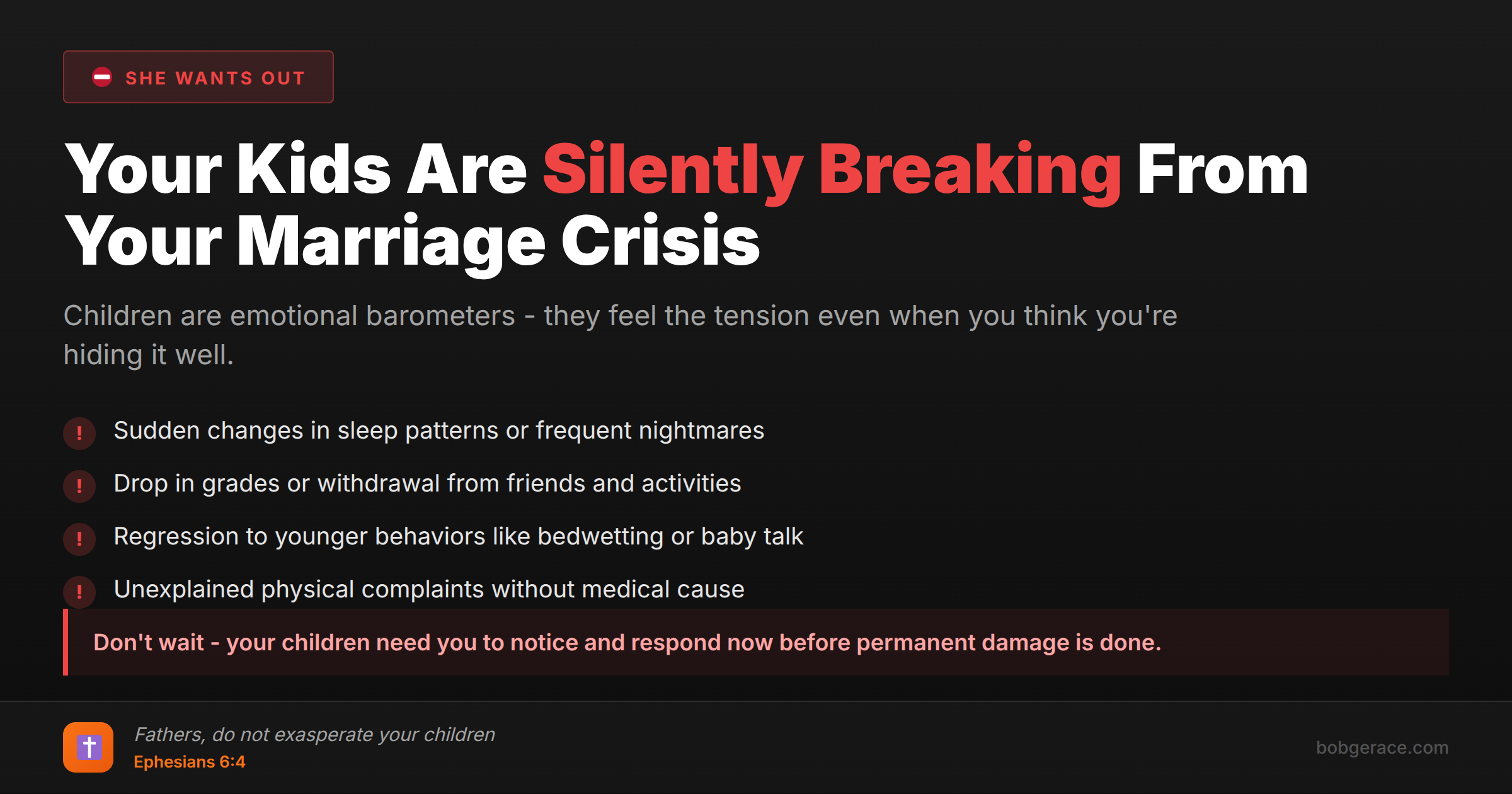
Your kids are likely struggling if you're seeing changes in their sleep patterns, academic performance, or social behavior. Look for regression to younger behaviors, increased anxiety or anger, withdrawal from family activities, or physical complaints without medical cause. Kids often absorb tension even when parents think they're hiding it well. The hard truth? Children are emotional barometers for the home. When your marriage is in crisis, they feel it in their bones, even if nobody's said a word. They might not have the vocabulary to express what's happening, but their behavior will tell the story. Don't wait for things to get worse - your kids need you to notice and respond now.
The Full Picture
Children are incredibly perceptive, and they pick up on marital tension long before parents realize it. When your marriage is struggling, your kids are often the first casualties, even when you think you're protecting them.
Academic and Social Red Flags: • Sudden drop in grades or school performance • Loss of interest in activities they used to enjoy • Difficulty concentrating on homework or tasks • Problems with friends or social withdrawal • Teachers reporting behavioral changes
Emotional and Behavioral Changes: • Increased irritability, anger, or emotional outbursts • Regression to younger behaviors (bedwetting, thumb sucking, baby talk) • Excessive worry about family, money, or the future • Taking on adult responsibilities or trying to "fix" problems • Perfectionism or people-pleasing to avoid conflict
Physical Symptoms: • Sleep disturbances, nightmares, or refusing to sleep alone • Frequent headaches or stomachaches without medical cause • Changes in appetite - eating too much or too little • Fatigue or low energy • Increased illness or complaints of feeling sick
The Mistake Most Dads Make: Assuming that if the kids aren't asking questions, they're fine. Kids often protect their parents by not expressing their fears. They might worry that talking about their concerns will make things worse, so they internalize everything.
Remember, children don't have the emotional tools adults have. They can't compartmentalize or rationalize what's happening. They experience your family crisis as a threat to their entire world, because in many ways, it is.
What's Really Happening
From a developmental perspective, children experiencing family stress often exhibit what we call "trauma responses," even when there's no overt abuse or violence. The nervous system of a child is wired to detect safety, and marital conflict triggers their threat detection system.
Research shows that children as young as six months can detect and respond to interpersonal tension between caregivers. This creates a chronic state of hypervigilance that impacts their developing brain architecture. The prefrontal cortex, responsible for executive functioning, becomes compromised when the limbic system is constantly activated by stress.
Developmental Regression is particularly common during family crises. Children may revert to earlier developmental stages as a coping mechanism. This isn't conscious behavior - it's their psyche's attempt to return to a time when they felt safer and more secure.
Parentification is another concerning pattern where children take on adult emotional responsibilities. They might become the family mediator, the emotional caretaker, or the "perfect child" to avoid adding stress to an already fragile situation. This robs them of their childhood and creates long-term attachment difficulties.
The concept of "loyalty conflicts" explains why many children don't express their struggles openly. They love both parents and feel caught in the middle, often believing they need to choose sides or protect one parent from the other. This internal conflict manifests as behavioral symptoms rather than verbal expression.
Attachment theory tells us that children need consistent, responsive caregiving to develop secure relationships. When parents are emotionally unavailable due to marital stress, children's attachment security becomes compromised, affecting their ability to regulate emotions and form healthy relationships later in life.
What Scripture Says
Scripture consistently emphasizes our responsibility to protect and nurture our children, especially during difficult times. God's heart for children is evident throughout the Bible, and He holds parents accountable for their spiritual and emotional well-being.
Ephesians 6:4 reminds us, "Fathers, do not exasperate your children; instead, bring them up in the training and instruction of the Lord." When our marriage struggles create an atmosphere of tension and unpredictability, we risk exasperating our children and hindering their spiritual development.
Psalm 127:3 declares that "Children are a heritage from the Lord, offspring a reward from him." This reminds us that our children are not just affected parties in our marriage crisis - they are precious gifts from God that we're called to steward well, regardless of what's happening between their parents.
Matthew 18:6 contains a sobering warning: "If anyone causes one of these little ones—those who believe in me—to stumble, it would be better for them to have a large millstone hung around their neck and to be drowned in the depths of the sea." While this doesn't mean we're condemned for struggling in our marriage, it does highlight how seriously God takes the impact of adult choices on children.
Malachi 4:6 speaks prophetically about turning "the hearts of the parents to their children, and the hearts of the children to their parents." This suggests that family restoration is close to God's heart and that we have a responsibility to prioritize our children's emotional and spiritual needs.
Proverbs 22:6 encourages us to "Start children off on the way they should go, and even when they are old they will not turn from it." Even in crisis, we can model repentance, humility, and dependence on God, teaching our children valuable lessons about faith and resilience.
What To Do Right Now
-
1
Create one-on-one time with each child weekly - ask directly how they're feeling about family changes
-
2
Establish consistent bedtime routines and maintain stability in daily schedules despite marital chaos
-
3
Validate their feelings without providing adult details - say 'It's normal to feel worried when parents are struggling'
-
4
Contact their teachers and coaches to alert them about home situation and watch for behavioral changes
-
5
Shield children from adult conversations, arguments, and legal discussions completely
-
6
Consider professional counseling for your children, even if they seem to be coping well
Related Questions
- How do I tell the kids?
- What do I say when kids ask what's happening?
- What do kids understand at different ages?
- How does parental conflict affect child attachment?
- What is 'parentification' and am I doing it to them?
- How do I give them stability when everything is unstable?
- What is 'betrayal trauma' and do I have it?
- What does trauma recovery look like?
- How do I not lose my mind right now?
- What does healthy coping look like?
Also find Bob on
Subscribe for weekly videos on Christian marriage.
Your Kids Need You Stable Now
A coach who knows your specific situation can help you protect your kids while you fix this. The next 30 days matter.
Talk to Bob →