How do I grow regardless of outcome?
6 min read
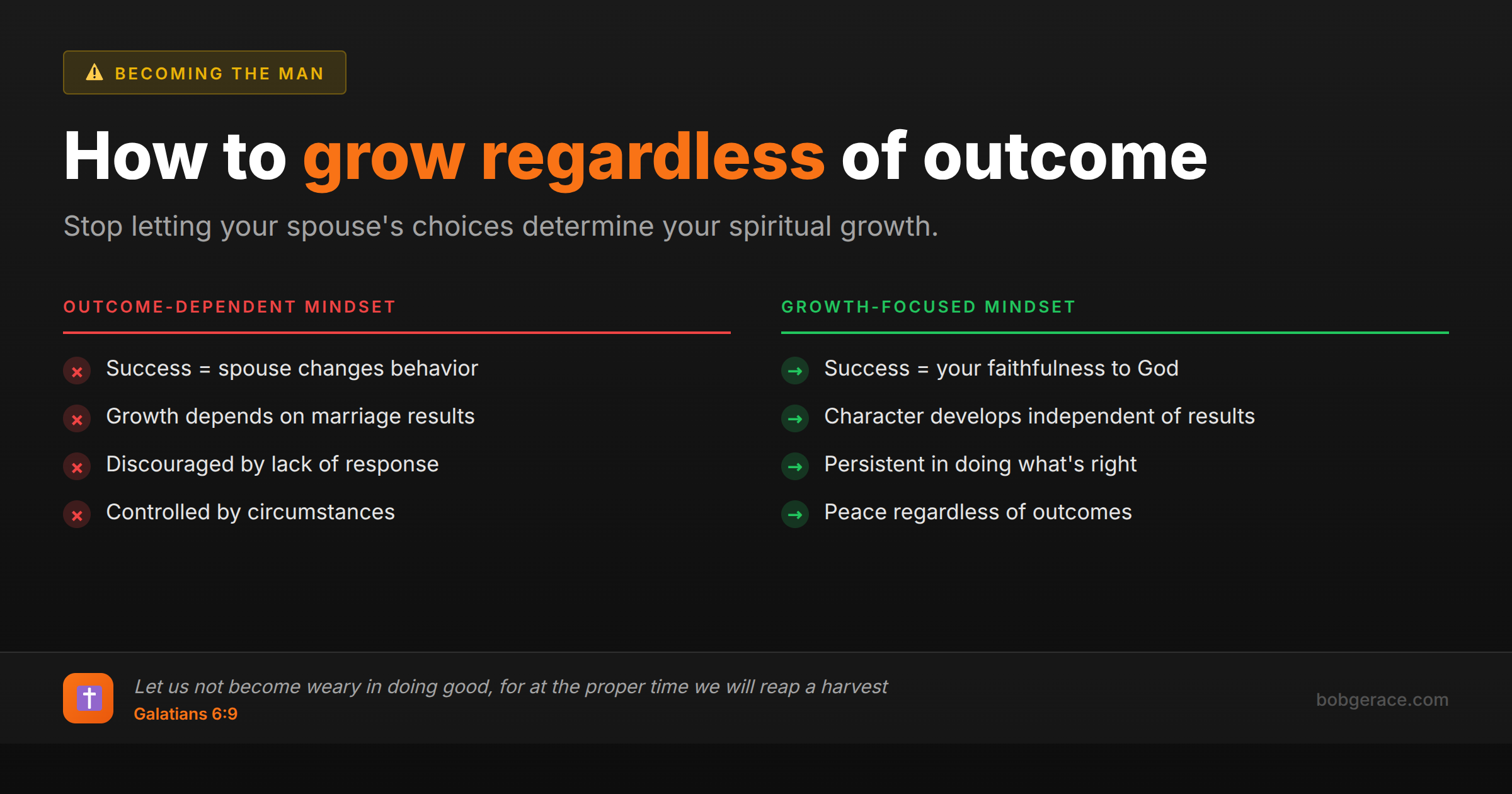
Growing regardless of outcome means shifting your focus from what you can't control (your spouse's choices, your marriage's future) to what you can control (your character, responses, and spiritual development). This isn't about giving up on your marriage—it's about becoming the woman God designed you to be, whether your marriage thrives or struggles. The key is defining success by your faithfulness, not by results. When you commit to growth for its own sake, you develop resilience, wisdom, and peace that no external circumstance can shake. You become outcome-independent while remaining fully engaged in doing your part.
The Full Picture
Most women get trapped in outcome-dependent living—their emotional well-being rises and falls based on their husband's behavior or their marriage's current state. This creates an exhausting cycle where your growth depends on factors completely outside your control.
Outcome-independent growth flips this script. It says, "I'm going to become the best version of myself regardless of what happens around me." This doesn't mean becoming indifferent to your marriage. It means grounding your identity and progress in unchanging truths rather than changing circumstances.
Consider what happens when you tie your growth to outcomes: If your husband responds well to your changes, you feel validated and continue growing. If he doesn't, you feel defeated and often stop the very behaviors that were benefiting you. You've essentially handed control of your development to someone else.
Outcome-independent growth operates differently. You pursue wisdom because wisdom is valuable, not because it might change your spouse. You develop patience because patience reflects Christ's character, not because it might improve your marriage. You set boundaries because they're healthy, not because they might produce specific results.
This approach creates sustainable transformation. When your growth isn't dependent on external validation, it becomes steady and consistent. You're no longer on an emotional roller coaster, riding the waves of your circumstances. Instead, you're building something solid within yourself that no one can take away.
The beautiful irony? When you stop making your growth contingent on outcomes, you often see better outcomes. But by then, you've learned that your worth and progress aren't defined by those results anyway.
What's Really Happening
From a psychological perspective, outcome-dependent behavior creates what we call external locus of control—your sense of agency and self-worth depends on factors outside yourself. This pattern often develops from childhood experiences where love or approval was conditional on performance or results.
Women in struggling marriages frequently exhibit learned helplessness, where repeated disappointments lead them to believe their efforts don't matter. They stop growing because growth seems pointless when it doesn't change their situation. This creates a dangerous cycle: stagnation leads to increased feelings of powerlessness, which leads to more stagnation.
Outcome-independent growth rebuilds your internal locus of control. It reconnects you with your personal agency—your ability to influence your own experience regardless of external circumstances. This shift is neurologically significant. When you consistently act according to your values rather than reacting to circumstances, you strengthen the prefrontal cortex pathways associated with self-regulation and decision-making.
Research shows that individuals who maintain growth-oriented mindsets during difficult seasons develop greater post-traumatic growth—they don't just survive challenges, they emerge stronger. They develop what psychologists call benefit-finding: the ability to identify positive changes in themselves that resulted from difficult experiences.
This approach also protects against codependency patterns where your emotional regulation depends on another person's behavior. When you commit to growing regardless of outcome, you maintain healthy differentiation—you remain connected to your marriage while maintaining your individual identity and development.
What Scripture Says
Scripture consistently calls us to faithfulness over results, character over circumstances. Galatians 6:9 reminds us, "Let us not become weary in doing good, for at the proper time we will reap a harvest if we do not give up." Notice it doesn't promise immediate results—it calls us to persistence in doing what's right.
1 Corinthians 15:58 provides the foundation for outcome-independent living: "Therefore, my dear brothers and sisters, stand firm. Let nothing move you. Always give yourselves fully to the work of the Lord, because you know that your labor in the Lord is not in vain." Your work has meaning because it's "in the Lord," not because of its immediate visible impact.
Jesus modeled this perfectly. He continued teaching, healing, and loving even when people rejected Him, misunderstood Him, or walked away. John 6:66-68 shows many disciples leaving, but Jesus didn't change His message to keep them. He remained faithful to His mission regardless of the response.
James 1:2-4 transforms our understanding of growth through difficulty: "Consider it pure joy, my brothers and sisters, whenever you face trials of many kinds, because you know that the testing of your faith produces perseverance. Let perseverance finish its work so that you may be mature and complete, not lacking anything." Growth happens through the process, not despite it.
The parable of the talents in Matthew 25:14-30 shows that God measures faithfulness with what we're given, not by the size of our results. The servants were commended for their faithfulness, not for producing identical outcomes.
Philippians 1:6 anchors our confidence: "He who began a good work in you will carry it on to completion until the day of Christ Jesus." Your growth is ultimately God's work in you—He's committed to your development regardless of your circumstances.
What To Do Right Now
-
1
Define growth-based goals: List 3-5 character qualities you want to develop (patience, wisdom, courage) independent of your marriage outcomes
-
2
Create daily growth practices: Establish small, consistent habits (prayer, journaling, exercise) that aren't dependent on anyone else's participation
-
3
Measure faithfulness, not results: Track your consistency in loving actions, not your spouse's responses to them
-
4
Develop outcome-independent affirmations: "I am growing in wisdom," "I choose peace," "I respond with love"—statements about your choices, not results
-
5
Find growth accountability: Connect with friends or mentors who will encourage your development regardless of your marriage situation
-
6
Celebrate process victories: Acknowledge when you respond well to difficulty, show patience under pressure, or choose wisdom over reaction
Related Questions
- What is 'post-traumatic growth'?
- What can I learn from this crisis?
- What does finding myself look like?
- What do I want regardless of what he does?
- What is my vision for my life?
- How do I recover my identity?
- What if I change and she still leaves?
- Is this suffering formative or just painful?
- What is sanctification and how does it work in crisis?
- What might I discover through this pain?
Also find Bob on
Subscribe for weekly videos on Christian marriage.
You Don't Have to Figure This Out Alone
A coach who knows your marriage can help you grow in the right direction—not just generic principles, but what actually matters in your situation right now.
Talk to Bob →