I make excuses instead of owning it
5 min read
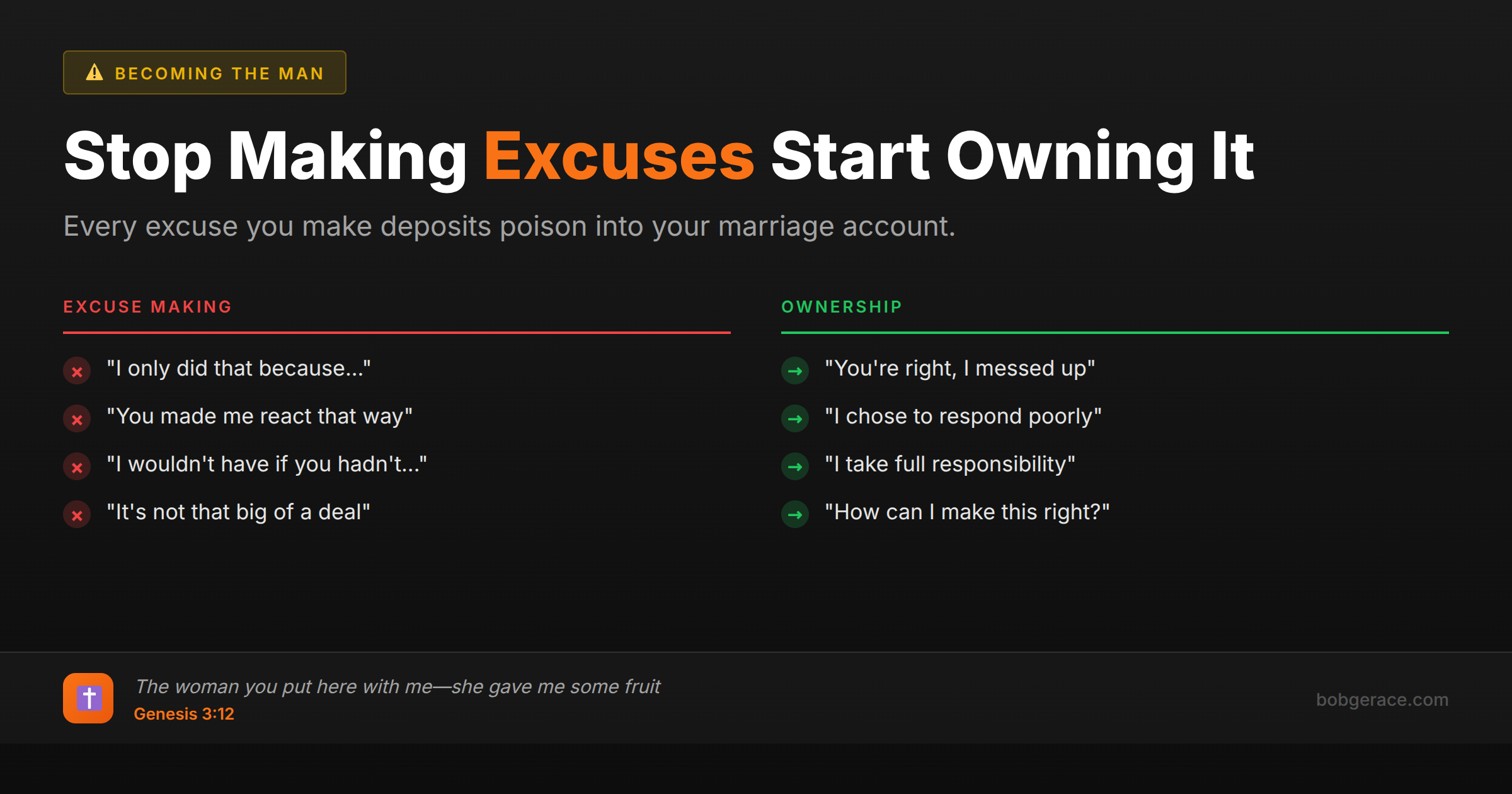
Making excuses instead of owning your mistakes is a marriage killer, but you're not alone in this struggle. It's our natural human response to protect ourselves when we feel threatened or ashamed. The problem is that every excuse you make deposits poison into your marriage account and erodes your spouse's trust in you. The good news? This pattern can be broken. It starts with recognizing that your excuses are actually fear talking - fear of disappointing your spouse, fear of being seen as flawed, or fear of conflict. But here's the truth: your spouse already knows you're imperfect. What they're desperately wanting is a partner who can own their stuff without deflection. When you consistently take ownership, you actually become more trustworthy, not less.
The Full Picture
Let me paint you a picture of what's really happening when you make excuses instead of owning your mistakes. Every time you deflect, minimize, or blame-shift, you're essentially telling your spouse that protecting your ego is more important than their feelings or your relationship.
The Excuse Cycle looks like this: You mess up → You feel shame/fear → You make an excuse → Your spouse feels unheard and invalidated → Trust erodes → The next conflict becomes bigger because there's unresolved hurt underneath.
Here's what most people don't realize: your spouse isn't primarily upset about your mistake. They're upset about your unwillingness to own it. When you say things like "I only did that because you..." or "I wouldn't have if you hadn't..." or "That's not what I meant," you're essentially saying their experience doesn't matter.
The Real Cost of excuse-making goes far beyond the immediate argument. It creates: - Emotional distance because your spouse stops feeling safe to bring up issues - Resentment buildup because problems never get fully resolved - Communication shutdown because your spouse learns that honesty leads to defensiveness - Trust erosion because your word becomes unreliable
But here's the encouragement: every marriage has this struggle. The couples who thrive aren't the ones who never mess up - they're the ones who get really good at owning their stuff quickly and completely. When you can look your spouse in the eye and say "You're right, I messed up, and I'm sorry" without any "buts" or qualifications, you become someone they can trust with their heart again.
The shift from excuse-making to ownership isn't just about better communication - it's about becoming the kind of person who can handle the truth about themselves without falling apart.
What's Really Happening
From a psychological perspective, excuse-making is a defense mechanism rooted in what we call 'threat response.' When we feel criticized or confronted with our mistakes, our brain interprets this as danger and activates protective strategies.
The Neuroscience Behind Excuses: When your spouse points out something you did wrong, your amygdala - the brain's alarm system - can trigger fight-or-flight responses before your rational mind engages. Excuse-making is essentially a 'fight' response designed to deflect the perceived attack on your character or competence.
Core Psychological Drivers include: - Shame avoidance: Fear that admitting fault means you're fundamentally flawed - Control maintenance: Belief that accepting responsibility makes you vulnerable - Identity protection: Your sense of self feels threatened by imperfection - Learned patterns: Childhood experiences where mistakes led to harsh consequences
The Attachment Wound: For many people, excuse-making stems from early attachment experiences where love felt conditional on performance. If you learned that mistakes meant rejection or criticism, your adult brain still operates from that childhood fear.
The therapeutic breakthrough comes when clients realize that vulnerability actually increases intimacy, not decreases it. When you can own your mistakes without defending them, you demonstrate emotional maturity that deepens trust. Research shows that couples who practice regular acknowledgment and repair after conflicts report significantly higher relationship satisfaction.
The Path Forward involves retraining your nervous system to see accountability as safety, not threat. This happens through small, consistent practices of ownership that prove to your brain that admitting mistakes actually strengthens your relationship rather than destroying it.
What Scripture Says
Scripture is crystal clear about the importance of owning our failures rather than making excuses. From the very beginning, we see the human tendency to deflect responsibility, but God calls us to something higher.
The First Excuse: In Genesis 3:12, when God confronts Adam about eating the forbidden fruit, Adam's response is telling: "The woman you put here with me—she gave me some fruit from the tree, and I ate it." Notice how Adam blames both Eve and God himself rather than simply owning his choice. This shows us that excuse-making is as old as humanity itself.
God's Heart for Ownership: Proverbs 28:13 gives us the formula: "Whoever conceals their sins does not prosper, but the one who confesses and renounces them finds mercy." This isn't just about sin in general - it's about the specific act of confession versus concealment. When we make excuses, we're concealing rather than confessing.
The Call to Humility: James 4:6 reminds us that "God opposes the proud but shows favor to the humble." Excuse-making is fundamentally about pride - protecting our image rather than pursuing truth. Humility, on the other hand, creates space for grace to flow in our marriages.
Practical Confession: 1 John 1:9 promises that "if we confess our sins, he is faithful and just and will forgive us our sins and purify us from all unrighteousness." This principle applies directly to marriage - when we confess our failures to our spouse without excuse or qualification, we create space for forgiveness and restoration.
The Jesus Model: Even Jesus, who never sinned, modeled taking responsibility. Philippians 2:6-8 shows how He "made himself nothing" and "humbled himself." If the Son of God chose the path of humility rather than self-protection, how much more should we?
Scripture teaches us that integrity means our words align with reality, not with our preferred version of events. When we own our mistakes completely, we reflect God's character and create the conditions for His grace to transform both us and our marriages.
What To Do Right Now
-
1
Pause before responding - When your spouse brings up an issue, take three deep breaths before saying anything. This gives your rational mind time to engage before your defenses kick in.
-
2
Use the ownership formula - Start with 'You're right, I...' instead of 'But...' or 'I only did that because...' Own your part completely before discussing context or circumstances.
-
3
Practice with small things first - Begin owning minor mistakes immediately and completely. This builds your ownership muscle for bigger issues later.
-
4
Ask clarifying questions - Instead of defending, ask 'Help me understand how that affected you' or 'What would you need from me going forward?' This shows you care more about resolution than being right.
-
5
Set a 24-hour rule - Commit to circling back within 24 hours if you initially responded with excuses. Say 'I thought about our conversation, and I want to own my part better.'
-
6
Create an accountability system - Ask your spouse to gently point out when you're making excuses, and thank them when they do. This turns excuse-catching into a team effort rather than another conflict.
Related Questions
- Why do I get defensive every time?
- I can't take criticism without exploding
- I justify instead of listen
- How do I hear her without defending myself?
- What does 'taking responsibility' actually look like?
- How do I receive feedback without counter-attacking?
- She doesn't believe I understand what I did
- What does genuine repair look like for old wounds?
- Why didn't my past apologies work?
- What are markers of genuine remorse vs. guilt?
Also find Bob on
Subscribe for weekly videos on Christian marriage.
Owning It in Your Actual Marriage
You know the pattern. A coach who knows your story helps you see where the excuse reflex kicks in—and what to say instead when it matters most in your home.
Talk to Bob →