She says she can't talk to me
6 min read
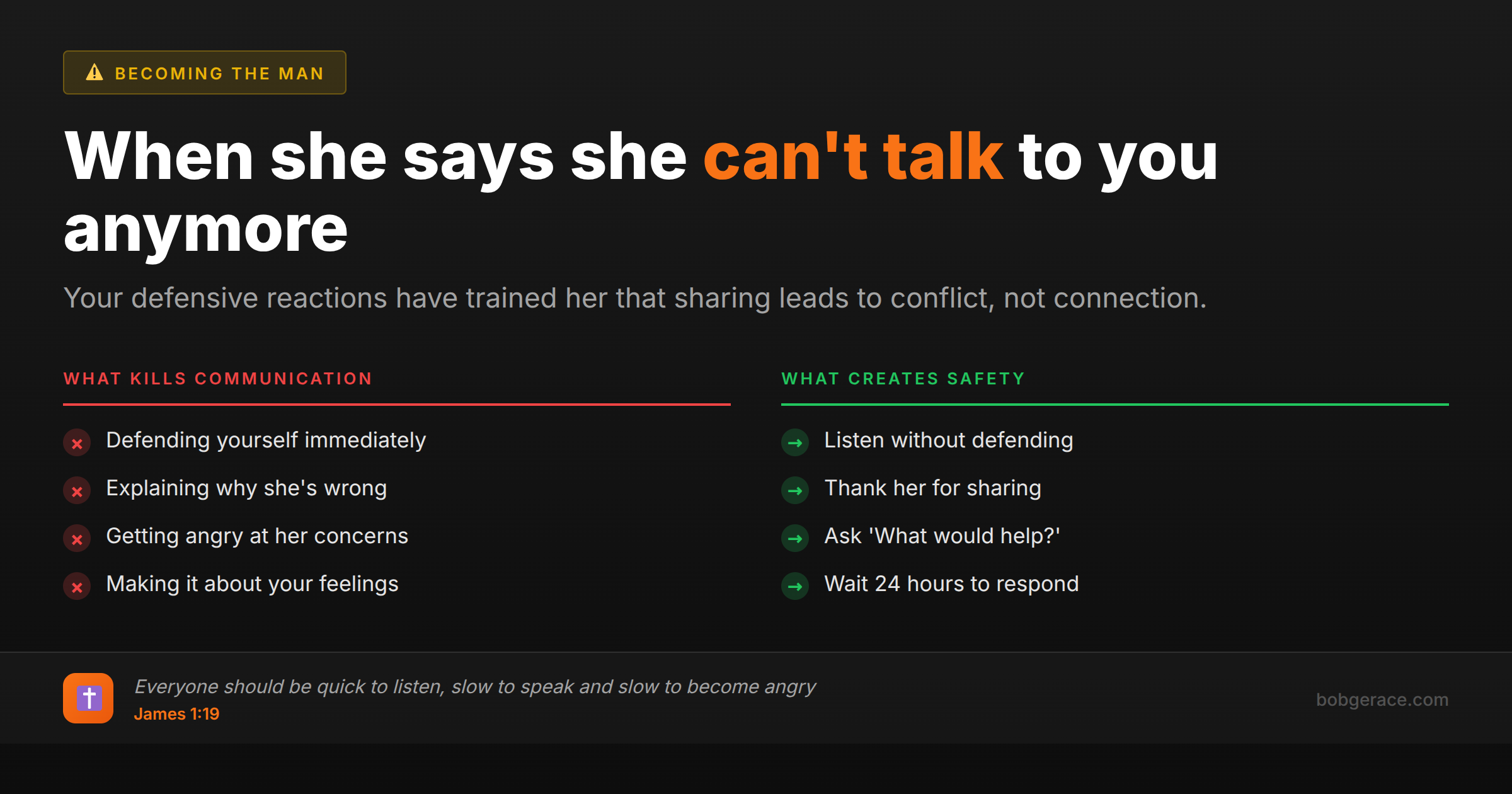
When your wife says she can't talk to you, she's telling you that you've made communication feel unsafe for her. This usually happens when you respond to her concerns with defensiveness, explanations, or pushback instead of simply listening. Your defensive reactions have trained her that bringing up problems leads to conflict rather than connection. The good news is this pattern can be broken, but it requires you to stop defending yourself and start creating emotional safety for her to share her heart with you.
The Full Picture
Your wife isn't being dramatic or oversensitive. She's protecting herself from what feels like emotional danger. Every time she's tried to share something important and you've gotten defensive, explained why she's wrong, or turned the conversation back to your perspective, you've inadvertently sent the message that her feelings aren't safe with you.
This creates a painful cycle. She pulls back, you feel rejected and get more defensive, she pulls back further. Soon you're living like roommates instead of lovers, and every attempt at conversation feels loaded with tension.
Defensiveness is a relationship killer because it makes your spouse the enemy instead of your teammate. When she brings up a concern, your brain interprets it as an attack and launches into protection mode. But what feels like self-protection to you feels like rejection and dismissal to her.
The real tragedy is that she probably still wants to connect with you. Most wives don't give up on communication because they don't care—they give up because caring hurts too much when every attempt leads to conflict or shutdown. She's not trying to control or criticize you; she's trying to save your marriage by addressing problems before they destroy it.
This pattern didn't develop overnight, and it won't change overnight either. But with consistent effort to listen instead of defend, you can rebuild the trust and safety that makes open communication possible again.
What's Really Happening
From a clinical perspective, your wife is experiencing what we call 'emotional flooding' when she tries to communicate with you. Her nervous system has learned to anticipate conflict or dismissal, triggering a stress response that makes vulnerable conversation feel impossible.
Defensiveness activates the same threat-detection systems in the brain that respond to physical danger. When you defend, explain, or counter-argue, you're essentially confirming to her nervous system that communication with you is unsafe. This leads to what Gottman research calls 'stonewalling'—she shuts down to protect herself from further emotional injury.
The neurological reality is that defensiveness prevents the prefrontal cortex from engaging in the kind of higher-order thinking required for empathy and connection. Instead, the limbic system takes over, creating a fight-or-flight response that makes productive dialogue nearly impossible.
What's particularly damaging is that defensive responses create a 'double bind' for your wife. She needs to communicate to feel connected, but communicating feels dangerous because of past defensive reactions. This creates chronic stress and relationship anxiety that can manifest as withdrawal, criticism, or eventual emotional disconnection.
The encouraging news is that the brain's plasticity means these patterns can change. By consistently responding with curiosity instead of defensiveness, you can literally rewire both your nervous systems for safer, more connected communication.
What Scripture Says
God's design for marriage includes safe, loving communication. Proverbs 18:13 warns us: "To answer before listening—that is folly and shame." When we defend instead of listen, we're responding before we've truly heard our wife's heart.
James 1:19 gives us the blueprint: "Everyone should be quick to listen, slow to speak and slow to become angry." Defensiveness violates all three principles—we're slow to listen, quick to speak, and quick to anger. This creates the opposite environment God intends for marriage.
Ephesians 4:29 calls us to speech that builds up: "Do not let any unwholesome talk come out of your mouths, but only what is helpful for building others up according to their needs." Defensive responses tear down rather than build up, making our wives feel criticized for trying to communicate.
1 Peter 3:7 specifically instructs husbands to live with their wives "in an understanding way, showing honor to the woman." You cannot understand without listening, and you cannot honor someone by dismissing their concerns with defensive explanations.
Proverbs 27:5-6 reminds us that "Better is open rebuke than hidden love. Wounds from a friend can be trusted." When your wife brings concerns, she's being a faithful friend to your marriage. Defensive responses push her concerns underground where they fester.
God calls us to be quick to listen and slow to speak because He knows that defensive reactions destroy the intimacy He designed marriage to provide.
What To Do Right Now
-
1
Acknowledge the pattern: Tell your wife, 'You're right—I haven't made it safe for you to talk to me, and I want to change that.'
-
2
Ask one question: 'What would help you feel safer sharing your heart with me?' Then listen without defending or explaining.
-
3
Practice the 24-hour rule: When she brings up a concern, say 'Thank you for telling me' and wait 24 hours before responding with solutions.
-
4
Stop explaining yourself: Replace 'But I...' or 'I was just...' with 'Tell me more about that' or 'Help me understand.'
-
5
Validate her experience: Even if you disagree, say 'I can see why you'd feel that way' before sharing your perspective.
-
6
Create regular check-ins: Schedule 15 minutes weekly to ask 'How are we doing?' and listen without fixing or defending.
Related Questions
- I can't take criticism without exploding
- Why do I get defensive every time?
- I turn everything into an argument
- How do I hear her without defending myself?
- She shuts down when I try to connect
- What does 'taking responsibility' actually look like?
- She won't talk about our problems
- What is 'stonewalling' and why does she do it?
- She stopped fighting — is that worse?
- Why does she seem unable to reason about this?
Also find Bob on
Subscribe for weekly videos on Christian marriage.
Your Marriage Can't Wait on Guesswork
When she won't talk to you, every day you fumble this costs you ground. A coach who knows your specific situation can tell you what to do tomorrow morning.
Talk to Bob →