Why do I get defensive every time?
6 min read
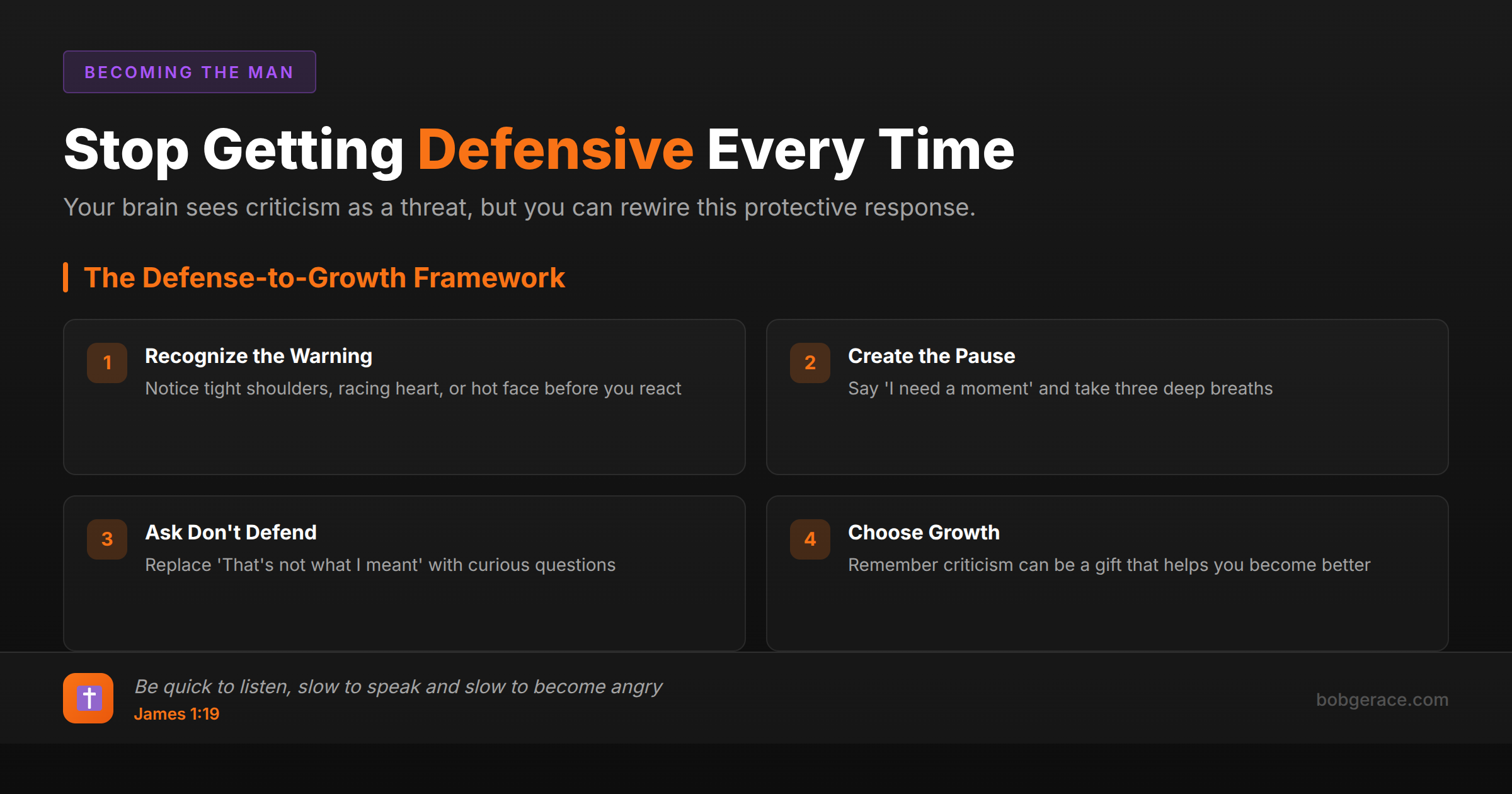
You get defensive because your brain perceives criticism or conflict as a threat to your sense of self. When you feel attacked, judged, or misunderstood, your nervous system triggers a protective response faster than your rational mind can intervene. This isn't a character flaw—it's a deeply ingrained survival mechanism. Defensiveness typically stems from past wounds, shame, or fear of rejection. Maybe you grew up in an environment where criticism felt overwhelming, or you've developed patterns where you equate being wrong with being worthless. The good news is that defensive reactions are learned behaviors, which means they can be unlearned with intention and practice.
The Full Picture
Defensiveness is one of the most destructive patterns in marriage, and it's incredibly common. When your spouse brings up an issue, your brain doesn't distinguish between "Hey, could you help with dishes?" and "You're a terrible person." It all registers as threat.
The Defensive Cycle typically looks like this: Your spouse expresses a need or concern → You feel criticized or attacked → Your body floods with stress hormones → You respond defensively → Your spouse feels unheard and escalates → You feel more attacked → The cycle intensifies.
Common triggers include feeling misunderstood, having your motives questioned, being compared to others, or hearing certain tones of voice. Your body remembers past hurts and reacts as if those old wounds are being reopened.
The cost is enormous. Defensiveness kills intimacy because it prevents real communication. When you're defending, you're not listening. When your spouse sees that wall go up, they either shut down or get louder, neither of which helps.
Here's what most people don't realize: The person getting defensive is often in more pain than the person bringing up the issue. Your defensiveness is actually your heart crying out "I'm already hurting—please don't hurt me more." But instead of creating safety, it creates more conflict.
The pattern becomes so automatic that you might not even realize you're doing it. Your spouse says something neutral, and suddenly you're explaining, justifying, or counter-attacking before you've even processed what they actually said.
What's Really Happening
From a neurological standpoint, defensiveness is your amygdala hijacking your prefrontal cortex. When your brain perceives threat, it activates your sympathetic nervous system faster than conscious thought. This "amygdala hijack" floods your body with stress hormones and shuts down your capacity for rational response.
Attachment theory explains much of this. If you grew up with inconsistent emotional safety, criticism might trigger deep fears of abandonment. Your defensive response isn't really about the dishes—it's about "Am I still loveable if I'm imperfect?"
Shame resilience research shows that people who struggle with defensiveness often have underdeveloped shame resilience. When feedback triggers shame, the brain's only options feel like fight, flight, or freeze. Defensiveness is the "fight" response.
The neuroplasticity principle gives us hope: Your brain can form new neural pathways. With practice, you can literally rewire your automatic responses. This requires recognizing your physical early warning signs—tight chest, hot face, racing thoughts—and learning to pause before reacting.
Polyvagal theory suggests that building your capacity to stay in your "social engagement system" during stress is key. This means learning to regulate your nervous system so you can remain connected even when triggered. The goal isn't to never feel defensive—it's to recognize the feeling and choose your response.
What Scripture Says
Scripture addresses our tendency toward self-protection and calls us to something higher. Proverbs 27:5-6 reminds us: "Better is open rebuke than hidden love. Wounds from a friend can be trusted, but an enemy multiplies kisses." God's design is for marriage to be a place where loving truth-telling helps us grow.
James 1:19 gives us the antidote to defensiveness: "My dear brothers and sisters, take note of this: Everyone should be quick to listen, slow to speak and slow to become angry." This isn't just good advice—it's a supernatural reordering of our natural responses.
Proverbs 12:1 is direct: "Whoever loves discipline loves knowledge, but whoever hates correction is stupid." That sounds harsh, but it's pointing to a profound truth—defensiveness keeps us from the growth that feedback offers.
1 Corinthians 13:5 tells us that love "is not easily angered, it keeps no record of wrongs." When we're defensive, we're often pulling up that record of wrongs to justify our reaction. Love chooses differently.
Ephesians 4:15 calls us to "speak the truth in love"—both giving and receiving it. This requires the humility to admit we might be wrong and the security to know we're loved even when we are.
The gospel transforms defensiveness because it removes the ultimate threat. In Christ, your identity isn't based on being right—it's based on being loved. When you know you're already accepted, criticism can't destroy you.
What To Do Right Now
-
1
Identify your early warning signs. Notice what happens in your body when you start to feel defensive—tight shoulders, racing heart, hot face. These physical signals come before the emotional reaction.
-
2
Create a pause ritual. When you notice those warning signs, say "I need a moment to process this" and take three deep breaths. This gives your prefrontal cortex time to come back online.
-
3
Ask clarifying questions instead of defending. Replace "That's not what I meant" with "Help me understand what you're feeling." This shifts you from defense mode to curiosity mode.
-
4
Own what you can own. Even if the feedback feels unfair, find the grain of truth and acknowledge it. "You're right that I haven't been helping with dishes consistently."
-
5
Practice self-compassion. After a defensive episode, don't shame yourself. Say "I'm learning to respond differently, and that's hard work. I'll try again next time."
-
6
Have a repair conversation. When you realize you've been defensive, go back to your spouse and say "I got defensive earlier. Can we try that conversation again? I want to really hear you."
Related Questions
Ready to Break the Defensive Cycle?
You don't have to stay stuck in patterns that hurt your marriage. Get personalized strategies to transform how you respond to conflict.
Get Help Now →