Why am I numb one moment and raging the next?
6 min read
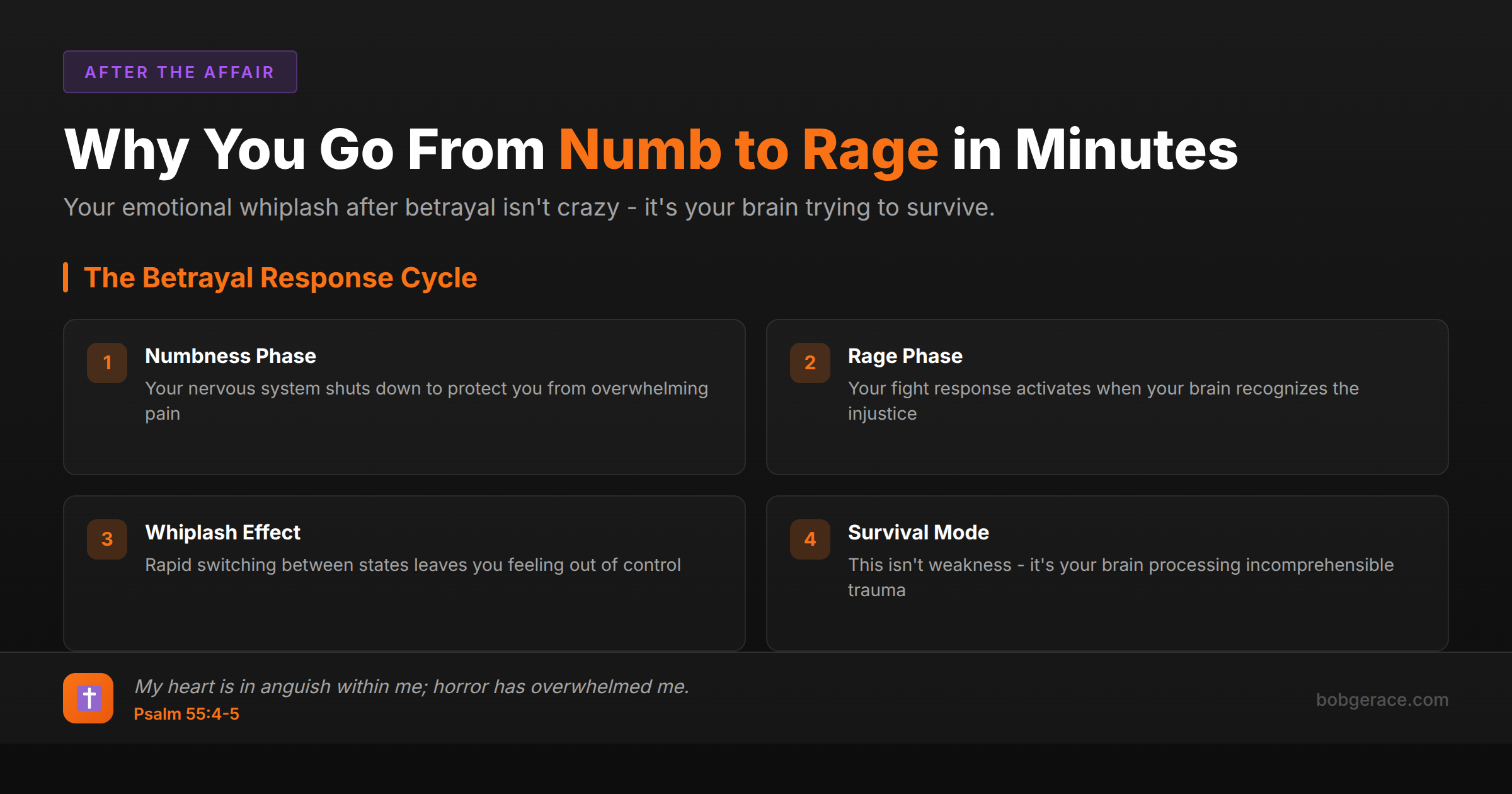
Your extreme emotional swings between numbness and rage are a completely normal neurobiological response to betrayal trauma. When you discovered your spouse's infidelity, your nervous system went into survival mode, alternating between shutting down to protect you from overwhelming pain (numbness) and activating your fight response (rage). This isn't weakness or instability - it's your brain trying to process an incomprehensible violation of trust. Think of it like emotional whiplash. Your nervous system is ping-ponging between two protective states: dissociation (numbing out) when the pain feels too intense, and hyperactivation (anger) when your system recognizes the injustice. These fluctuations can happen within minutes or hours, leaving you feeling like you're losing your mind. You're not. You're having a predictable response to an unpredictable trauma.
The Full Picture
Betrayal doesn't just break your heart - it literally rewires your brain. When you discovered your spouse's affair, your nervous system registered this as a life-threatening event. Not metaphorically, but literally. Your brain's alarm system couldn't distinguish between a physical attack and this emotional devastation.
Here's what's happening in your body: Your amygdala (fear center) is hyperactive, constantly scanning for more threats. Meanwhile, your prefrontal cortex (logical thinking) is offline, making it nearly impossible to think clearly. Your nervous system is stuck in a loop, oscillating between two survival states.
The Numb Phase: This is called dissociation or the freeze response. Your system shuts down emotional processing because the pain is literally too much to handle. You might feel disconnected from your body, like you're watching your life from outside yourself. Colors seem muted, food has no taste, and you go through motions mechanically.
The Rage Phase: This is your fight response kicking in. Your system floods with stress hormones - cortisol, adrenaline, norepinephrine. Your heart races, muscles tense, and you feel like you could explode. This isn't just anger; it's primal fury at the injustice and violation.
These swings can be triggered by anything - a text notification, a song, even silence. Your traumatized nervous system is hypersensitive, interpreting neutral stimuli as potential threats. Understanding this helps you realize you're not going crazy - you're responding normally to an abnormal situation.
What's Really Happening
From a clinical perspective, you're experiencing what we call betrayal trauma syndrome. The emotional dysregulation you're describing is a hallmark symptom, and it's rooted in how trauma affects the nervous system's ability to maintain homeostasis.
When betrayal occurs, especially by an attachment figure like a spouse, it creates what we call a double bind. The person who was supposed to be your safe harbor becomes the source of danger. This contradictory reality overwhelms the nervous system's capacity to integrate the experience, leading to fragmented emotional responses.
The alternation between numbness and rage reflects your autonomic nervous system cycling through different survival states. The dorsal vagal complex activation creates the shutdown, numb feeling - essentially your system playing dead when fight or flight seems impossible. The sympathetic nervous system activation creates the rage response - mobilizing energy to fight the perceived threat.
What's particularly challenging about betrayal trauma is that these emotional states can shift rapidly and unpredictably. Unlike single-incident traumas, betrayal often involves ongoing deception, creating complex trauma patterns. Your nervous system remains in a state of chronic activation, unable to find safety or predictability.
The good news is that with proper support and intervention, nervous system regulation can be restored. Techniques like EMDR, somatic therapy, and specialized //blog.bobgerace.com/gaslighting-recovery-christian-marriage-timeline/:betrayal trauma treatment-therapy-look-like) can help your system learn to find balance again. This isn't about 'getting over it' - it's about helping your nervous system process and integrate this experience so it stops controlling your emotional state.
What Scripture Says
Scripture doesn't shy away from the reality of intense emotional pain or the human struggle with overwhelming feelings. Even biblical heroes experienced emotional extremes when facing betrayal and injustice.
Psalm 55:4-5 captures this emotional turmoil perfectly: *"My heart is in anguish within me; the terrors of death have fallen on me. Fear and trembling have beset me; horror has overwhelmed me."* David understood the physical and emotional devastation that comes from betrayal by those closest to us.
Jesus himself experienced the full spectrum of human emotion. In John 11:35, we see *"Jesus wept"* - he felt deep grief. In Mark 3:5, we read that *"He looked around at them in anger"* - righteous indignation at injustice. Christ's emotional range validates that feeling intensely isn't sinful; it's human.
Psalm 31:9-10 gives language to your experience: *"Be merciful to me, Lord, for I am in distress; my eyes grow weak with sorrow, my soul and body with grief. My life is consumed by anguish and my years by groaning; my strength fails because of my affliction, and my bones grow weak."*
Yet Scripture also points us toward hope and healing. Psalm 34:18 promises: *"The Lord is close to the brokenhearted and saves those who are crushed in spirit."* God doesn't minimize your pain or tell you to just get over it. He draws near in your suffering.
Isaiah 61:3 speaks of God's restorative work: to give you *"beauty instead of ashes, the oil of joy instead of mourning, and a garment of praise instead of a spirit of despair."* This isn't about pretending everything is fine - it's about trusting God's ability to bring healing to your traumatized heart and mind.
What To Do Right Now
-
1
Track your emotional patterns - Notice what triggers the shifts between numbness and rage without judging them
-
2
Practice grounding techniques - Use 5-4-3-2-1 sensory grounding (5 things you see, 4 you feel, 3 you hear, 2 you smell, 1 you taste)
-
3
Regulate your nervous system daily - Try box breathing, cold water on wrists, or gentle movement to signal safety to your body
-
4
Create emotional safety rituals - Establish predictable, calming routines that help your system find stability
-
5
Limit decision-making during emotional extremes - Don't make major choices when you're in shutdown or rage mode
-
6
Seek specialized trauma therapy - Work with a counselor trained specifically in betrayal trauma and nervous system regulation
Related Questions
- What is 'betrayal trauma' and do I have it?
- Why do I feel like I'm going to die?
- What's happening to my nervous system right now?
- What is the 'trauma loop' and how do I interrupt it?
- How do I function when my body won't calm down?
- What does betrayal do to the brain?
- I can't control my anger
- What is 'amygdala hijack' and how do I interrupt it?
- What's happening in my brain when I rage?
- What is 'window of tolerance' and how do I widen mine?
Also find Bob on
Subscribe for weekly videos on Christian marriage.
Your Nervous System Needs a Human Coach
This whiplash between numb and raging isn't something you fix with information. A coach who knows your story can help you regulate when you're flooded and see what's actually driving the swings in your marriage.
Talk to Bob →