Why do I keep replaying the discovery?
5 min read
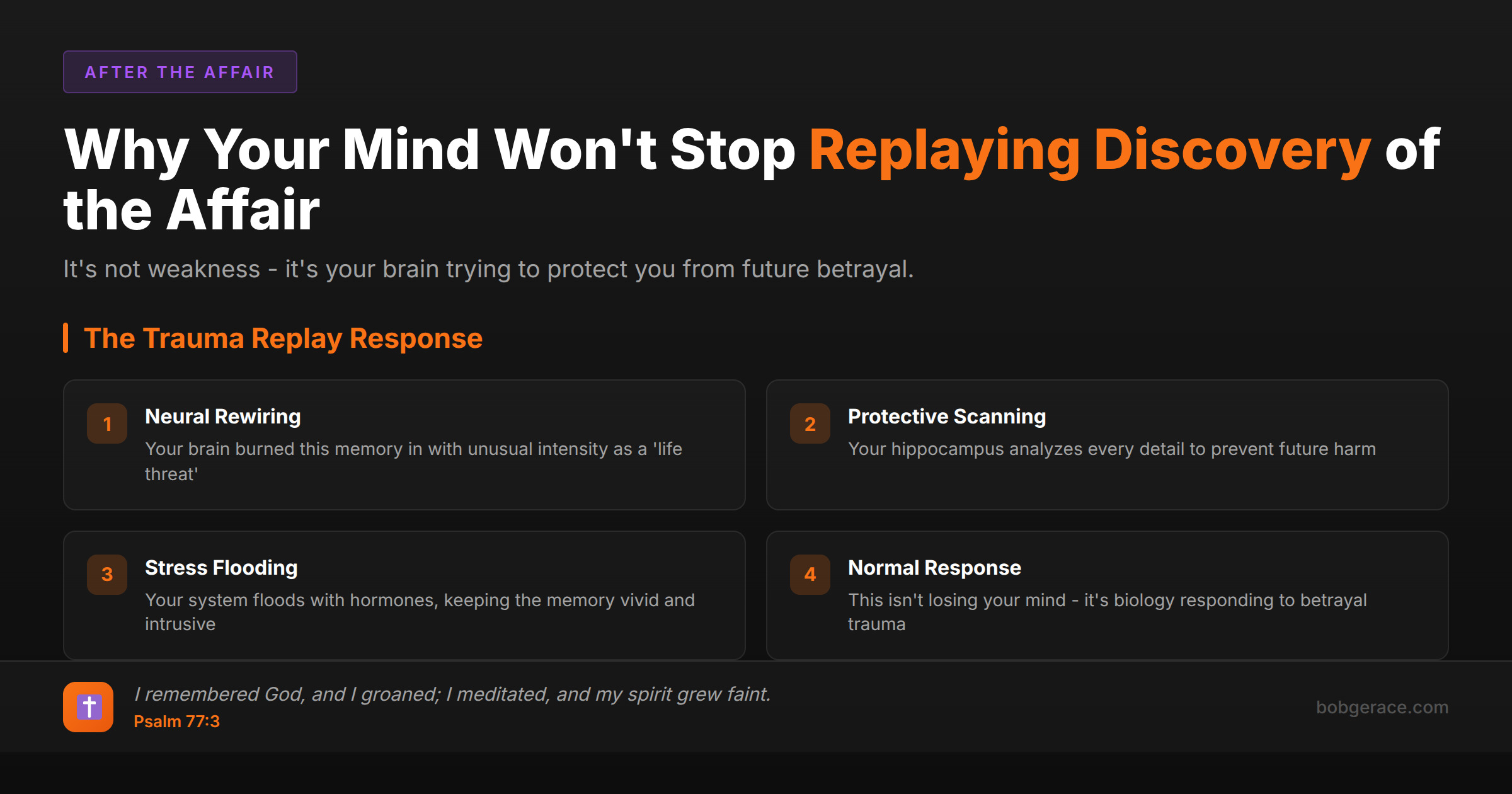
Your brain keeps replaying the discovery because trauma literally rewires your neural pathways, creating what neuroscientists call 'intrusive rehearsal.' When you discovered your spouse's betrayal, your brain registered it as a life-threatening event, flooding your system with stress hormones and burning the memory into your neural networks with unusual intensity. This isn't weakness or obsession - it's your brain trying to protect you by analyzing every detail to prevent future harm. The hippocampus and amygdala work overtime, constantly scanning the memory for clues you might have missed. Understanding this biological reality is the first step toward healing, because it means you're not losing your mind - you're experiencing a normal neurological response to abnormal circumstances.
The Full Picture
The moment you discovered your spouse's betrayal, your brain didn't just record a memory - it created a neural superhighway. Betrayal trauma activates the same brain regions as physical assault, flooding your system with cortisol, adrenaline, and norepinephrine. These stress hormones act like neural cement, making the discovery memory far more vivid and accessible than ordinary memories.
Your prefrontal cortex - the rational, thinking part of your brain - goes offline during trauma, while your limbic system takes control. This primitive brain region doesn't understand time, which is why the memory feels like it's happening *now* every time it surfaces. You're not stuck in the past; your brain is stuck in survival mode.
The replay serves three neurological purposes: First, your brain is trying to make sense of information that contradicts everything you believed about your reality. Second, it's scanning for warning signs you might have missed, hoping to prevent future blindsiding. Third, it's attempting to regain control by obsessively analyzing a situation where you had none.
This process, called 'intrusive rehearsal,' can happen hundreds of times per day in early betrayal trauma. Each replay actually strengthens the neural pathway, making the memory more accessible and more painful. It's like your brain has created a dirt road that becomes a highway through repeated traffic.
The good news? Neuroplasticity means your brain can form new pathways. The same mechanism that created this painful loop can create healing pathways. Understanding that this is biology, not choice, removes shame and opens the door to targeted recovery strategies.
What's Really Happening
From a clinical perspective, what you're experiencing is called 'traumatic reenactment' - a neurobiological //blog.bobgerace.com/christian-marriage-death-protocol-kill-old-patterns/:process where the brain attempts to master an overwhelming experience by repeatedly reliving it. The discovery of infidelity creates what we call a 'flashbulb memory' - extraordinarily detailed and emotionally charged memories that resist normal forgetting processes.
Your nervous system is essentially stuck in a state of hypervigilance. The vagus nerve, which regulates your rest-and-digest response, has been hijacked by your sympathetic nervous system's fight-or-flight response. This creates a feedback loop where stress hormones keep the traumatic memory active and accessible.
The replaying intensifies because betrayal trauma is uniquely complex - it combines attachment injury, sexual trauma, and cognitive dissonance all at once. Your brain is trying to reconcile the person you trusted most with the person who deceived you. This cognitive impossibility creates what we call 'meaning-making attempts' - your mind desperately trying to create a coherent narrative from incomprehensible information.
I often tell clients that their brain is essentially 'stuck in the spin cycle.' The hippocampus, which normally helps process memories into long-term storage, can't effectively categorize betrayal trauma because it defies all existing categories. Instead, the memory remains in active, unprocessed form, creating the constant replay.
Healing happens when we help the nervous system move from hyperarousal to regulation, and when we support the natural memory consolidation process that trauma interrupted.
What Scripture Says
Scripture acknowledges that traumatic experiences create lasting impressions on our hearts and minds. Psalm 77:3-4 captures this perfectly: *'I remembered God, and I groaned; I meditated, and my spirit grew faint. You kept my eyes from closing; I was too troubled to speak.'* The psalmist describes the exact experience you're having - memories that won't stop, a mind that won't rest.
God understands that painful memories can dominate our thoughts. Lamentations 3:19-20 says: *'I remember my affliction and my wandering, the bitterness and the gall. I well remember them, and my soul is downcast within me.'* The Hebrew word for 'remember' here implies repetitive, involuntary recollection - exactly what you're experiencing.
But Scripture also provides the pathway to healing. Lamentations 3:21-23 continues: *'Yet this I call to mind and therefore I have hope: Because of the Lord's great love we are not consumed, for his compassions never fail. They are new every morning; great is your faithfulness.'* Notice the phrase 'this I call to mind' - it's intentional, chosen remembering that counters involuntary replay.
Philippians 4:8 gives us the neural rewiring strategy: *'Finally, brothers and sisters, whatever is true, whatever is noble, whatever is right, whatever is pure, whatever is lovely, whatever is admirable—if anything is excellent or praiseworthy—think about such things.'* This isn't positive thinking; it's intentional creation of new neural pathways.
Isaiah 43:18-19 promises: *'Forget the former things; do not dwell on the past. See, I am doing a new thing! Now it springs up; do you not perceive it?'* God doesn't minimize your trauma, but He promises new neural pathways - new things that can override the old patterns of pain.
What To Do Right Now
-
1
Name it when it happens: Say 'I'm having a trauma replay' - this activates your prefrontal cortex and creates distance from the experience
-
2
Use the 5-4-3-2-1 grounding technique: Name 5 things you see, 4 you can touch, 3 you hear, 2 you smell, 1 you taste to bring yourself into the present
-
3
Practice bilateral stimulation: Tap alternating knees, walk, or do cross-body movements to help integrate the traumatic memory
-
4
Write it down once: Journal the replay in detail, then tell yourself 'I've recorded this, my brain doesn't need to keep it active'
-
5
Create a competing neural pathway: Immediately after replay, recite Scripture, pray, or recall a specific good memory for 2 minutes
-
6
Seek professional EMDR or trauma therapy: These evidence-based approaches specifically target traumatic memory processing and can significantly reduce replay frequency
Related Questions
You Don't Have To Suffer Alone
Betrayal trauma is real, but so is recovery. Let me help you understand what's happening in your brain and create a path toward healing that honors both science and Scripture.
Get Help Now →