What is the 'trauma loop' and how do I interrupt it?
6 min read
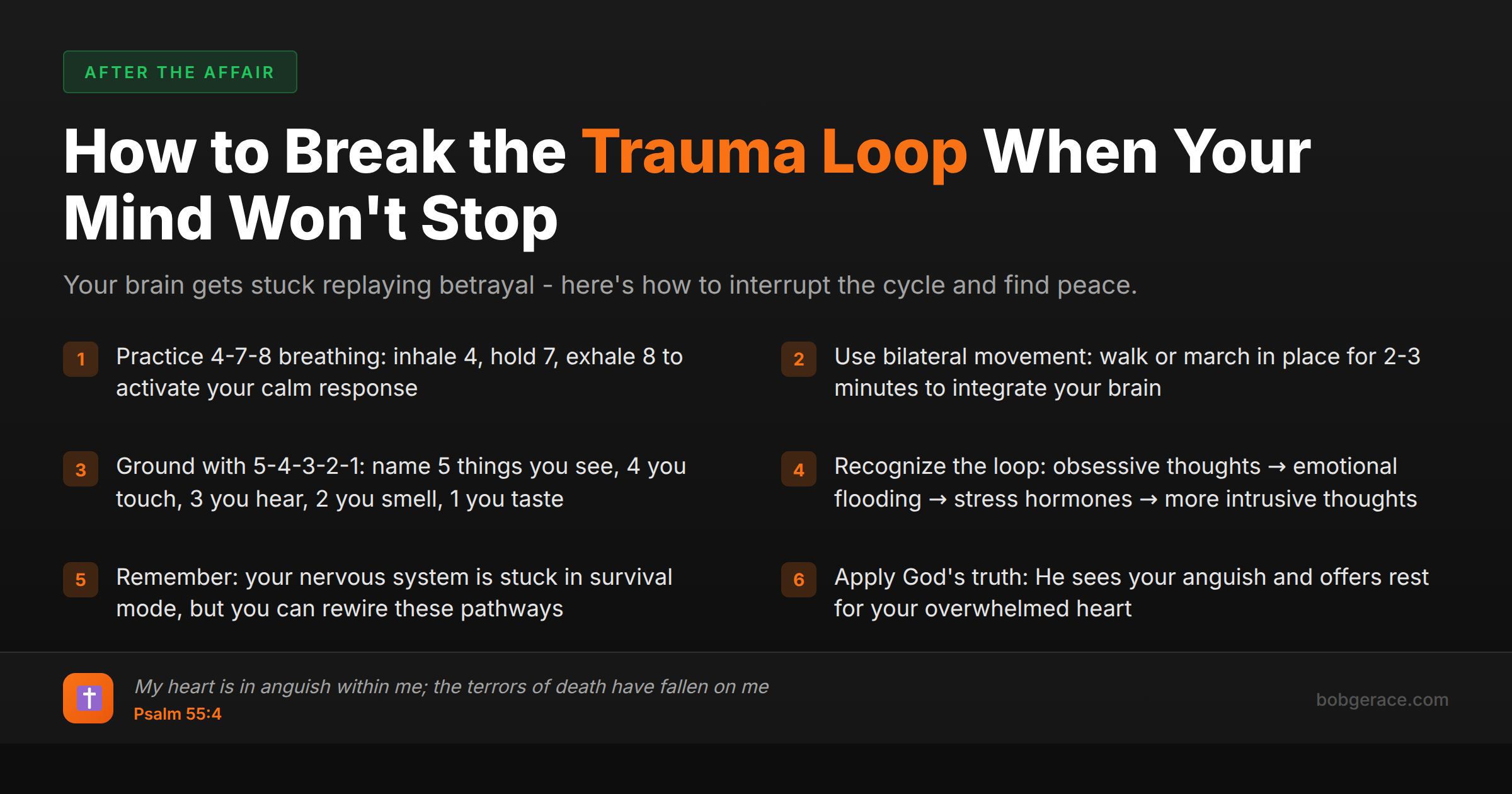
The trauma loop is your brain's protective but destructive response to betrayal that keeps you cycling through obsessive thoughts, emotional flooding, and hypervigilance. When you discover infidelity, your nervous system gets stuck in survival mode - constantly scanning for threats, replaying painful memories, and flooding you with stress hormones like cortisol and adrenaline. This creates a vicious cycle: traumatic memories trigger intense emotions, which spike stress hormones, which make you more likely to have intrusive thoughts, which trigger more emotional flooding. Your brain literally rewires itself around the trauma, making these pathways stronger each time you travel them. The good news? You can interrupt this loop through specific neurobiological interventions that calm your nervous system and create new, healthier neural pathways.
The Full Picture
Here's what's really happening when you're caught in the trauma loop after betrayal. Your brain has three main parts working against you right now: the brainstem (survival), the limbic system (emotions), and the prefrontal cortex (thinking). When betrayal hits, your brainstem hijacks the show, flooding your system with stress hormones and putting you in constant fight-or-flight mode.
Your limbic system, particularly the amygdala, becomes hyperactive - like a smoke detector that won't stop going off. It's scanning everything for threats, real or imagined. Meanwhile, your prefrontal cortex - the part that thinks rationally and makes good decisions - goes offline. This is why you can't "think your way out" of betrayal trauma.
The trauma loop looks like this: Trigger (seeing his phone, remembering something) → Emotional Flood (panic, rage, despair) → Stress Response (heart racing, can't breathe) → Obsessive Thoughts (replaying, analyzing, imagining) → More Triggers → repeat. Each cycle strengthens these neural pathways, making them your brain's default highway.
Your nervous system is stuck in "threat detection mode" - hypervigilant, sleepless, and exhausted. You're not crazy or weak. Your brain is doing exactly what it's designed to do when facing a life-threatening situation. The problem? It can't tell the difference between a physical threat and emotional betrayal, so it treats both the same way.
This loop affects everything: your sleep, appetite, concentration, immune system, and ability to connect with others. Understanding this isn't just helpful - it's essential for your healing. You can't shame yourself out of a neurobiological response, but you can rewire your brain with the right interventions.
What's Really Happening
From a neuroscience perspective, betrayal trauma creates what we call 'nervous system dysregulation.' Your autonomic nervous system - which controls your heart rate, breathing, and stress response - gets //blog.bobgerace.com/plateau-breakthrough-christian-marriage-reignite-momentum/:stuck in sympathetic activation (fight-or-flight) or dorsal vagal shutdown (freeze/collapse).
The key players here are your HPA axis (hypothalamic-pituitary-adrenal) and your vagus nerve. When betrayal hits, your HPA axis floods your system with cortisol and adrenaline - helpful for escaping a tiger, destructive when sustained long-term. Your vagus nerve, which should help you return to calm, becomes compromised.
We see specific brain changes on imaging: increased amygdala activity, decreased prefrontal cortex function, and disrupted connections between emotional and rational brain centers. This explains why logical thinking feels impossible and why you feel emotionally hijacked.
The trauma loop strengthens through a process called 'kindling' - each activation makes the next one more likely and more intense. However, neuroplasticity means your brain can change. Through targeted interventions like EMDR, somatic therapy, and vagal toning exercises, we can literally rewire your neural networks.
The most effective interruption strategies work at the body level first, then the mind. We need to regulate your nervous system before we can process the trauma cognitively. This is why breathing techniques, movement, and grounding exercises are so powerful - they speak directly to your brainstem and vagus nerve, creating safety from the bottom up.
What Scripture Says
God's Word speaks directly to the trauma loop, offering both understanding and healing pathways. Psalm 55:4-5 captures the physical reality: *"My heart is in anguish within me; the terrors of death have fallen on me. Fear and trembling have beset me; horror has overwhelmed me."* David describes exactly what betrayal trauma feels like - your nervous system in complete dysregulation.
But God doesn't leave us stuck. Psalm 34:18 promises: *"The Lord is close to the brokenhearted and saves those who are crushed in spirit."* This isn't just comfort - it's neuroscience. God's presence literally calms our nervous system when we turn to Him.
Isaiah 26:3 reveals the interruption strategy: *"You will keep in perfect peace those whose minds are steadfast, because they trust in you."* The Hebrew word for 'steadfast' means anchored or fixed. When we anchor our racing minds to God's truth, we create new neural pathways of peace instead of panic.
Philippians 4:6-7 gives us the practical framework: *"Do not be anxious about anything, but in every situation, by prayer and petition, with thanksgiving, present your requests to God. And the peace of God, which transcends all understanding, will guard your hearts and your minds in Christ Jesus."* This describes perfect nervous system regulation - moving from anxiety to peace through connection with God.
2 Corinthians 10:5 shows us how to interrupt obsessive thoughts: *"We take captive every thought to make it obedient to Christ."* This isn't about suppression - it's about redirecting your mental energy toward truth instead of trauma.
God designed your brain to heal. The same neuroplasticity that creates trauma loops can create pathways of peace, hope, and restoration when we align with His design for healing.
What To Do Right Now
-
1
Practice the 4-7-8 breath immediately when triggered: inhale for 4, hold for 7, exhale for 8. This activates your parasympathetic nervous system and interrupts the stress response.
-
2
Use bilateral movement to calm your brain: walk, march in place, or do cross-body movements for 2-3 minutes. This integrates your brain hemispheres and reduces emotional intensity.
-
3
Ground yourself with the 5-4-3-2-1 technique: name 5 things you see, 4 you can touch, 3 you hear, 2 you smell, 1 you taste. This brings you back to the present moment.
-
4
Create a 'window of tolerance' practice: when calm, spend 5 minutes daily visualizing yourself handling triggers peacefully. You're literally rewiring your brain's default response.
-
5
Establish morning and evening nervous system routines: consistent sleep, prayer time, and calming activities train your brain that you're safe and can regulate your emotions.
-
6
Limit trauma loop fuel: reduce caffeine, avoid obsessive research about affairs online, and set boundaries around trigger-heavy conversations until you're stronger.
Related Questions
- What is 'betrayal trauma' and do I have it?
- Why do I keep replaying the discovery?
- What is 'hypervigilance' and why am I doing it?
- How do I function when my body won't calm down?
- Why can't I stop obsessing over details?
- How do I deal with intrusive images?
- What is 'amygdala hijack' and how do I interrupt it?
- How do I regulate my own system?
- What does nervous system regulation look like?
- What's happening in my nervous system right now?
Also find Bob on
Subscribe for weekly videos on Christian marriage.
Your Loop Isn't Everyone's Loop
A coach who knows your specific triggers, your marriage's history, and where you get stuck can help you interrupt the cycle faster than working from a script.
Talk to Bob →