What does 'dorsal vagal shutdown' look like in marriage?
6 min read
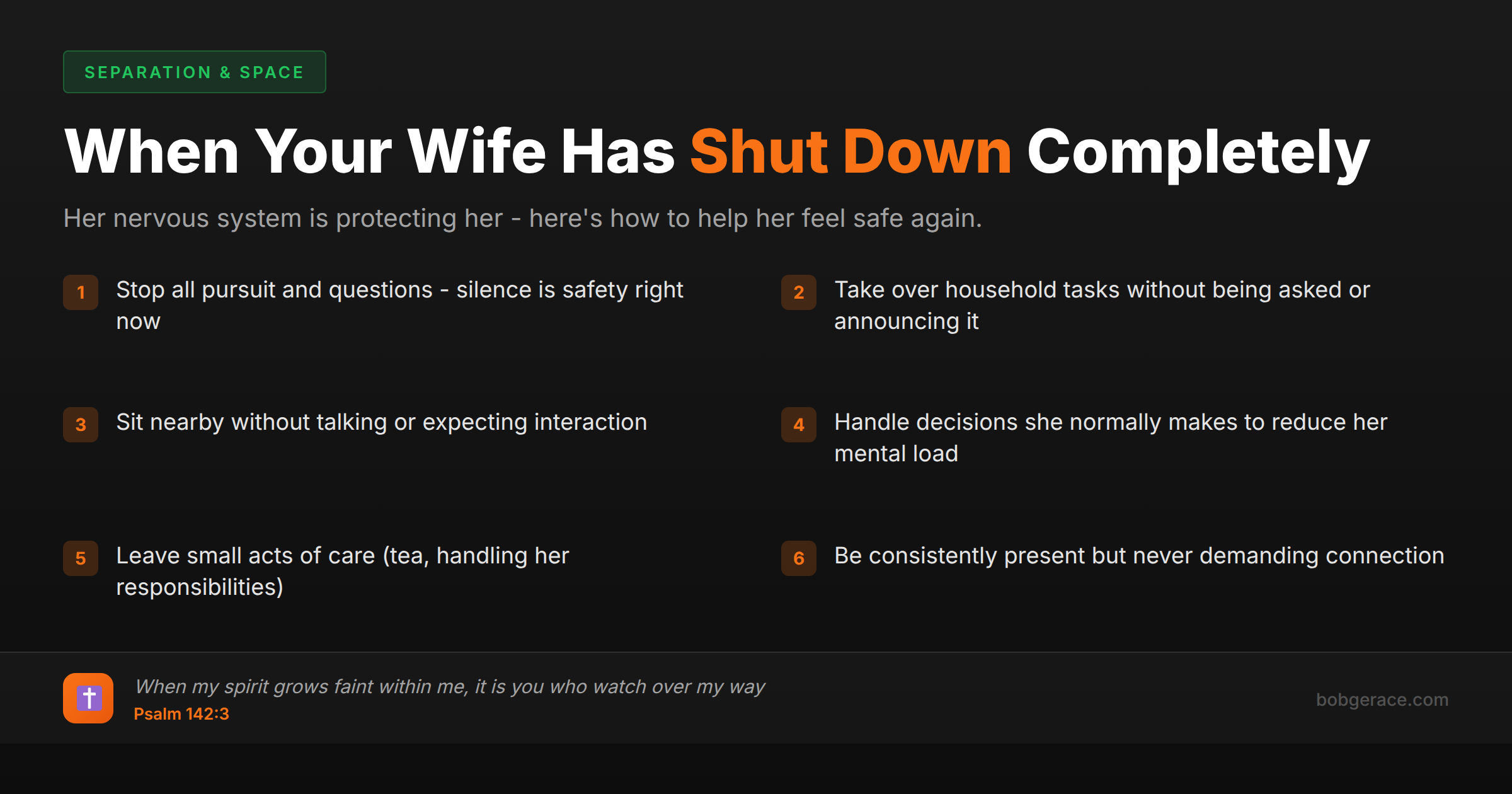
Dorsal vagal shutdown is your nervous system's most primitive survival response - essentially playing dead when fight or flight isn't possible. In marriage, this looks like your spouse becoming emotionally unreachable, physically present but mentally gone. She might sit quietly during conversations, respond with minimal words, or seem to "check out" entirely during conflict or connection attempts. This isn't stubbornness or manipulation - it's a neurobiological response to feeling overwhelmed, unsafe, or chronically stressed. When someone enters dorsal vagal shutdown, their body literally slows down heart rate, breathing, and brain function to conserve energy. They're not choosing to withdraw; their nervous system is protecting them the only way it knows how.
The Full Picture
Dorsal vagal shutdown represents the deepest level of nervous system protection, and in marriage, it's often the final stage of emotional withdrawal. When your wife has reached this state, she's moved beyond anger, beyond fighting, beyond even sadness - into a place of profound disconnection.
Physical signs include slumped posture, minimal eye contact, speaking in monotone or very few words, and appearing "flat" emotionally. She might spend excessive time sleeping, seem perpetually tired, or move through daily routines like she's on autopilot.
Emotional signs are equally telling: complete withdrawal from conflict (not resolution, just silence), lack of response to both positive and negative interactions, and an overall sense that she's "not there" even when physically present. She might respond to direct questions with minimal answers but won't initiate conversations or engage beyond basic necessities.
Relational patterns show up as avoiding physical intimacy, canceling social plans, withdrawing from family activities, and creating physical or emotional distance. This isn't the same as being upset or giving the silent treatment - those require energy. Dorsal shutdown is characterized by a profound lack of energy and engagement.
The progression typically follows this path: chronic stress or repeated relationship injuries → hypervigilance and fighting → emotional numbing → complete withdrawal. By the time dorsal shutdown occurs, the nervous system has determined that connection itself is dangerous and must be avoided for survival.
What's Really Happening
From a polyvagal theory perspective, dorsal vagal shutdown is the most primitive branch of our autonomic nervous system taking control. The dorsal vagal complex evolved to help organisms survive life-threatening situations by essentially "playing dead" - slowing heart rate, reducing metabolic function, and disconnecting from the environment.
In modern relationships, this ancient survival mechanism activates when someone perceives chronic threat without escape options. For many women, this happens after months or years of feeling unheard, criticized, or emotionally unsafe. Their nervous system eventually concludes that engagement itself is dangerous.
What makes this particularly challenging in marriage is that dorsal shutdown doesn't just affect behavior - it literally changes brain function. The prefrontal cortex, responsible for connection and communication, goes offline. The person isn't choosing to be difficult; they're neurologically incapable of normal relational engagement.
Recovery requires what we call "co-regulation" - having another nervous system help regulate yours. This means the non-shutdown partner must maintain their own nervous system stability while offering consistent, non-demanding presence. Pushing for connection, asking repeatedly "what's wrong," or attempting to logic someone out of shutdown typically deepens the response.
The pathway back involves micro-moments of safety: gentle presence without demands, consistent small acts of care, and most importantly, addressing whatever originally felt threatening to the nervous system. This isn't a quick fix - it can take weeks or months of consistent co-regulation to help someone's nervous system remember that connection can be safe.
What Scripture Says
Scripture speaks profoundly to both the reality of overwhelming circumstances and our response to those who are struggling. When someone is in dorsal shutdown, they're experiencing what the Bible describes as being "overwhelmed" or having their "spirit crushed."
Psalm 142:3-4 captures this experience: *"When my spirit grows faint within me, it is you who watch over my way. In the path where I walk, people have hidden a snare for me. Look and see, there is no one at my right hand; no one is concerned for me. I have no refuge; no one cares for my life."* This describes the profound isolation and overwhelm that leads to shutdown.
Proverbs 18:14 warns us: *"The human spirit can endure in sickness, but a crushed spirit who can bear?"* This acknowledges that emotional and spiritual crushing is among the heaviest burdens someone can carry.
Our response should mirror Christ's gentleness with the overwhelmed. Isaiah 42:3 prophesies of Jesus: *"A bruised reed he will not break, and a smoldering wick he will not snuff out."* This speaks to approaching someone in shutdown with extraordinary tenderness, not demanding more than they can give.
Galatians 6:2 instructs us: *"Carry each other's burdens, and in this way you will fulfill the law of Christ."* When your spouse is in shutdown, you're called to carry more of the relational and emotional load without resentment.
1 Thessalonians 5:14 provides clear direction: *"And we urge you, brothers and sisters, warn those who are idle and disruptive, encourage the disheartened, help the weak, be patient with everyone."* Someone in dorsal shutdown falls into the "disheartened" and "weak" categories, requiring encouragement and help, not confrontation.
God's response to our own shutdown moments is instructive: He pursues gently, provides comfort before demanding change, and offers His presence as the foundation for healing.
What To Do Right Now
-
1
Stop pursuing and start providing safety - Cease all attempts to draw her out through conversation, questions, or requests for connection. Instead, focus on consistent, non-demanding presence.
-
2
Take over practical burdens - Assume responsibility for household tasks, childcare, and decisions she normally handles. Her nervous system needs to conserve energy for healing.
-
3
Offer micro-moments of care - Leave her favorite tea by her chair, handle something she typically worries about, or simply sit nearby without talking. Small, consistent acts signal safety.
-
4
Regulate your own nervous system - Practice deep breathing, prayer, or other calming activities. Your calm presence is essential for her eventual recovery, but you can't fake nervous system regulation.
-
5
Address underlying safety concerns - Honestly assess what behaviors, patterns, or circumstances might have contributed to her overwhelm. Begin changing these without announcing or expecting recognition.
-
6
Seek professional support immediately - Dorsal shutdown can be associated with depression and requires professional intervention. Contact a therapist familiar with polyvagal theory and trauma-informed approaches.
Related Questions
- What is 'dorsal vagal' state?
- Is she in shutdown, not choosing coldness?
- What signals threat to her nervous system?
- What would help her ventral vagal (social engagement)?
- What is 'freeze' in polyvagal terms?
- Why does she seem numb/flat/dead inside?
- What is 'emotional disengagement'?
- What does chronic stress do to her capacity for connection?
- What does nervous system regulation look like?
- How do I regulate my own system?
Also find Bob on
Subscribe for weekly videos on Christian marriage.
This Pattern Needs a Coach
When shutdown is active in your marriage, you need someone who knows your specific dynamic and can calibrate to where she actually is. Bob works with men in exactly this spot.
Talk to Bob →