What is 'freeze' in polyvagal terms?
6 min read
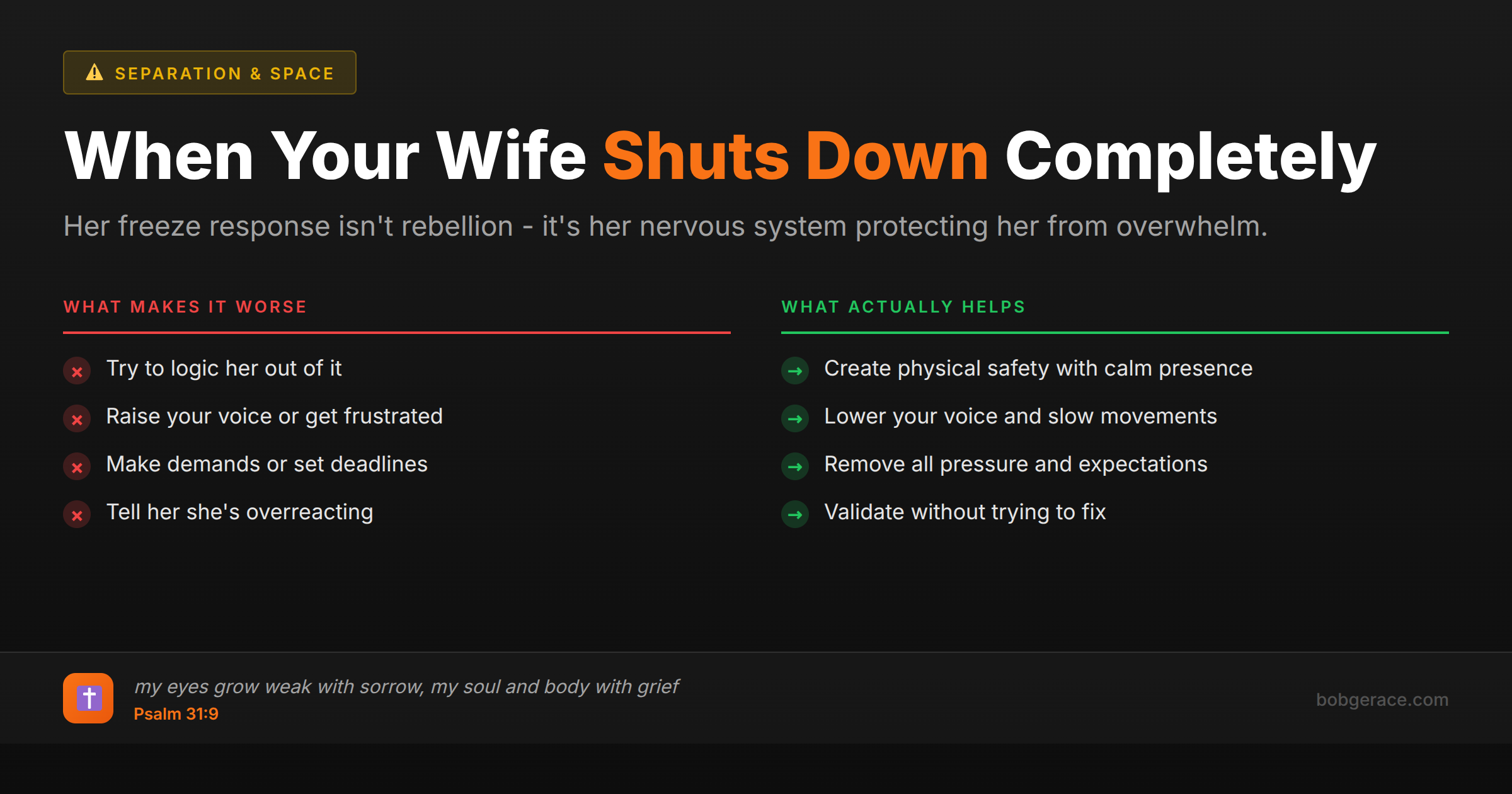
In polyvagal terms, 'freeze' is your nervous system's ancient survival response when it perceives overwhelming threat with no escape route. Think of it as your body's circuit breaker - when fight or flight won't work, your system shuts down to protect itself. In marriage, this shows up as emotional numbness, physical stillness, mental fog, and complete withdrawal from connection. When your wife has 'frozen,' she's not choosing to ignore you or be difficult. Her nervous system has literally downshifted into dorsal vagal shutdown - the most primitive survival state. Her heart rate drops, her thinking becomes cloudy, and she feels disconnected from her body and emotions. This isn't conscious rebellion; it's neurological protection mode.
The Full Picture
Polyvagal theory, developed by Dr. Stephen Porges, maps three distinct nervous system states that determine how we respond to life. At the top is social engagement (ventral vagal) - where connection, communication, and intimacy thrive. In the middle sits fight-or-flight (sympathetic) - where we mobilize energy to combat or escape threats. At the bottom lies freeze (dorsal vagal) - where the system shuts down when overwhelmed.
The freeze response isn't emotional weakness - it's evolutionary wisdom. When our ancestors faced overwhelming predators with no escape, playing dead often meant survival. Your nervous system still carries this ancient programming, activating it when modern threats feel inescapable.
In marriage, freeze typically follows chronic activation of fight-or-flight responses. Maybe your wife has endured months of conflict, criticism, or feeling unheard. Her system fought back, then tried to flee emotionally, but found no resolution. Eventually, it defaulted to freeze - the deepest form of self-protection.
Physical signs of freeze include: slumped posture, shallow breathing, vacant stare, slow or slurred speech, and physical stillness. Emotional markers: numbness, disconnection, feeling 'dead inside,' and inability to access normal feelings. Mental symptoms: foggy thinking, memory problems, difficulty making decisions, and feeling 'not present.'
This state serves a biological purpose - conserving energy and avoiding further harm when the system perceives no viable options. But in marriage, it creates devastating disconnection that can feel impossible to bridge.
What's Really Happening
From a clinical perspective, the freeze response represents the dorsal vagal complex taking control of the nervous system. This is the oldest part of our autonomic nervous system, shared with reptiles and primitive vertebrates. When activated, it literally slows down heart rate, breathing, and metabolism to conserve energy for survival.
I see this regularly in couples therapy when one partner has become completely overwhelmed by relationship dynamics. The frozen partner often reports feeling like they're 'watching their life from outside their body' or being 'unable to feel anything anymore.' This dissociative quality is the hallmark of dorsal vagal shutdown.
What's crucial to understand is that this isn't a conscious choice or character flaw. The person in freeze cannot simply 'snap out of it' through willpower or logical reasoning. Their prefrontal cortex - responsible for higher-order thinking and emotional regulation - has gone offline. They're operating from the brainstem level, focused solely on survival.
The pathway back requires patience, safety, and gradual nervous system regulation. We must first address the underlying threat detection that triggered the freeze, then slowly guide the system back through sympathetic activation toward ventral vagal engagement. This process cannot be rushed and requires consistent co-regulation from safe others.
What Scripture Says
Scripture acknowledges that overwhelming circumstances can shut us down physically and emotionally. David experienced this freeze-like state repeatedly, crying out in Psalm 31:9-10: *'Be merciful to me, LORD, for I am in distress; my eyes grow weak with sorrow, my soul and body with grief. My life is consumed by anguish and my years by groaning; my strength fails because of my affliction, and my bones grow weak.'*
God doesn't condemn us for neurological responses to overwhelming stress. In 1 Kings 19:4, even mighty Elijah reached a point where he 'sat down under the solitary broom tree and prayed that he might die.' God's response wasn't rebuke but gentle care - providing rest, food, and gradual restoration.
The Bible recognizes that our bodies and spirits are interconnected. Psalm 32:3-4 describes how unresolved issues affect us physically: *'When I kept silent, my bones wasted away through my groaning all day long. For day and night your hand was heavy on me; my strength was sapped as in the heat of summer.'*
Jesus himself understands overwhelming emotional states. In the Garden of Gethsemane, He experienced such intense distress that Luke 22:44 records: *'And being in anguish, he prayed more earnestly, and his sweat was like drops of blood falling to the ground.'* Even Christ's nervous system responded to extreme stress.
God calls us to gentle restoration, not harsh judgment. Galatians 6:1 instructs: *'Brothers and sisters, if someone is caught in a sin, you who live by the Spirit should restore that person gently.'* How much more should we approach those caught in neurological overwhelm with tenderness?
Isaiah 42:3 promises Christ's gentle approach: *'A bruised reed he will not break, and a smoldering wick he will not snuff out.'* This is our model for responding to a frozen spouse.
What To Do Right Now
-
1
Stop trying to logic her out of it - Freeze isn't rational, so rational arguments only increase the threat perception
-
2
Create physical safety cues - Soften your voice, slow your movements, and maintain non-threatening body language
-
3
Remove pressure and demands - Any expectation feels like a threat to a frozen nervous system
-
4
Focus on co-regulation - Your calm presence can help regulate her overwhelmed system through mirror neurons
-
5
Validate without trying to fix - 'I see you're really struggling right now, and that makes sense' goes further than solutions
-
6
Seek professional help - A trauma-informed therapist can guide the delicate process of nervous system restoration
Related Questions
Don't Navigate This Alone
When your wife is in freeze mode, you need specialized guidance to avoid making things worse. Let's work together to understand her nervous system and create the safety she needs to reconnect.
Get Help Now →