Why does she seem numb/flat/dead inside?
6 min read
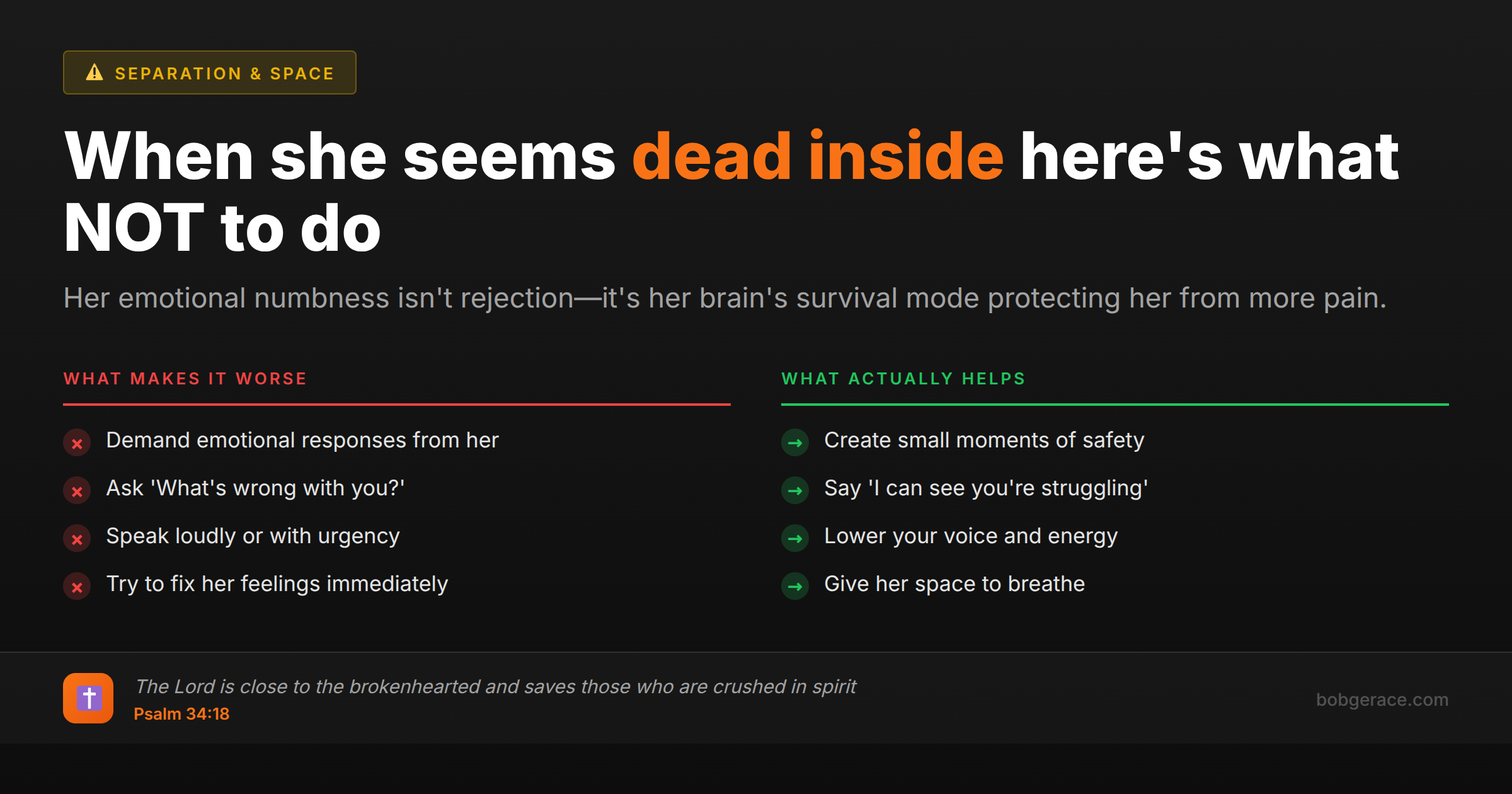
When your wife seems emotionally numb or 'dead inside,' her brain has likely activated protective shutdown mechanisms. This isn't conscious rejection—it's neurological self-preservation. Chronic stress, unresolved conflict, or feeling unheard triggers the nervous system to essentially 'go offline' emotionally to prevent further pain. This flatness is actually her brain trying to protect her from overwhelming emotions. The limbic system becomes dysregulated, and she may literally lose access to her full range of feelings. She's not choosing to be distant—she's stuck in a neurological state that prioritizes survival over connection. Understanding this changes everything about how you approach her.
The Full Picture
That emotional numbness you're seeing isn't your wife being cold or vindictive—it's her nervous system in protective mode. When someone experiences chronic stress, repeated disappointment, or feeling consistently unheard in their marriage, their brain can shift into what neuroscientists call a 'dorsal vagal state'—essentially an emotional shutdown.
Here's what's happening neurologically: Her brain's threat detection system (the amygdala) has been hyperactive for so long that it's now essentially offline. The prefrontal cortex, responsible for emotional regulation and connection, isn't getting the resources it needs. She's operating from her brainstem—the most primitive part that only cares about survival.
This isn't a character flaw or a choice she's making. It's a biological response to feeling unsafe in the relationship. Safety doesn't just mean physical—it means emotional, psychological, and relational safety. If she's felt criticized, dismissed, or overwhelmed repeatedly, her system has learned to shut down rather than risk more pain.
The flatness is actually serving a purpose—it's numbing her to potential hurt. But it also numbs her to joy, love, and connection. She's not selectively choosing to shut you out; she's shut down to everything because her nervous system can't differentiate between sources of stress anymore.
This state can persist even when external stressors decrease because the nervous system holds these patterns. She may want to feel more but literally can't access those emotions. The pathway back requires patience, safety, and often professional help to retrain her nervous system that it's safe to feel again.
What's Really Happening
From a clinical perspective, what you're observing is likely a form of dissociation—a protective mechanism where the mind disconnects from overwhelming emotional experiences. This often develops gradually in marriages where a woman has felt chronically misunderstood, invalidated, or emotionally unsafe.
The polyvagal theory explains this beautifully. Her vagus nerve, which regulates the nervous system, has shifted into a dorsal state—the most primitive response characterized by shutdown, numbness, and withdrawal. This happens when both fight-or-flight responses have been exhausted. She's not choosing this; her autonomic nervous system is choosing survival over connection.
Neuroimaging studies show that chronic relational stress actually changes brain structure. The areas responsible for emotional processing and social connection can become less active, while stress-response regions remain hypervigilant. This creates a neurological state where she may literally be unable to access positive emotions or connection, even when she wants to.
I often see this in women who have spent years trying to communicate their needs, only to feel unheard or dismissed. Eventually, the brain says, 'This is too dangerous—we're going offline.' The numbness isn't depression in the traditional sense; it's protective dissociation.
Recovery requires rebuilding neurological safety through consistent, patient, non-demanding connection. Small moments of attunement and validation can slowly help her nervous system learn it's safe to come back online. But this process cannot be rushed—her brain will only reconnect when it truly believes the threat has passed.
What Scripture Says
Scripture speaks directly to the reality of emotional numbness and God's heart for restoration. Psalm 34:18 reminds us that 'The Lord is close to the brokenhearted and saves those who are crushed in spirit.' God sees her pain, even when it's hidden beneath numbness.
Ezekiel 36:26 offers incredible hope: 'I will give you a new heart and put a new spirit in you; I will remove from you your heart of stone and give you a heart of flesh.' This verse acknowledges that hearts can become hardened—like stone—but God specializes in restoration and renewal.
As her husband, you're called to love her as Ephesians 5:28-29 instructs: 'Husbands ought to love their wives as their own bodies... no one ever hated their own body, but they feed and care for their body.' When she's emotionally numb, she needs your patient care, not your frustration or demands for her to 'snap out of it.'
Isaiah 42:3 describes Jesus' gentle approach: 'A bruised reed he will not break, and a smoldering wick he will not snuff out.' Your wife's emotional capacity may be like a bruised reed right now—fragile and barely functioning. Christ's example shows us to approach with tenderness, not force.
Psalm 147:3 declares that God 'heals the brokenhearted and binds up their wounds.' Healing is possible, but it requires the same patience and gentleness that God shows us. Your role is to create safety where her heart can begin to thaw, trusting God for the deeper work of restoration.
What To Do Right Now
-
1
Stop demanding emotional responses - Pressuring her to 'feel more' only confirms to her nervous system that she's not safe
-
2
Create micro-moments of safety - Small, consistent acts of kindness without expecting anything in return
-
3
Lower your voice and energy - Speak softly, move slowly, reduce any sense of urgency or intensity around her
-
4
Validate without trying to fix - 'I can see you're struggling' instead of 'What's wrong with you?'
-
5
Give her space to breathe - Don't hover or constantly check on her emotional state
-
6
Seek professional help together - A trauma-informed therapist can help guide her nervous system back to connection
Related Questions
- What is 'emotional disengagement'?
- What is 'freeze' in polyvagal terms?
- What does 'dorsal vagal shutdown' look like in marriage?
- Is her shutdown protective or permanent?
- What is 'deactivation' and did I cause it?
- Can neural bonding pathways reopen?
- What is 'betrayal trauma' and do I have it?
- What does chronic stress do to her capacity for connection?
- Why am I numb one moment and raging the next?
Also find Bob on
Subscribe for weekly videos on Christian marriage.
Your Marriage Isn't a Textbook Case
Her shutdown has a specific history—and your next moves need to account for what got you both here. A coach who knows your story can see what you can't.
Talk to Bob →