What happens neurologically when bonding shuts down?
6 min read
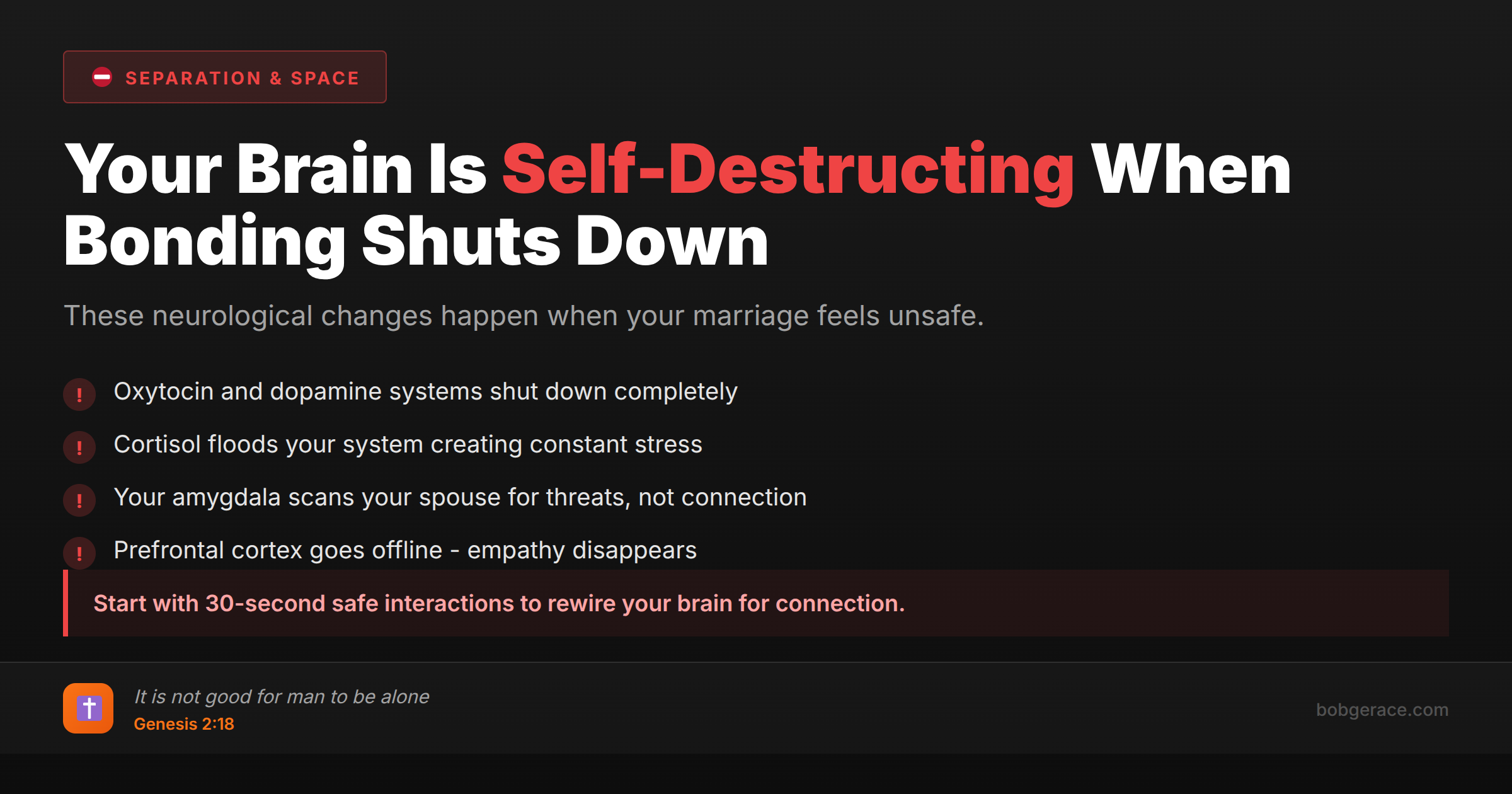
When bonding shuts down in marriage, your brain literally rewires itself for self-protection rather than connection. The oxytocin and dopamine systems that create feelings of love and attachment become suppressed, while stress hormones like cortisol flood your system. Your amygdala - the brain's alarm center - becomes hyperactive, scanning for threats from your spouse rather than opportunities for intimacy. This isn't just emotional - it's a measurable neurological shift. The prefrontal cortex, responsible for empathy and emotional regulation, goes offline. Meanwhile, the brain's threat detection systems work overtime. What once felt safe and bonding now triggers fight-or-flight responses. Your spouse's voice, touch, or even presence can activate stress pathways instead of comfort systems. This creates a neurological prison where the person who should feel safest becomes the source of greatest activation.
The Full Picture
Understanding bonding shutdown requires looking at your brain as a sophisticated relationship system designed by God for connection. When this system works properly, being near your spouse triggers cascades of bonding chemicals - oxytocin creates feelings of trust and attachment, dopamine generates pleasure and motivation to connect, and serotonin stabilizes mood and promotes contentment.
But chronic relationship stress, betrayal, or emotional neglect flips these systems into reverse. Your brain begins treating your marriage as a threat rather than a sanctuary. The vagus nerve, which normally promotes calm connection, becomes dysregulated. Heart rate variability decreases. The nervous system gets stuck in sympathetic overdrive.
The most devastating change happens in your attachment system itself. Mirror neurons, which help you attune to your spouse's emotions, become less active. The anterior cingulate cortex, responsible for emotional empathy, shows decreased activation when focused on your partner. Your brain literally becomes less capable of feeling what they feel.
Memory systems shift too. The hippocampus, under chronic stress, becomes less effective at forming new positive memories while the amygdala strengthens negative emotional memories. This creates a neurological bias where you remember every hurt but struggle to recall moments of connection.
Sleep patterns deteriorate, affecting emotional regulation. REM sleep, crucial for processing emotions and consolidating positive memories, becomes fragmented. This creates a vicious cycle where poor sleep makes emotional regulation harder, leading to more relationship stress.
The tragedy is that these protective mechanisms become self-perpetuating. Your brain's attempt to shield you from pain actually prevents the very experiences needed for healing - vulnerability, trust, and emotional intimacy.
What's Really Happening
From a clinical neuroscience perspective, bonding shutdown represents a complete reorganization of neural networks from approach to avoidance systems. I see this daily in brain scans of disconnected couples - areas associated with reward and attachment show dramatically reduced activity when viewing images of their spouse.
The polyvagal theory helps explain this progression. Couples typically move from social engagement (ventral vagal) to fight-or-flight (sympathetic) to finally shutdown (dorsal vagal). In the shutdown phase, the brain essentially goes offline relationally. Clients describe feeling numb, empty, or like they're "going through the motions."
Neuroplasticity research offers hope here. The same brain that learned to shut down can learn to reconnect, but it requires specific interventions. We need to activate the parasympathetic nervous system through co-regulation - literally borrowing another person's calm nervous system to retrain our own.
The attachment system is particularly malleable. New experiences of safety and attunement can literally rewire neural pathways. I've seen couples rebuild bonding capacity through structured emotional experiences that gradually retrain the brain's threat detection systems.
Timing matters crucially in this process. The brain needs consistent, repeated experiences of safety before it will risk vulnerability again. This typically requires 6-12 months of intentional nervous system regulation work before we see significant neurological shifts in bonding capacity.
Understanding this neuroscience helps couples have compassion for the healing process rather than expecting immediate emotional connection.
What Scripture Says
Scripture reveals that God designed us for connection at the deepest level. "It is not good for man to be alone" (Genesis 2:18) isn't just about companionship - it's about how our very neurology requires relationship to function properly.
The Bible describes the devastating impact of relational breakdown: "Hope deferred makes the heart sick" (Proverbs 13:12). This isn't poetic language - it's describing the actual physiological impact of broken bonding systems. When our deepest relational hopes are repeatedly disappointed, our hearts - and our brains - literally become sick.
"Above all else, guard your heart, for everything you do flows from it" (Proverbs 4:23). In bonding shutdown, the heart closes for protection, but this same protective mechanism blocks the flow of love, empathy, and connection. What feels like wisdom becomes a prison.
Jesus understood trauma's impact on our capacity to connect: "Come to me, all you who are weary and burdened, and I will give you rest" (Matthew 11:28). The word for "rest" here implies not just cessation of activity, but restoration of proper function - exactly what shutdown bonding systems need.
"Perfect love drives out fear" (1 John 4:18) reveals God's solution. Fear-based neural patterns can only be overwritten by experiences of perfect love - first from God, then through restored human connection.
"Be renewed by the transforming of your mind" (Romans 12:2) points to neuroplasticity itself - God's design that allows our brains to be rewired through new experiences of His love and grace.
What To Do Right Now
-
1
Regulate your nervous system daily - practice deep breathing, cold exposure, or progressive muscle relaxation to retrain your threat detection systems
-
2
Create micro-moments of safety - start with 30-second interactions with your spouse that feel genuinely safe and non-threatening
-
3
Practice gratitude specifically for your spouse - spend 2 minutes daily noting one small thing they did well to begin rewiring positive attention
-
4
Limit activation triggers - identify what specifically triggers your shutdown response and temporarily minimize those situations while healing
-
5
Engage in parallel calming activities - do relaxing activities side-by-side without pressure for emotional connection
-
6
Seek professional help - bonding shutdown often requires clinical intervention to safely navigate the rewiring process
Related Questions
- What is 'emotional disengagement'?
- What is 'freeze' in polyvagal terms?
- Why does she seem numb/flat/dead inside?
- What does 'dorsal vagal shutdown' look like in marriage?
- Can neural bonding pathways reopen?
- What would help her nervous system feel safe again?
- What is 'betrayal trauma' and do I have it?
- What does betrayal do to the brain?
- What is 'attachment injury' and did I cause one?
- How do I become a safe emotional presence?
Also find Bob on
Subscribe for weekly videos on Christian marriage.
This Crisis Needs a Coach Today
Your brain is in full shutdown mode. A coach who knows your specific marriage can map the fastest path back to safety — before this pattern calcifies.
Talk to Bob →