What does chronic stress do to her capacity for connection?
6 min read
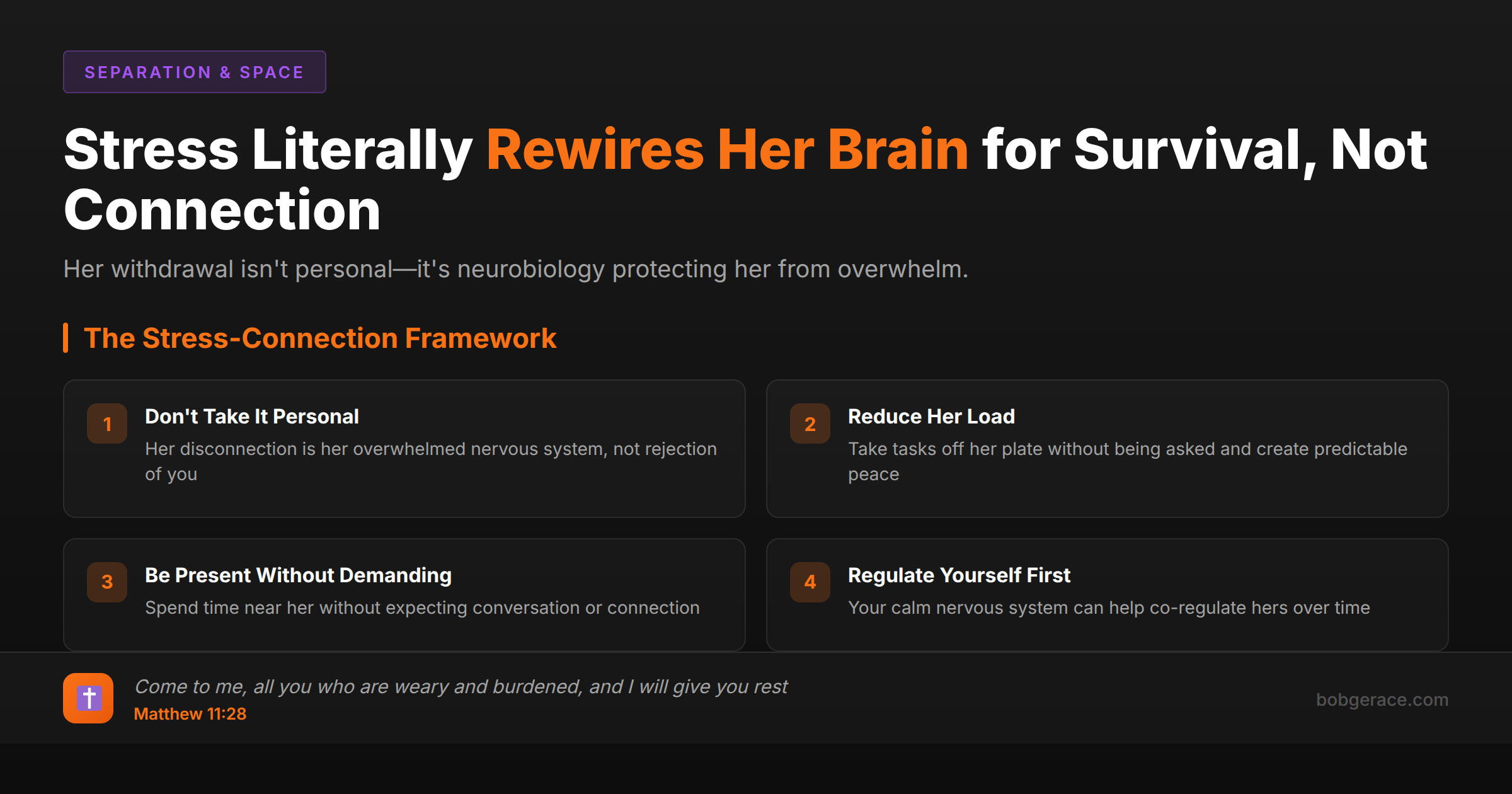
Chronic stress fundamentally rewires your wife's brain for survival, not connection. When her nervous system is constantly activated by stress hormones like cortisol, the brain prioritizes immediate threats over relational bonding. Her prefrontal cortex—the area responsible for emotional regulation and empathy—goes offline, while her amygdala stays hypervigilant. This isn't a choice she's making. It's neurobiology. The same brain that once felt safe enough to be vulnerable with you now perceives everything, including intimacy, as potentially overwhelming. Her capacity for connection literally shrinks as stress hormones flood her system, making even simple conversations feel like additional burdens rather than sources of comfort.
The Full Picture
When your wife is chronically stressed, her brain operates in a fundamentally different mode than when she's calm and connected. Think of it like a computer running too many programs at once—everything slows down, crashes become frequent, and basic functions that once worked seamlessly now feel impossible.
The Stress-Connection Paradox
Here's what most men don't understand: chronic stress doesn't just make her tired or irritable. It literally changes her brain chemistry in ways that make connection feel dangerous rather than desirable. When cortisol and adrenaline are constantly coursing through her system, her nervous system stays locked in fight-or-flight mode.
In this state, her brain interprets your attempts at intimacy—whether physical, emotional, or even conversational—as additional demands on an already overloaded system. It's not that she doesn't want to connect with you. It's that her stressed brain literally cannot process connection as safe or beneficial.
The Neurological Shutdown
Chronic stress causes what neuroscientists call "neural hijacking." Her amygdala, the brain's alarm system, becomes hyperactive while her prefrontal cortex—responsible for rational thinking, empathy, and emotional regulation—goes offline. This creates a perfect storm for disconnection.
She may seem like she's choosing to withdraw, but what's really happening is that her brain is conserving energy for what it perceives as survival. Connection requires vulnerability, and vulnerability requires a sense of safety that chronic stress destroys.
The Compound Effect
The cruel irony is that disconnection creates more stress, which creates more disconnection. As she withdraws, you likely feel rejected and respond with your own stress responses—pursuing harder, getting frustrated, or withdrawing yourself. This confirms her brain's assessment that even her closest relationship isn't safe, deepening the neurological patterns that keep her checked out.
What's Really Happening
From a clinical perspective, what we're seeing in chronically stressed wives is a textbook case of nervous system dysregulation. The polyvagal theory helps us understand that when someone is in chronic stress, their autonomic nervous system shifts away from the social engagement system—the neurological state required for healthy connection and intimacy.
In my practice, I consistently observe that women experiencing chronic stress show measurable changes in their stress hormone levels, sleep patterns, and even their ability to read social cues accurately. The hippocampus, crucial for memory and emotional processing, actually shrinks under prolonged stress exposure. This means she may literally struggle to remember positive interactions or access feelings of love and connection that exist beneath the stress response.
What's particularly important for husbands to understand is that this isn't a conscious rejection. Her nervous system has shifted into what we call a "dorsal vagal shutdown"—a protective state where the body conserves energy by reducing social and emotional responsiveness. She's not choosing to be distant; her nervous system is choosing survival over connection.
The pathway back to connection requires consistent, patient work to help her nervous system return to a regulated state. This means creating safety through predictability, reducing additional stressors where possible, and understanding that her capacity for intimacy will return as her stress levels decrease. Pushing for connection before addressing the underlying stress typically backfires, as it activates her threat-detection system further.
What Scripture Says
Scripture acknowledges both the reality of overwhelming stress and God's design for restoration and connection. When we understand how stress affects our capacity for relationship, we can respond with the wisdom and patience that reflects Christ's heart.
God Sees Her Overwhelm
*"Come to me, all you who are weary and burdened, and I will give you rest"* (Matthew 11:28). Jesus recognized that people can become so overwhelmed that they need relief before they can engage fully in relationship. Your wife's stress-induced disconnection isn't a spiritual failing—it's a human response that even Christ addressed with compassion.
The Call to Understanding
*"Husbands, in the same way be considerate as you live with your wives, and treat them with respect as the weaker partner and as heirs with you of the gracious gift of life, so that nothing will hinder your prayers"* (1 Peter 3:7). The word "considerate" here means to live with knowledge and understanding. Part of loving your wife well means understanding how stress affects her capacity for connection.
Patience in Restoration
*"Be patient, bearing with one another in love"* (Ephesians 4:2). Biblical patience isn't passive waiting—it's active love that persists through difficult seasons. When stress has hijacked her ability to connect, your patient, consistent presence can help create the safety her nervous system needs to heal.
Creating Safety
*"Above all else, guard your heart, for everything you do flows from it"* (Proverbs 4:23). While she needs to guard her heart, you can help create an environment where that guarding feels less necessary. Your emotional regulation and consistent, non-demanding presence can signal safety to her stressed system.
God designed us for connection, but He also created us with nervous systems that respond to threat. Understanding this design helps us respond with wisdom rather than taking her disconnection personally.
What To Do Right Now
-
1
Stop taking her disconnection personally - Her withdrawal is about her overwhelmed nervous system, not your worth as a husband
-
2
Reduce additional stressors - Take tasks off her plate without being asked and create predictable, peaceful environments
-
3
Practice consistent, non-demanding presence - Spend time near her without expecting conversation or connection in return
-
4
Regulate your own stress response - Your calm, regulated nervous system can help co-regulate hers over time
-
5
Address root causes of stress - Work together to identify and tackle the sources of her chronic overwhelm
-
6
Seek professional support - Consider counseling to help both of you understand and address the neurological impact of chronic stress
Related Questions
- What is 'emotional disengagement'?
- Why does she seem numb/flat/dead inside?
- What is 'freeze' in polyvagal terms?
- What does 'dorsal vagal shutdown' look like in marriage?
- Can neural bonding pathways reopen?
- What would help her nervous system feel safe again?
- What is 'betrayal trauma' and do I have it?
- What does trauma recovery look like?
- How do I regulate my own system?
- What does nervous system regulation look like?
Also find Bob on
Subscribe for weekly videos on Christian marriage.
You Can't Fix Her Stress Alone
A coach who knows your marriage can help you stop making it worse and start creating the conditions where her nervous system actually settles. This isn't generic advice—it's calibrated to where she is right now.
Talk to Bob →