When does patience become enabling?
6 min read
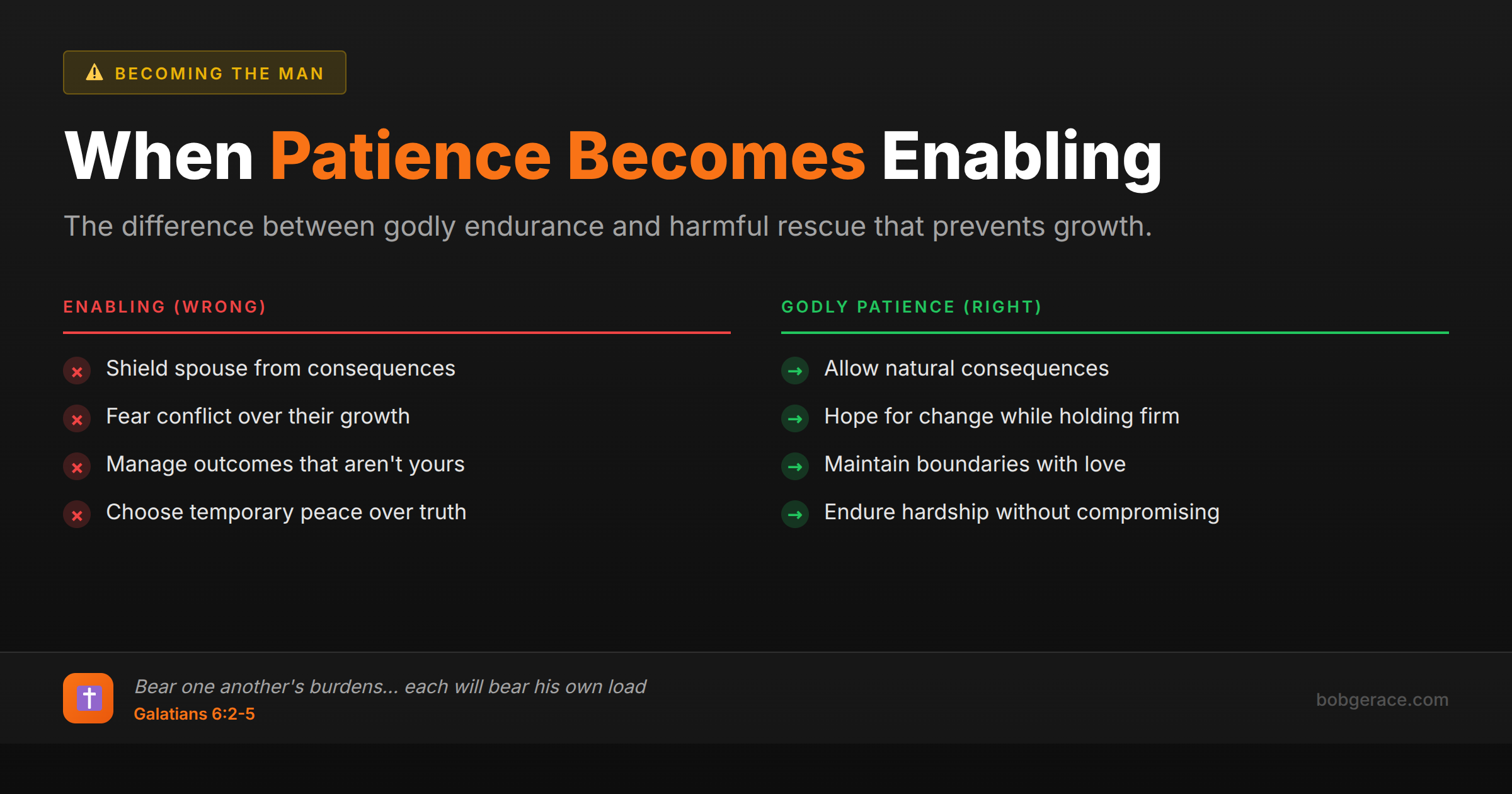
Patience becomes enabling when it removes consequences for destructive behavior rather than creating space for genuine repentance and change. Biblical patience endures hardship while maintaining truth and boundaries—it doesn't tolerate ongoing sin or shield someone from the natural results of their choices. The key difference: patience says 'I'll walk through this difficult season with you as you do the hard work of change.' Enabling says 'I'll absorb the pain so you don't have to face the consequences.' When your patience allows continued deception, emotional affairs, or betrayal without real accountability, you've crossed into enabling territory.
The Full Picture
This is one of the most confusing aspects of dealing with infidelity, especially for Christian wives who've been taught that patience is a virtue. You want to be loving, forgiving, and Christ-like. But somewhere in your gut, you know that your 'patience' might actually be making things worse.
Here's what patience actually looks like in a marriage crisis: - You give your spouse time to prove change through consistent actions - You endure the emotional difficulty of recovery while boundaries are respected - You remain committed to the marriage while requiring transparency and accountability - You allow natural consequences to do their work in your spouse's life
Here's what enabling looks like: - You repeatedly accept promises without requiring proof of change - You protect your spouse from facing the full weight of their betrayal - You minimize the impact of their choices to keep peace - You take on responsibility for their emotional well-being while yours deteriorates - You make excuses for continued boundary violations
The difference isn't always obvious in the moment. Enabling often feels like the 'nice' or 'Christian' thing to do. But enabling actually prevents the crisis that could lead to genuine repentance and change. When you remove consequences, you remove motivation for your spouse to do the hard work of rebuilding trust.
Patience works alongside firm boundaries, not instead of them. It's patient to say, 'I'll give you time to prove change, but I won't live with ongoing deception.' It's enabling to say, 'I'll just keep waiting and hoping things get better' while accepting continued betrayal.
What's Really Happening
From a clinical perspective, enabling behavior often stems from anxiety about abandonment and a misguided attempt to control the outcome of the relationship. When someone enables, they're unconsciously trying to manage their spouse's choices and emotions to prevent further loss.
Enabling creates what we call a 'trauma bond'—where the betrayed spouse becomes psychologically dependent on managing the crisis rather than addressing it. This actually rewires the brain to associate caretaking with love, making it incredibly difficult to establish healthy boundaries.
The neurological impact is significant. When you're constantly in enabling mode, your brain stays in a heightened state of hypervigilance. You become addicted to the adrenaline rush of managing crises and 'fixing' your spouse. This keeps you stuck in survival mode rather than allowing your nervous system to regulate and make clear decisions.
Healthy patience, by contrast, activates the prefrontal cortex—the part of your brain responsible for executive function and long-term thinking. It allows you to stay emotionally regulated while maintaining clear boundaries about acceptable behavior.
The key indicator that patience has become enabling is this: Are your actions increasing or decreasing your spouse's motivation to change? Enabling removes external pressure for change, while healthy patience maintains that pressure through natural consequences and clear expectations.
Recovery requires what I call 'boundaried patience'—you're willing to endure the difficulty of rebuilding, but only within the context of genuine effort and transparency from your spouse.
What Scripture Says
Scripture gives us a clear framework for distinguishing between godly patience and destructive enabling. Biblical patience is always aligned with truth and righteousness—it never tolerates ongoing sin for the sake of peace.
Love does not enable sin: *"Love does not delight in evil but rejoices with the truth."* (1 Corinthians 13:6) True love confronts sin rather than covering for it. When your 'patience' allows continued deception, you're not showing biblical love.
Patience has boundaries: *"Be completely humble and gentle; be patient, bearing with one another in love. Make every effort to keep the unity of the Spirit through the bond of peace."* (Ephesians 4:2-3) Notice that patience works alongside truth and peace—not at their expense.
Natural consequences teach: *"A man reaps what he sows. Whoever sows to please their flesh, from the flesh will reap destruction."* (Galatians 6:7-8) When you shield your spouse from consequences, you interfere with God's teaching process.
Confront sin directly: *"If your brother or sister sins, go and point out their fault, just between the two of you. If they listen to you, you have won them over."* (Matthew 18:15) Jesus commands direct confrontation, not patient tolerance of ongoing sin.
Wisdom guides patience: *"The simple believe anything, but the prudent give thought to their steps."* (Proverbs 14:15) Biblical patience is informed by wisdom, not naive hope.
Restoration requires repentance: *"If he sins against you seven times in a day and seven times comes back to you saying 'I repent,' you must forgive him."* (Luke 17:4) Notice the requirement: genuine repentance, not just apologies or promises.
What To Do Right Now
-
1
Audit your current patience: Write down specific behaviors you're currently tolerating. Ask yourself: 'Is my response increasing or decreasing their motivation to change?'
-
2
Establish consequence boundaries: Identify what will happen if betrayal continues. Don't threaten—just clarify what natural consequences you'll allow to occur.
-
3
Require proof, not promises: Stop accepting words without corresponding actions. Create specific, measurable ways your spouse must demonstrate change.
-
4
Set time boundaries on patience: Biblical patience isn't endless tolerance. Establish reasonable timelines for seeing genuine progress and behavioral change.
-
5
Get external accountability: Find a counselor or trusted friend who can help you distinguish between healthy patience and enabling in your specific situation.
-
6
Protect your own well-being: Stop sacrificing your emotional and physical health to manage your spouse's crisis. Your well-being matters to God too.
Related Questions
- What boundaries should I set?
- What's the difference between boundary and ultimatum?
- What makes boundaries effective vs. empty threats?
- How do I set boundaries without controlling?
- What are reasonable timelines for decisions?
- When does grace become enabling sin?
- Should I give her space or fight for her?
- How long do I wait before giving up?
- When does waiting become enabling?
- Does forgiveness mean no consequences?
Also find Bob on
Subscribe for weekly videos on Christian marriage.
Get a Coach Who Knows Your Story
You don't have to keep second-guessing where the line is in your marriage. A coach who hears your actual situation can help you see what patience looks like when it's not enabling.
Talk to Bob →